
HDMI Distribution for Large Venues: 2026 Pro AV Guide
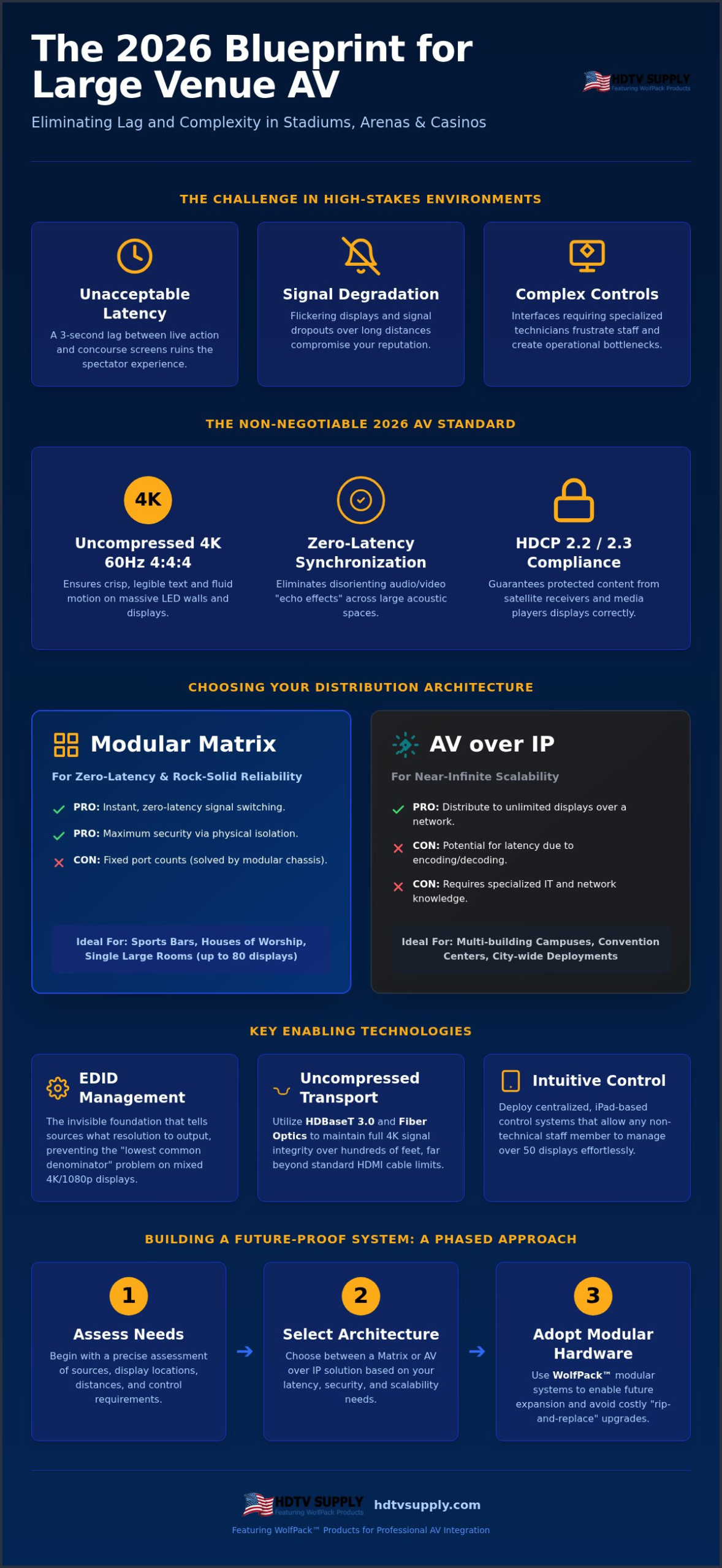
Why does a massive stadium or casino still suffer from a three-second lag between the live action and the concourse screens? Lag is unacceptable. In a high-stakes environment, even a minor delay or a flickering display ruins the spectator experience and compromises your facility’s reputation. Designing a reliable HDMI distribution system for large venue applications isn’t just about running cables; it’s about engineering a scalable architecture that handles uncompressed 4K signals without breaking a sweat.
You’ve likely dealt with signal degradation over long runs or control interfaces that require a specialized technician just to change a channel. It’s frustrating when staff can’t manage simple screen transitions or when latency issues desync your entire facility. This 2026 guide provides the blueprints to eliminate these bottlenecks, delivering zero-latency 4K video across any footprint. We’ll explore the latest WolfPack modular matrix switchers, uncompressed HDBaseT 3.0 standards, and iPad-based control systems that make complex management intuitive. From houses of worship to global sports hubs, this is your roadmap to a modular, future-proof video network that grows with your needs.
Key Takeaways
- Identify the critical differences between centralized modular matrix architectures and scalable AV over IP solutions for massive footprints.
- Select the optimal transport layer, such as HDBaseT 3.0 or fiber, to maintain uncompressed 4K signal integrity in an HDMI distribution system for large venue settings.
- Solve the “user experience” bottleneck by deploying centralized control systems that allow non-technical staff to manage 50+ displays effortlessly.
- Adopt a modular WolfPack hardware strategy to enable future system expansion and avoid costly rip-and-replace upgrades.
- Apply a phased implementation strategy that prioritizes precise needs assessment and distance-based architecture selection.
Fundamentals of Large Venue HDMI Distribution
HDMI distribution is the centralized routing of video sources to multiple displays without quality loss. In environments like stadiums, casinos, mega-churches, and convention centers, this process moves beyond simple connectivity into the territory of high-level systems engineering. These facilities often require content to reach 50 or more endpoints simultaneously. Standard consumer-grade HDMI splitters fail at this scale because they cannot overcome the physical limitations of the technology. The traditional 5-meter rule for passive copper cables is irrelevant here; a professional HDMI distribution system for large venue applications must maintain signal integrity across hundreds of feet of infrastructure.
The core challenge lies in balancing signal strength with complex digital handshaking protocols. When you scale a system to dozens of screens, managing High-bandwidth Digital Content Protection (HDCP) and Extended Display Identification Data (EDID) becomes a logistical hurdle. If one screen fails to handshake correctly, it can cause the entire system to flicker or drop out. Professional-grade architectures prevent these failures by isolating signals and managing the digital conversation between every source and every display.
Key Requirements for Professional Venue AV
By 2026, 4K 60Hz 4:4:4 has become the non-negotiable standard for large-scale displays. High-capacity venues demand this level of color depth and refresh rate to ensure that text is legible and motion is fluid on massive LED walls. Latency and synchronization are equally critical. In large acoustic spaces, even a slight delay between screens creates a disorienting “echo effect” that ruins the experience for the audience. Furthermore, your hardware must support the latest HDCP 2.2 and 2.3 standards. This ensures that DRM-protected content from satellite receivers or media players actually reaches every screen in the building without blacking out.
The Role of EDID Management
EDID management is the invisible foundation of a stable AV network. It’s the mechanism that tells your source device exactly what resolution and frame rate to output. In a mixed-display environment, such as a casino floor with both 4K monitors and legacy 1080p signage, the source often defaults to the lowest common denominator. This results in blurry images on your most expensive screens. You can avoid this by Mastering HDMI Matrix EDID Management for Pro AV Systems. Custom EDID settings allow you to force the source to provide the optimal signal for high-performance zones, using dedicated hardware to downscale the image only where necessary. This granular control is vital for maintaining a premium visual experience across a diverse equipment inventory.
Comparing Distribution Architectures: Matrix vs. AV over IP
Choosing the right architecture for an HDMI distribution system for large venue requirements depends on balancing latency against scalability. You have two primary paths: the traditional hardware-based matrix or the software-defined AV over IP network. Matrix switchers provide a direct, physical connection between sources and displays. This ensures zero-latency performance and instant switching. It’s the standard for environments where timing is critical and network complexity is unwanted.
Traditional Matrix Switcher Pros and Cons
Matrix systems are prized for their reliability and simplicity. They don’t require complex network configurations or specialized IT knowledge to deploy. Performance is predictable because every connection is dedicated.
- Pros: Instant switching between sources; maximum security due to physical isolation; zero-latency signal delivery.
- Cons: Historically fixed port counts; distance limitations when using standard copper cabling.
To overcome the “fixed port” limitation, many integrators utilize WolfPack modular HDMI matrix switchers. These systems allow you to swap input and output cards as your venue grows. If you need to manage up to 80 TVs in a sports bar or a single-room house of worship, a modular matrix is the most efficient choice. You can browse professional matrix solutions to find a chassis that fits your specific port requirements.
AV over IP: The Scalability King
AV over IP represents near-infinite scalability. It turns video into data packets using encoders at the source and decoders at the display. By leveraging 10Gb network switches, you can distribute 4K 60Hz content across multi-building campuses or massive stadiums. This architecture allows you to add a single display anywhere there’s a network drop, making it the superior choice for distributed digital signage.
A dedicated IGMP-snooping network switch is essential for this setup. Without it, multicast traffic will flood your network and crash your connected devices. While AV over IP offers unmatched flexibility, it introduces a layer of network management that a traditional matrix avoids. It’s the ideal architecture for venues where displays are separated by kilometers of fiber optic cable or for facilities that anticipate constant, unpredictable expansion.
The cost-benefit analysis often comes down to port density versus infrastructure. Matrix switchers are usually more cost-effective for high-density, localized switching. AV over IP wins when you need to add one screen at a time across a vast area. Most seasoned veterans prioritize the matrix for its “set and forget” reliability in high-stakes environments.
Solving the Distance Challenge: Fiber, HDBaseT, and Coax
Distance is the enemy of high-resolution video. When you’re managing an HDMI distribution system for large venue environments, the physics of signal loss dictates your hardware choices. Standard 18Gbps signals, required for 4K60 performance, cannot travel more than a few meters over standard copper HDMI cables without significant bit errors. To bridge the gap between a centralized rack and a distant display, you must utilize specialized transport layers that can handle the massive data throughput of modern video standards.
HDBaseT 3.0 has emerged as the premier solution for mid-range distribution. It delivers uncompressed 4K 60Hz 4:4:4 video, along with control signals and Ethernet, up to 100 meters over a single Cat6a cable. Unlike previous generations that relied on light compression, version 3.0 maintains bit-for-bit accuracy. This is the backbone of most modern pro-AV installations where reliability and image quality are paramount. It’s a robust, point-to-point solution that fits perfectly within an HDMI distribution system for large venue footprints.
HDBaseT 3.0 vs. Fiber Optic
Choosing between HDBaseT and fiber depends on your specific environment and installation constraints. HDBaseT is often the more practical choice for indoor venues. It’s easier to terminate in the field and supports Power over Cable (PoC). PoC allows the matrix to power the remote receivers, which simplifies display mounting because you don’t need a dedicated electrical outlet at every screen location. This reduces both labor costs and infrastructure requirements.
Fiber optic HDMI becomes mandatory when runs exceed 100 meters or when cables must pass through high-interference zones. In stadiums or large industrial convention centers, electromagnetic interference (EMI) from massive lighting rigs and power generators can corrupt copper-based signals. Fiber is immune to EMI and can carry signals for 300 meters or more without loss. While fiber hardware carries a higher cost and requires more delicate termination, it remains the gold standard for massive footprints that demand total signal isolation.
Leveraging Legacy Cabling with Modulators
You don’t always need to pull new wire to achieve effective distribution. If a facility already has a backbone of RG6 coax, you can utilize HDMI modulators to distribute video. These devices convert HDMI sources into RF channels that any standard TV tuner can decode. It’s a cost-effective way to reach hundreds of screens without the labor costs of a full re-wire.
Consult The Professional Guide to HDMI Modulators for a deep dive into this technology. Keep in mind that coax distribution typically limits you to 1080p resolution and introduces higher latency than a dedicated matrix. It’s an excellent solution for digital signage and overflow areas where millisecond-perfect synchronization isn’t the primary goal. For high-stakes live viewing, stick to HDBaseT or fiber.
Centralized Control: Managing 50+ Displays Seamlessly
A sophisticated HDMI distribution system for large venue environments often hits a wall at the user interface. You can have the highest quality 4K signal in the world, but if the facility staff can’t switch sources quickly, the system is a failure. In a stadium or casino, expecting an usher or bartender to manage 50+ displays with IR remotes is unrealistic. These consumer-grade remotes lack the range and reliability needed for professional spaces. High-capacity venues require IP or RS232 control to ensure every command is received and executed instantly across the entire network.
Centralized control eliminates the guesswork. It moves the management layer from the equipment rack to the palm of your hand. This shift is essential for maintaining the fast-paced rhythm of a live event or a busy floor. For a detailed look at how these control strategies apply to high-traffic hospitality environments, read our guide on 2026 Sports Bar TV Distribution: Scaling for Success.
Tablet-Based AV Management
The WolfPad TV Control system revolutionizes how staff interact with complex hardware. It utilizes a visual routing interface where users simply drag a source icon to a specific TV on a digital floor plan. This removes the need for technical staff to be present for every source change. Group commands further enhance efficiency, allowing a single button press to power on every screen in the building or switch all displays to an emergency alert source. Since there’s no custom programming required, you don’t have to wait for an expensive specialist to make minor adjustments to your layout.
System Feedback and Monitoring
Reliability in an HDMI distribution system for large venue settings depends on proactive monitoring. Modern control systems provide real-time feedback, showing the status of every encoder, decoder, and display in the network. If a screen loses its signal, the system alerts the IT manager immediately. Remote access capabilities allow for off-site troubleshooting, which is critical for venues operating across multiple time zones or large campuses. You can also integrate these controls with existing building automation systems to synchronize video content with facility-wide lighting or audio presets.
View WolfPad TV Control options to eliminate control anxiety for your facility staff.
Implementation Strategy: Building a Future-Proof System
Successful deployment of a high-capacity HDMI distribution system for large venue environments requires a methodical approach to avoid costly post-installation failures. You shouldn’t start by picking products. Start by defining the workflow and the physical constraints of the space. Engineering a system that lasts through 2026 and beyond involves a four-phase strategy designed to eliminate technical bottlenecks before they reach the field.
Phase 1 involves a rigorous needs assessment. Calculate your exact source-to-display ratio and measure every cable path to its furthest endpoint. Phase 2 focuses on architecture selection. As established in previous sections, choose a modular matrix for localized, high-performance switching or AV over IP for sprawling, multi-zone facilities. Phase 3 moves into hardware specification. Prioritize components capable of 4K 60Hz 4:4:4 to ensure your facility meets modern performance standards. Finally, Phase 4 covers testing and commissioning. You must verify every HDCP handshake and measure signal strength at the receiver to ensure the system is stable under full load. Don’t skip the stress test; run all sources to all displays simultaneously for several hours to identify any thermal or bandwidth bottlenecks.
Why Modularity Matters
The WolfPack approach to system design centers on long-term flexibility. Instead of replacing an entire chassis when technology shifts, you simply swap individual input or output cards. This modularity is the single best way to protect an AV investment. It allows your facility to adapt to new sources or higher resolutions without a total system overhaul. It’s the difference between a five-year lifecycle and a ten-year lifecycle. Even if you aren’t deploying 8K today, installing a fiber or Cat6a backbone ensures your infrastructure is ready when the hardware catches up. This strategy prevents the “rip and replace” cycle that drains capital budgets.
Professional Support and Custom Design
Pre-configured systems are essential for large-scale success. They drastically reduce on-site “black screen” troubleshooting by ensuring all components are vetted for compatibility before they arrive at your loading dock. HDTV Supply assists integrators by providing technical validation and custom system layouts tailored to specific venue challenges. We analyze your signal paths and control requirements to eliminate bottlenecks before they become field issues. This professional oversight ensures that your HDMI distribution system for large venue applications performs reliably from day one.
Contact HDTV Supply for a Custom Large Venue System Design to begin your project with expert validation and technical support.
Future-Proof Your Venue Video Architecture
Deploying a high-performance HDMI distribution system for large venue applications requires a balance of modular hardware and intuitive control. You’ve learned how WolfPack modular matrix systems eliminate the need for costly rip-and-replace upgrades by allowing for simple card swaps as your needs grow. We’ve also explored how WolfPad iPad control integration removes the technical barriers for your staff, ensuring that managing 50+ screens is as simple as a drag-and-drop operation. By prioritizing uncompressed 4K signal integrity and scalable transport layers like HDBaseT 3.0 or fiber, you ensure your facility remains at the cutting edge of Pro AV standards through 2026 and beyond.
Efficiency and reliability are the foundations of a successful large-scale installation. Don’t leave your system design to chance. Our team provides free technical support from AV experts to help you navigate complex routing requirements and technical validation. Take the next step in optimizing your facility’s video network today. Shop Professional HDMI Distribution Systems at HDTV Supply to find the perfect architecture for your specific needs. Your venue is ready for a professional-grade upgrade.
Frequently Asked Questions
What is the best HDMI distribution system for a stadium?
The best HDMI distribution system for large venue applications like stadiums is typically a fiber-based architecture or an AV over IP network. Fiber is immune to electromagnetic interference from massive lighting rigs and power grids. These systems handle the extreme distances found in open-air facilities. By using WolfPack modular components, you ensure uncompressed 4K signals reach the furthest concourse screens without losing quality or introducing disruptive lag.
How many TVs can I control from a single HDMI matrix switcher?
You can control dozens of displays from a single chassis. A WolfPack modular matrix switcher often supports configurations like 16×16, 32×32, or even 80×80. This allows you to route any source to any combination of TVs. If your venue requires even more endpoints, an AV over IP system can scale to hundreds of screens by leveraging high-capacity network switches and individual encoders for every source.
Can I use wireless HDMI for a large venue?
Wireless HDMI is not recommended for professional large venue environments. High-stakes settings like casinos or stadiums have too much structural interference and electronic noise. Wireless signals often drop out or suffer from significant latency. For reliable performance, you should always use a wired HDMI distribution system for large venue projects, utilizing fiber optic or HDBaseT 3.0 cabling to maintain a stable, high-bandwidth connection.
What is the difference between HDBaseT and AV over IP for long distances?
HDBaseT 3.0 is a point-to-point technology that carries uncompressed 4K video up to 100 meters over Cat6a cable. It’s simple to deploy and requires no network configuration. AV over IP turns video into data packets for distribution across a network. While AV over IP offers near-infinite scalability across buildings, it requires managed 10Gb switches. HDBaseT remains the preferred choice for zero-latency, localized distribution within a single large room.
How do I prevent signal lag between different TVs in a sports bar?
Preventing signal lag requires a centralized switching architecture. Standard consumer-grade splitters often cause desynchronization, but a WolfPack matrix switcher ensures every screen receives the signal at the exact same millisecond. This eliminates the “echo effect” where audio and video are out of sync across a room. For effortless management, a WolfPad control system allows you to synchronize groups of TVs with a single button press on an iPad.
Do I need a special network switch for HDMI over IP distribution?
Yes, a specialized network switch is mandatory for AV over IP systems. You need a managed 10Gb switch that supports IGMP snooping and Jumbo Frames. This hardware manages the heavy multicast traffic generated by 4K video streams. Without these features, the video data will flood your network and crash other connected devices. Choosing the right switch architecture is as important as selecting your encoders and decoders to ensure system stability.
What resolution should I plan for in a new 2026 venue installation?
Plan for 4K 60Hz 4:4:4 resolution as your baseline for 2026. This standard ensures your infrastructure handles the highest quality content currently available from media players and satellite receivers. While 8K is emerging, 4K remains the practical standard for large-scale visibility. Ensure your cabling, whether fiber or Cat6a, supports at least 18Gbps bandwidth to prevent your distribution system from becoming obsolete within a few years as content standards evolve.
How does HDCP 2.2 affect my HDMI distribution system?
HDCP 2.2 is a digital rights management protocol required for playing protected 4K content. Every device in your signal chain, including the matrix switcher, cables, and displays, must be HDCP 2.2 compliant. If a single component fails to meet this standard, your screen will likely stay black or show a resolution error. Using WolfPackSecure 4K 60 4:4:4 matrix switchers ensures full compliance across your entire venue’s high-resolution video network.
Leave a Reply
Want to join the discussion?Feel free to contribute!