
Modular HDMI Matrix Switchers: 2026 Pro AV Guide
Investing in a fixed-port system in 2026 is a calculated risk that rarely pays off for growing venues. When you need to scale your video distribution, a modular HDMI matrix switcher is the only logical choice to avoid the high cost of replacing entire systems just to add a single display. You’ve likely dealt with the frustration of signal loss over long distances or the headache of screen flickering when resolutions don’t match. It’s a common pain point for technicians who need precision and reliability across a massive inventory of screens.
We understand that maintaining a seamless, 4K 60Hz signal path across dozens of TVs requires a backbone that grows with your facility. This guide shows you how modularity provides the technical precision and future-proofing required to handle HDCP 2.3 and HDMI 2.1 standards without a total hardware overhaul. You’ll learn how to build a scalable system that offers centralized tablet control and zero-latency switching for any professional environment.
Key Takeaways
- Learn why a modular HDMI matrix switcher is the industry standard for preventing hardware obsolescence in high-demand video environments.
- Understand the core components of a professional AV system, including chassis options ranging from 8×8 to 160×160 configurations.
- Compare the long-term ROI of modular systems against fixed units, focusing on the ability to swap individual cards during maintenance.
- Follow a structured five-step audit process to map your sources and display locations for maximum signal integrity.
- Explore high-bandwidth solutions like the WolfPackSecure line that support 4K 60 4:4:4 for mission-critical clarity.
What is a Modular HDMI Matrix Switcher and Why Does It Matter?
A modular HDMI matrix switcher serves as the high-capacity central hub for professional video distribution. It provides true “Any-to-Any” routing, allowing you to send any input source to any output display in any combination. Whether you’re managing a sports bar with 50 screens or a corporate campus, this hardware eliminates the “spaghetti mess” of unmanaged cables and unreliable splitters. It’s the technical successor to the traditional Vision mixer, refined for the demands of modern system integration and 24/7 uptime.
Modularity matters because it prioritizes system longevity. In commercial environments like casinos or hospitals, hardware failure isn’t an option. These venues require a scalable AV backbone that can adapt to changing technology without requiring a complete rip-and-replace of the existing infrastructure. By centralizing the signal path, you gain immediate access to every connection point, simplifying both initial installation and long-term maintenance. Systems like the WolfPack series are built for this exact level of high-volume reliability and immediate accessibility.
The Core Difference: Fixed vs. Modular Architecture
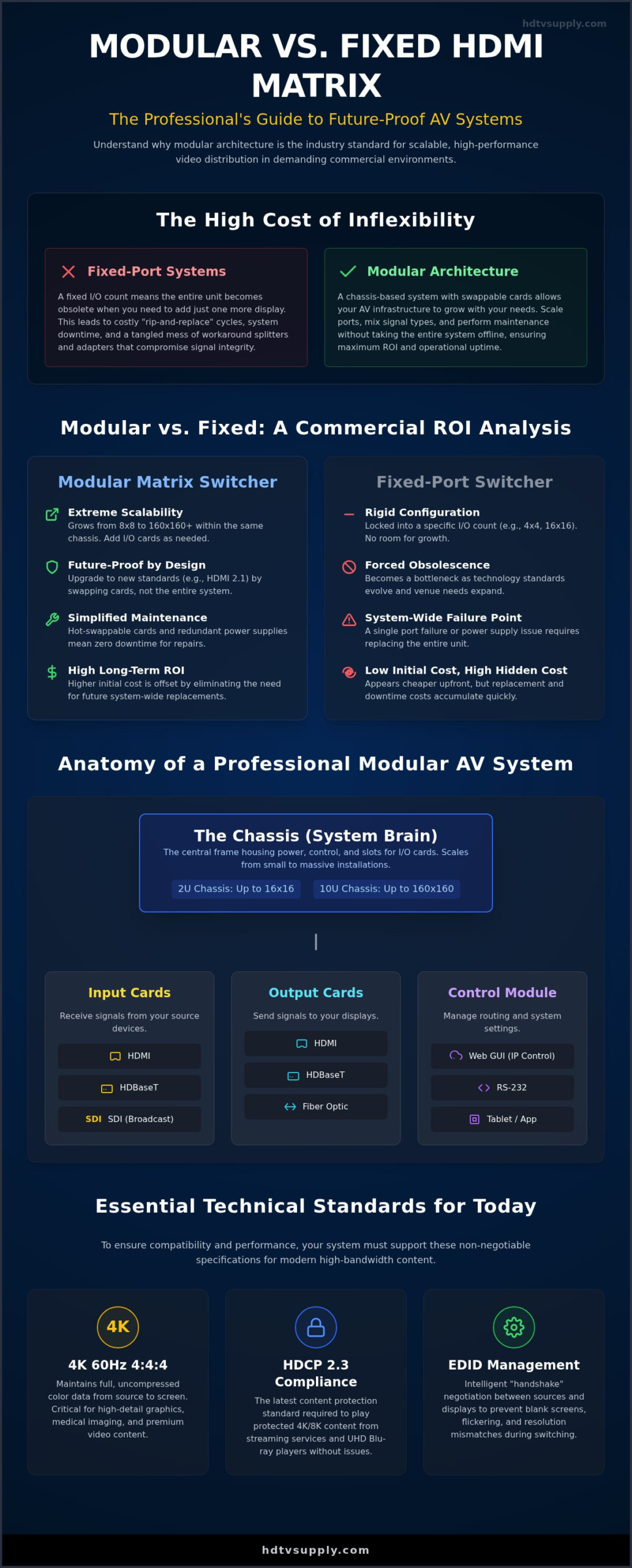
Fixed-port switchers come with a predetermined number of inputs and outputs, such as a 4×4 or 16×16 configuration. These units are rigid; if your needs grow by just one display, the entire unit becomes obsolete. Modular architecture utilizes a chassis with empty slots designed for interchangeable cards. This allows you to scale from an 8×8 setup to a 160×160 system within the same frame. You can mix and match signal types, including HDMI, HDBaseT, and Fiber, to meet the specific distance requirements of your venue. It’s a pragmatic approach to system design that values variety and reduces the logistical headache of hardware decommissioning. If an input card fails, you simply swap it out without taking the entire system offline.
Key Technical Requirements for 2026
For installations designed in 2026, 4K 60Hz 4:4:4 support is the baseline requirement for professional clarity. This ensures that high-bandwidth content maintains its integrity from source to screen without color compression. Compliance with HDCP 2.3 is equally vital, as it allows for the seamless playback of protected 4K and 8K streaming content without resolution downgrades. EDID Management is the critical software layer that negotiates resolutions between sources and displays to prevent the dreaded blank screen during switching. Without these specifications, your system will struggle with modern hardware compatibility and signal handshake delays. Choosing a modular HDMI matrix switcher that supports these standards ensures your facility stays ahead of the technology curve.
The Anatomy of a Professional Modular AV System
Every modular HDMI matrix switcher relies on a high-density chassis to function as the system’s brain. Unlike fixed units, these systems separate the processing frame from the physical I/O ports. This architecture allows technicians to customize the signal path based on the specific hardware in the rack. Understanding how HDMI matrix switchers work at a component level is essential for designing a system that handles both legacy sources and modern 4K distributions. The system is comprised of four primary components: the chassis, input cards, output cards, and the control module.
- Input Cards: Select between HDMI for local media players, SDI for broadcast equipment, or HDBaseT for remote sources located in different rooms.
- Output Cards: Match these to the destination requirements. Use standard HDMI for displays within 50 feet and HDBaseT or Fiber for long-distance runs.
- Control Modules: Professional systems offer multiple layers of management, including an IP-based Web GUI for remote configuration and RS-232 for integration with legacy automation systems.
If you’re unsure which card configuration fits your venue, explore the pre-configured WolfPack Modular Matrix Switchers available for immediate shipping.
Chassis Sizes and Scalability
Chassis frames are measured in standard rack units (U). A 2U chassis typically supports up to 16×16 port configurations, while larger 6U or 10U frames can scale to a massive 160×160 capacity. When planning your rack layout, always leave empty slots or “dark” capacity for future expansion. This strategy prevents the need for a total system rebuild when you add your next bank of displays. For mission-critical environments like hospital surgical suites, prioritize frames equipped with redundant, hot-swappable power supplies to ensure 24/7 uptime. To ensure the broader facility power infrastructure is equally resilient, you can discover Tesla Electrical Company for professional industrial electrical and automation systems.
Signal Extension: HDBaseT and Fiber Cards
Distance is the primary enemy of signal integrity in large-scale installations. HDBaseT cards allow uncompressed 4K signals to travel up to 330 feet over standard CAT6 cabling. This is the industry standard for sports bars and corporate offices where sources are centralized in a back room. If your distribution spans multiple kilometers, such as in a large campus or stadium, utilize Fiber Optic cards to maintain zero-latency performance. Remember that these long-distance runs require “Baluns” or receivers at the display end to convert the signal back to HDMI for the television.
Modular vs. Fixed Matrix Switchers: A Commercial ROI Analysis
Choosing between a fixed and a modular HDMI matrix switcher is a decision between short-term savings and long-term profitability. Fixed units offer a lower initial point of entry. However, they lack a clear path for expansion. When your venue grows, a fixed unit becomes a bottleneck. A modular HDMI matrix switcher acts as a permanent piece of infrastructure. You pay for the chassis capacity today to avoid the massive cost of a full system replacement tomorrow.
Maintenance costs reveal the real story of ROI. If a single port fails on a 32×32 fixed unit, the entire system is compromised. You either tolerate the dead port or pay for a complete replacement. Modular systems utilize hot-swappable cards. You replace the specific module in minutes without taking the “game” off the other screens. This reliability is vital for sports bars and casinos where downtime translates directly to lost revenue. It turns a potential multi-thousand-dollar disaster into a simple component swap.
Scenario: The Growing Sports Bar
Imagine a bar that starts with 16 TVs and eventually expands to 24. With fixed units, you’re often forced to buy multiple units and “daisy-chain” them together. This method degrades signal quality and increases latency across the chain. In a modular environment, you simply slide an additional 8-port output card into your existing chassis. It’s a cleaner, more efficient way to scale that preserves signal integrity. The WolfPack advantage lies in this high-density flexibility, ensuring your rack stays organized and your signal stays pure as your business grows.
Technical Longevity and Standards
Technology standards like HDCP evolve faster than most businesses can renovate. Modular systems handle these shifts by allowing you to upgrade specific cards to support HDCP 2.3 or 8K resolutions while keeping your original chassis in the rack. These systems also bridge the gap between old and new hardware. Built-in scaling allows you to mix legacy 1080p displays with new 4K screens on the same system without signal handshake errors. Seamless Switching is the critical feature that prevents the 3-second black screen during transitions, keeping the viewing experience fluid and professional for your customers.
Designing Your Modular Matrix System: A 5-Step Process
Building a high-performance distribution hub requires more than just selecting a chassis. It demands a methodical approach to ensure every component works in harmony. A modular HDMI matrix switcher provides the framework, but the efficiency of the final installation depends on your initial design phase. Follow this five-step process to architect a system that meets your current needs and anticipates future growth.
- Step 1: Audit your sources. Identify every device feeding the system. This includes cable boxes, media players, PCs, and cameras. Note the resolution and HDCP requirements for each.
- Step 2: Map display locations. Measure the exact cable run distance from the central rack to every screen. This data dictates your choice of output cards.
- Step 3: Determine control preference. Decide how your staff will interact with the system. Options range from simple front-panel buttons to sophisticated iPad interfaces.
- Step 4: Select a chassis with headroom. Never buy a chassis that you will fill on day one. Aim for at least 20% “dark” or unused slots to accommodate future displays or source upgrades.
- Step 5: Choose your card mix. Finalize the specific combination of HDMI, HDBaseT, or Fiber cards based on the distances recorded in Step 2.
If you’re ready to specify your components, browse the full inventory of WolfPack Modular Matrix Switchers to find the right chassis for your project.
Step 2 Deep Dive: Distance and Cabling
Distance is the primary factor in signal degradation. For displays located within 50 feet of the rack, standard high-speed HDMI cables are sufficient. When distances reach up to 330 feet, you must deploy CAT6 cabling paired with HDBaseT output cards. This ensures uncompressed 4K delivery without the latency found in lower-tier distribution methods. For runs that sit between these two extremes, Active Optical Cables (AOC) offer a reliable hybrid solution. They provide the bandwidth of fiber with the plug-and-play convenience of a standard HDMI connector.
Step 3 Deep Dive: Control and Automation
The control interface is the most visible part of your AV system. Modern facility owners increasingly prefer tablet-based control for its mobility and intuitive layout. The WolfPad system is a standout choice here because it offers a “No Programming Needed” iPad interface. It allows you to manage 30 or more TVs without the high cost of custom code. For larger enterprise environments, ensure your modular HDMI matrix switcher includes drivers for 3rd party automation platforms like Control4, Crestron, or Elan. This integration allows the AV system to function as part of a broader building management strategy.
WolfPack Modular Solutions: Why HDTV Supply is the Pro Choice
HDTV Supply has established itself as a global hub for professional AV equipment. With an inventory exceeding 12,000 products, we provide the scale and readiness required for complex system integrations. The WolfPack line is our flagship modular HDMI matrix switcher series. It’s designed for technicians who demand immediate accessibility and technical mastery. For mission-critical environments needing maximum bandwidth, the WolfPackSecure series supports 4K 60 4:4:4 and HDCP 2.2/2.3 standards. This ensures your system handles high-definition content without signal degradation or handshake failures.
We also offer specialized Sports Bar TV Distribution Systems. These packages bundle the matrix, control interface, and necessary cabling into a single, efficient deployment. It’s a “one-stop” resource that eliminates the guesswork from system design. Our global support network is ready 24/7 to assist with technical specifications or logistical challenges. We prioritize results and practical application over aesthetic marketing, positioning our hardware as the industry standard for high-volume distribution.
For manufacturers and facilities that require similar precision in their supply chain logistics, OEM Materials & Supplies provides the specialized packaging and industrial materials necessary to support large-scale infrastructure and equipment distribution.
WolfPad: The End of Complex Programming
Traditional AV control often requires expensive programmers and weeks of code development. WolfPad changes this dynamic. It’s a “No Programming Needed” solution that gives you iPad control over 30 or more TVs instantly. The interface uses a visual floor plan of your venue. Staff can use “Drag and Drop” functionality to switch sources without any technical training. It’s fast. It’s intuitive. It saves thousands in professional programming fees while ensuring your staff can manage the environment with ease. This level of efficiency is why WolfPad is the preferred choice for high-traffic sports bars and restaurants.
Procurement and Technical Support
Buying direct from HDTV Supply ensures you receive genuine WolfPack hardware backed by our extensive industry experience. We maintain a sense of urgency in our shipping and support to keep your projects on schedule. Our toll-free support line connects you with experts for real-time troubleshooting. We also offer extended warranty options to protect your investment for years to come. This air of dependability is why seasoned installers choose us as their primary distributor for modular HDMI matrix switcher technology. We provide the technical depth and inventory variety that boutique providers simply cannot match.
Build your custom WolfPack Modular Matrix Switcher today
Future-Proof Your Facility with Scalable AV Architecture
Building a robust video distribution network requires a focus on both current performance and long-term scalability. You’ve seen how modular systems decouple the chassis from the signal standard, allowing for seamless upgrades and easier maintenance. By prioritizing 4K 60Hz 4:4:4 support and intuitive control interfaces like WolfPad, you eliminate the technical bottlenecks that plague fixed-port installations. Choosing a modular HDMI matrix switcher ensures your system remains functional as industry standards evolve toward 8K and higher bandwidth requirements.
HDTV Supply is your authorized WolfPack dealer, providing immediate access to over 12,000 professional AV products. We offer global technical support and 24/7 readiness to ensure your project succeeds. If you need assistance with system architecture or card selection, our experts are available via toll-free consultation to provide technical precision for your specific venue. Don’t let your hardware limit your growth.
Browse our full catalog of WolfPack Modular Matrix Switchers and start designing your scalable AV backbone today.
Frequently Asked Questions
Can I mix 4K and 1080p TVs on the same modular matrix switcher?
Yes. Many professional modular HDMI matrix switcher units feature built-in scaling on the output cards. This technology allows the system to downscale 4K source signals for 1080p displays while simultaneously outputting full 4K resolution to compatible screens. It’s an essential feature for venues that aren’t ready to replace every legacy television but still want to utilize modern 4K media players and cable boxes.
How far can I run an HDMI signal using a modular matrix with HDBaseT cards?
HDBaseT output cards allow you to send uncompressed 4K video up to 330 feet over a single CAT6 cable. This is a massive jump from standard HDMI cables, which typically experience signal dropouts after just 50 feet. For installations spanning an entire stadium or corporate campus, you can utilize Fiber Optic cards to maintain signal integrity over several kilometers without adding latency to the distribution.
Do I need a professional programmer to set up a WolfPack matrix?
No, provided you use the WolfPad control interface. While traditional matrix systems often require expensive third party programming and custom code, WolfPad is designed as a “No Programming Needed” solution. You can configure your floor plan and manage source switching via a simple iPad app. This approach saves significant upfront costs and allows non-technical staff to manage the system with minimal training.
What is the difference between a modular matrix and a video wall processor?
A modular matrix routes different sources to different displays independently. A video wall processor takes one or more sources and tiles them across multiple screens to create a single large image. While some WolfPack systems include secondary video wall processing modes, their primary purpose is “Any-to-Any” routing. This allows you to show the big game on twenty TVs while displaying different menu loops on five others.
Is it possible to add more inputs to my matrix later if I buy a modular chassis?
Yes, as long as your chassis has available empty slots. This scalability is the core benefit of choosing a modular HDMI matrix switcher over a fixed-port unit. If you purchase a 32×32 chassis but only install 16 inputs today, you can simply slide in additional 4-port or 8-port cards next year. You won’t need to rewire the entire rack or buy a new processing frame.
How does HDCP 2.2 affect my modular matrix switcher setup?
HDCP 2.2 is the digital rights management standard required to play protected 4K content. Every device in your signal chain must be compliant. If your source and TV support HDCP 2.2 but your matrix only supports version 1.4, the signal will likely be downgraded to 1080p or blocked entirely. Our WolfPackSecure line ensures full compliance with HDCP 2.2 and 2.3 standards for seamless 4K playback.
What happens if a single card fails in a modular system?
Only the specific ports on that card will go dark. In a fixed-port switcher, a single internal failure often requires you to ship the entire unit back for repair, leaving your venue without video. In a modular system, you simply unscrew the faulty card and slide in a replacement. This “hot-swappable” nature ensures that the rest of your screens stay active, making it the standard for mission-critical commercial environments.
Can I control my modular matrix switcher from an iPad?
Yes, iPad control is the preferred method for modern system management. By integrating the WolfPad TV Control System, you gain a visual representation of your venue on your tablet. You can drag a source icon to any TV icon to change the channel instantly. This replaces the need for dozens of individual remote controls and allows managers to adjust the atmosphere from the floor rather than the equipment closet.
Leave a Reply
Want to join the discussion?Feel free to contribute!