
Pro Guide to Long Distance HDMI Signal Distribution in 2026
If you’re still relying on thicker copper cables to solve your 4K dropouts, you aren’t just wasting money; you’re fighting a losing battle against physics. Modern high-bandwidth signals require more than just a better cable; they require a sophisticated architecture. Achieving reliable long distance HDMI signal distribution in 2026 means moving beyond basic extenders to integrated systems that handle EDID and HDCP 2.2 handshakes with surgical precision. Most technicians have faced the frustration of flickering screens or total signal loss during a high-stakes 4K 60Hz playback. It’s a common failure that usually stems from a mismatch between extension technology and distribution logic.
You can eliminate these handshake failures and build a stable, set-and-forget video network across any facility. This guide provides the technical strategies and hardware requirements to deliver flawless performance without the high cost of specialized long-run cables. We’ll examine the latest HDBaseT 3.0 specifications, fiber optic integration, and the role of modular matrix switchers in centralized control. By the end of this professional guide, you’ll have the expertise to deploy a rock-solid system that guarantees 4K 4:4:4 clarity in every zone.
Key Takeaways
- Identify the physical limitations of passive copper and how signal attenuation impacts 4K UHD playback over distances exceeding 25 feet.
- Evaluate high-performance alternatives like HDBaseT and Active Optical Cables to maintain full bandwidth across your facility.
- Implement WolfPack Modular Matrix Switchers to master long distance HDMI signal distribution while ensuring seamless EDID and HDCP compatibility.
- Master installation best practices, including the mandatory use of shielded CAT6A cabling and strategic routing to eliminate electromagnetic interference.
- Optimize large-scale venue operations by integrating WolfPad control systems for centralized, intuitive management of 30 or more displays.
Why HDMI Fails at Distance: The Physics of Signal Loss
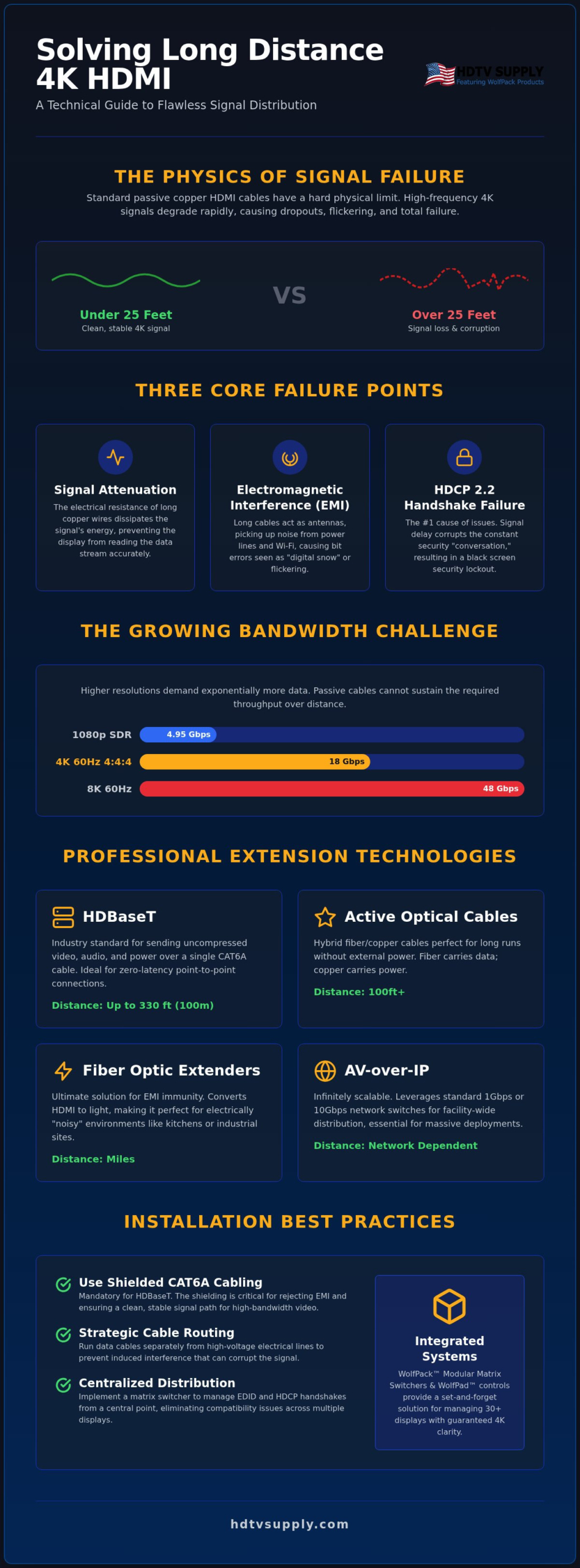
Passive HDMI cables are essentially copper pipes for data. While they work perfectly for connecting a source to a TV three feet away, they encounter a hard physical limit at roughly 25 feet. Beyond this point, high-frequency digital signals begin to degrade. This phenomenon, known as signal attenuation, occurs because the electrical resistance of the copper wire dissipates the signal’s energy. In the context of the HDMI standard, this loss of energy prevents the receiving display from accurately interpreting the binary data stream.
External factors complicate this further. Long copper runs act as massive antennas. They pick up electromagnetic interference (EMI) from nearby power lines, fluorescent lights, and wireless routers. This noise creates bit errors that manifest as digital snow or intermittent flickering. Achieving reliable long distance HDMI signal distribution requires an understanding that distance isn’t just a length; it’s a source of signal corruption.
The Role of HDCP 2.2 in Long-Distance Failures
High-bandwidth content requires a constant, bidirectional conversation between the source and the display. This is the High-bandwidth Digital Content Protection (HDCP) protocol. It’s not a one-time check; it’s a continuous, low-latency feedback loop. If signal degradation delays or corrupts a single packet of this security data, the system assumes an unauthorized device is attempting to intercept the content. The result is an immediate black screen security lockout. HDCP handshaking is the #1 cause of distance issues in professional installations. Without a clean, high-speed path for these packets, even the most expensive 4K displays will fail to show an image.
Bandwidth vs. Distance: The Mathematical Reality
Modern video formats have pushed bandwidth requirements to extreme levels. A standard 4K 60Hz 4:4:4 signal requires a consistent 18Gbps throughput. If you move to HDMI 2.1b specs for 8K or high-frame-rate gaming, that requirement jumps to 48Gbps. As bandwidth increases, achieving stable long distance HDMI signal distribution becomes exponentially harder. At these frequencies, copper cables over 30 feet long often suffer from clock stretching and timing errors. You might see sparkles, which are tiny white pixels dancing across the screen. These indicate that the data is arriving just slightly out of sync. It’s a clear sign that your infrastructure can no longer support the signal’s bitrate. To solve this, you must look beyond passive copper to active distribution technologies.
Technologies for Professional HDMI Extension
Ensuring that every component of your infrastructure is built for reliability is a universal requirement, whether you are distributing 4K video or managing a food production line; for those in the food processing industry, you can visit Scotnet to explore their world-class elastic netting and protection solutions.
Selecting the right hardware for long distance HDMI signal distribution depends entirely on your environment and performance requirements. Passive cables fail early, so professionals turn to active technologies that can maintain the 18Gbps or 48Gbps bandwidth required for modern 4K and 8K content. These solutions range from point-to-point extenders to complex network-based architectures. Each technology offers distinct advantages in terms of latency, distance, and signal integrity. Deploying a professional-grade HDMI extender over Cat6 is one of the most cost-effective ways to bridge the gap between your source equipment and distant displays while maintaining full 4K bandwidth.
- HDBaseT: The industry standard for transmitting uncompressed video, audio, and power over a single CAT6A cable.
- Active Optical Cables (AOC): Hybrid cables that use fiber for data and copper for power, ideal for 100ft+ runs without external power supplies.
- Fiber Optic Extenders: Specialized hardware that converts HDMI to light signals, providing the highest level of interference immunity.
- AV-over-IP: A scalable approach that uses standard network switches to distribute video across an entire facility.
HDBaseT vs. HDMI over IP: Choosing the Right Protocol
When comparing various HDMI extender technologies, installers must choose between uncompressed point-to-point systems and network-based solutions. HDBaseT is the preferred choice for zero-latency applications where you need a direct link between a source and a display. It’s cost-effective and uses standard category cabling. In contrast, HDMI over IP offers infinite scalability. It allows you to leverage existing 1Gbps or 10Gbps networks for multi-room or multi-building distribution. While IP-based systems introduce a negligible amount of compression, they’re essential for massive deployments where a central matrix switcher isn’t feasible.
Fiber Optics: Future-Proofing for 8K and Beyond
Fiber is the ultimate solution for EMI-prone environments like commercial kitchens or industrial warehouses. Because fiber transmits light rather than electricity, it’s completely immune to the electrical noise that plagues copper. For 4K 60Hz 4:4:4 and 8K signals, OM3 or OM4 multi-mode fiber provides the necessary headroom to prevent data bottlenecks. This technology also solves critical electrical issues in large venues. Fiber optics prevent ground loops in stadium-scale installs by providing total electrical isolation between the source and the display. If you’re planning a high-end installation, the HDTV Supply technical team can help you select the right fiber hardware to ensure long-term reliability.
For those requiring the highest level of security and performance, WolfPackSecure 4K 60 4:4:4 HDMI Matrix Switchers offer a robust backbone for any distribution network. These systems integrate seamlessly with the extension technologies mentioned above to provide a complete, professional-grade solution.
Centralized Distribution: Matrix Switchers vs. Modulators
Moving from simple point-to-point extension to facility-wide management requires a strategic shift in architecture. You must decide between a “many-to-many” matrix environment or a “one-to-many” broadcast setup. For high-end commercial installs, centralized control is the standard. This approach places all source equipment in a secure, climate-controlled rack. By managing all handshakes and signal routing from one location, you ensure every display maintains the official HDMI specification without the instability of localized consumer hardware. Effective long distance HDMI signal distribution relies on this centralized logic to prevent EDID conflicts across multiple zones.
WolfPack Modular Matrix Switchers provide the necessary flexibility for these complex environments. These systems allow you to route any source to any display instantly. They eliminate the need for redundant hardware and simplify the signal chain. When you integrate long-distance receivers into a centralized rack, you create a robust backbone that supports 4K 60Hz performance across your entire facility. This is the foundation of a professional Sports Bar TV Distribution System where uptime is non-negotiable.
The Power of Modular AV Systems
Modularity is the key to future-proofing your investment. Modular chassis allow you to mix and match input and output cards within a single frame. You can utilize HDBaseT cards for standard rooms while reserving Fiber cards for distances exceeding 300 feet. This customization is essential for scaling from a modest 4×4 setup to massive 16×16 or 32×32 systems. Professional matrix switchers also offer redundancy through hot-swappable components. If a specific zone requires an upgrade or maintenance, the rest of the venue stays online. This level of reliability is why modular systems are the industry standard for high-capacity providers.
When to Choose HDMI Modulators for Coax
Modulators serve as the primary solution for retrofits in older facilities. If you’re working in a hospital, hotel, or a historic building with existing Coax wiring, pulling new CAT6A or Fiber can be cost-prohibitive. HDMI modulators convert the digital HDMI signal into an RF channel that travels over existing cable TV lines. There is a slight trade-off in latency compared to a matrix switcher, but the ease of installation is unmatched for digital signage applications. It’s a practical, high-volume approach to long distance HDMI signal distribution when infrastructure limits prevent a standard network overhaul. For high-end installs where zero latency is required, stick to the WolfPackSecure 4K 60 4:4:4 HDMI Matrix Switchers.
Installation Best Practices for Long-Distance Reliability
Hardware selection is only half the battle. Even the highest-quality components fail if the underlying infrastructure is compromised. For HDBaseT deployments, specify shielded CAT6A cabling. Unshielded twisted pair (UTP) is prone to alien crosstalk and electromagnetic interference, especially when cables are bundled together. Shielded cable (STP) provides the necessary protection to maintain the high-frequency data rates required for 4K 60Hz video. When routing these cables, maintain a generous bend radius. Kinking or tight bends change the impedance of the wire, leading to signal reflections and intermittent dropouts in your long distance HDMI signal distribution network.
Testing and certification are non-negotiable for professional installers. Use a dedicated HDBaseT field tester to verify link quality, cable length, and HDCP compatibility before leaving the site. This proactive approach identifies “weak” links that might pass a basic continuity test but fail during high-bandwidth UHD playback. Additionally, understand the difference between Power over Cable (PoC) and Power over Ethernet (PoE). PoC is often proprietary and requires specific matching between the transmitter and receiver. Always use the manufacturer-provided power supplies to avoid damaging sensitive chipsets.
Managing Heat and Power in the AV Rack
High-density WolfPack Modular Matrix Switchers generate significant thermal energy. Without proper ventilation, internal temperatures can spike, causing the processors to throttle or fail. Implement active cooling with rack-mounted fans and maintain at least one rack unit (1RU) of spacing between heavy components. Dedicated electrical circuits are also essential. Large distribution systems draw considerable current; sharing a circuit with high-draw appliances like refrigerators or HVAC units introduces electrical noise. Use a rack-mounted power conditioner to filter this noise and provide a stable voltage floor for your equipment.
EDID Management: Ensuring Source-to-Display Harmony
Handshake failures often occur because the source doesn’t know what resolution the display can handle. This is an EDID conflict. To prevent “lowest common denominator” issues where all screens drop to 1080p, manually set the EDID on your matrix switcher. Copy the EDID data from the furthest or most demanding display and force that profile across the entire zone. This ensures the source consistently outputs the correct 4K 60Hz signal. You can also use EDID emulators to solve handshake loops by providing a constant, “always-on” signal to the source device. For a reliable, high-performance system, browse our full inventory of professional AV hardware to find the right tools for your next project.
Scalable Solutions for Large Venues: The HDTV Supply Advantage
Large-scale venues like sports bars, casinos, and corporate campuses require more than just signal extension. They need a system that grows with the facility. Fixed-port hardware often leads to expensive “rip-and-replace” cycles when an extra display or source is added. WolfPack Modular Matrix Switchers solve this by allowing installers to swap input and output cards as needs change. This adaptability is the gold standard for long distance HDMI signal distribution, ensuring you can mix HDBaseT, Fiber, and local HDMI within a single chassis without replacing the entire backbone.
For mission-critical environments where video quality is non-negotiable, WolfPackSecure 4K 60 4:4:4 HDMI Matrix Switchers provide the necessary bandwidth for high-end installs. These systems handle the most demanding UHD signals without color subsampling or artifacts. This hardware is backed by global technical support, providing a reliable safety net for complex system designs that span multiple floors or buildings. It’s the difference between a consumer-grade experiment and a professional-grade distribution network. Sports bar operators managing 50 or more screens can further streamline their setup by deploying the best HDMI to IPTV encoder for sports bars, which leverages existing network infrastructure to eliminate long-distance cable runs entirely.
Simplified Control for Complex Distribution
Beyond the internal technical infrastructure, maintaining the exterior of large venues or corporate campuses is just as vital for a professional presentation; you can learn more about Garden Watering to see how automated irrigation systems can simplify your property management.
Managing 30 or more displays shouldn’t require a degree in computer programming or expensive third-party coding. WolfPad TV Control Systems eliminate the need for traditional, high-cost control solutions. The interface provides a visual, drag-and-drop environment on an iPad. You can see your sources and displays in real-time. Drag a source to a specific TV or an entire group of screens instantly. This simplifies the management of game day transitions or corporate event presets. It’s an intuitive solution designed for staff members who need immediate results without technical training.
Why Direct Sourcing Matters for Integrators
Efficiency in procurement is as important as signal integrity. Access to a catalog of over 12,000 professional-grade products ensures that every niche requirement is met from a single, reliable source. Integrators benefit from specialized distribution gear that includes extended warranties, providing peace of mind in high-traffic environments. Whether you need a single receiver or a complete Sports Bar TV Distribution System, the ability to buy HDMI matrix switchers online with expert guidance streamlines the entire project lifecycle. This transactional readiness and technical depth define the HDTV Supply advantage for the modern AV professional.
Implement a High-Performance Video Distribution Network
Achieving reliable long distance HDMI signal distribution requires moving beyond basic copper cables to a sophisticated architecture. You’ve learned that the 25-foot barrier is a hard physical limit for passive UHD signals. Bridging this gap demands the precision of HDBaseT 3.0 or the interference immunity of fiber optics. By centralizing control through WolfPack Modular technology, you eliminate handshake loops and ensure 4K 60Hz 4:4:4 performance across every zone. Success depends on following installation best practices, including the use of shielded CAT6A cabling and proactive EDID management.
It’s time to replace flickering screens with a stable, set-and-forget video network. Our team provides technical support from AV veterans to help you navigate complex system designs. With a massive inventory of 12,000+ specialized products, we have the hardware ready for immediate deployment. Design your professional HDMI distribution system with HDTV Supply and secure the reliability your facility requires. Build a system that performs flawlessly under the most demanding conditions.
Frequently Asked Questions
What is the maximum distance for a standard HDMI cable?
Standard passive HDMI cables effectively transmit signals up to 25 feet before signal degradation becomes a factor. For 4K UHD content, reliability often drops at 15 feet. Beyond these lengths, you’ll likely experience handshake failures or “sparkles” in the video. If your installation requires a run longer than 50 feet, you’ve got to transition to active technology like HDBaseT or fiber optics to maintain signal integrity.
Can I use CAT5e for 4K HDMI distribution?
Using CAT5e for 4K distribution isn’t recommended because it lacks the necessary bandwidth to support 18Gbps data rates. While it might work for short 1080p runs, 4K signals will suffer from intermittent dropouts or total failure. We mandate shielded CAT6A cabling for all professional HDBaseT deployments. This ensures sufficient headroom for high-resolution video and protects the signal from external electromagnetic interference in complex environments.
What is the difference between HDBaseT and HDMI over IP?
HDBaseT is a point-to-point protocol that provides uncompressed, zero-latency video over a single category cable. It’s ideal for direct source-to-display connections. HDMI over IP leverages your existing network infrastructure for infinite scalability, allowing you to distribute signals across multiple buildings. While IP-based systems introduce a negligible amount of latency due to compression, they offer superior flexibility for massive venue-wide distribution where a centralized matrix isn’t practical.
How do I prevent HDMI signal flickering at long distances?
Preventing flickering requires a stable long distance HDMI signal distribution architecture that manages EDID and HDCP handshakes correctly. Start by replacing passive cables with active optical cables or HDBaseT extenders. Ensure you’re using shielded CAT6A and that cables aren’t run parallel to high-voltage power lines. If flickering persists, use a dedicated EDID manager to force a specific resolution, which prevents the source from losing its connection to the display.
Do I need a special transmitter for 4K 60Hz 4:4:4 video?
Yes, you need hardware specifically rated for 18Gbps bandwidth to handle 4K 60Hz 4:4:4 video. Standard 10.2Gbps extenders will either downscale the signal to 4:2:0 or fail to show an image entirely. Our WolfPackSecure 4K 60 4:4:4 HDMI Matrix Switchers are engineered to meet these mission-critical standards. Always verify that both the transmitter and receiver in your signal chain support the full HDMI 2.0 or 2.1b specifications.
Can I distribute HDMI over existing coax cables?
You can distribute HDMI over existing coax cables by using an HDMI modulator for coax distribution. This technology converts the digital signal into an RF channel, similar to a cable TV broadcast. It’s an excellent solution for retrofitting older hotels or hospitals where pulling new CAT6A is impossible. While modulators introduce more latency than HDBaseT, they allow for massive “one-to-many” distribution over long distances using the building’s original wiring.
What happens if my displays have different resolutions in a matrix system?
In a standard matrix system, the source will often default to the lowest resolution display connected to avoid a total signal failure. If you’ve got a 4K source and a mix of 4K and 1080p screens, all displays might drop to 1080p. To prevent this, use a matrix switcher with built-in downscaling on specific outputs. This allows the source to output 4K while the switcher converts the signal for older 1080p displays.
Is there a delay or latency when using HDMI extenders?
Latency depends entirely on the technology you choose for long distance HDMI signal distribution. HDBaseT and fiber optic extenders provide zero-latency transmission because they don’t compress the signal. This is critical for gaming or live presentations. AV-over-IP systems and modulators introduce a small amount of delay, typically measured in milliseconds, because the signal must be encoded and decoded. For most commercial applications, this delay is unnoticeable to the viewer.
Leave a Reply
Want to join the discussion?Feel free to contribute!