
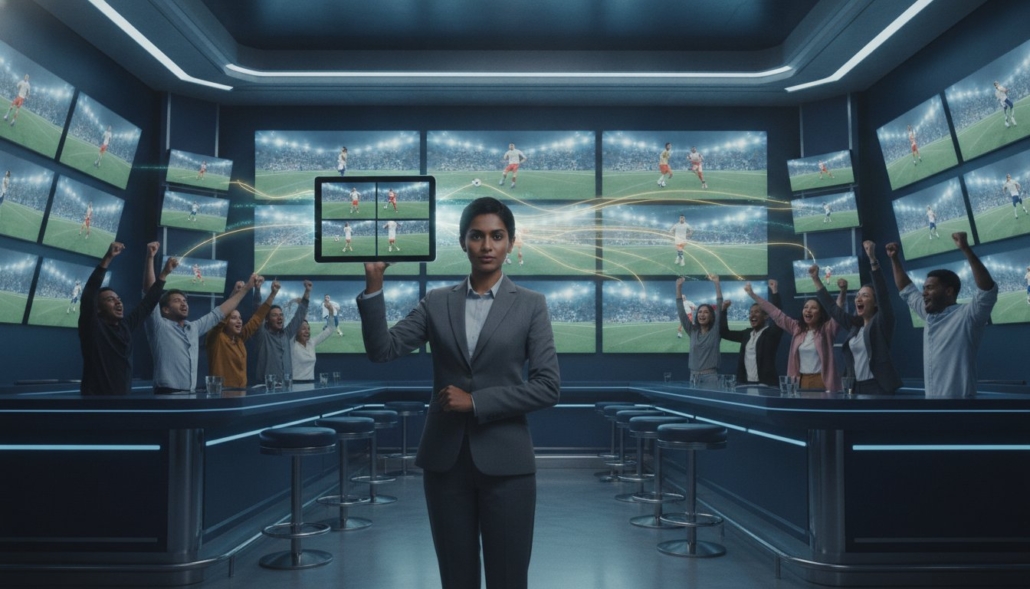
2026 Sports Bar TV Distribution: Scaling for Success
Why are you still paying thousands in monthly equipment fees for a stack of satellite receivers that your staff can’t even operate correctly? Most sports bar owners accept the “remote control nightmare” and signal lag as an unavoidable cost of doing business, but that business model is obsolete. By 2026, scaling your venue requires a professional sports bar TV distribution system that prioritizes efficiency over hardware clutter. You know the frustration of a packed house waiting for a kickoff while a manager fumbles with five different remotes to find the right channel. It’s a waste of time and potential revenue.
We’ll show you how to centralize your entire AV rack into a single WolfPack Modular Matrix Switcher, allowing you to control dozens of screens from one intuitive interface. You’ll learn how to slash recurring hardware costs while delivering crystal clear 4K 60Hz video across your entire floor. This guide breaks down the transition from hardware management to seamless content distribution using the WolfPad tablet system. We cover everything from system architecture to achieving the centralized matrix setup your venue needs to stay competitive and profitable.
Key Takeaways
- Transition from a clutter of individual receivers to a centralized sports bar TV distribution system that routes any source to any display instantly.
- Evaluate the advantages of WolfPack modular switchers to ensure your system architecture supports future expansion without total hardware replacement.
- Consolidate venue management into a single WolfPad interface to eliminate the remote control nightmare and simplify staff training.
- Adopt 2026 technical standards like 4K 60Hz 4:4:4 to guarantee signal integrity and high-quality imagery on every screen in the building.
- Utilize custom AV design and video wall processors to strategically create high-impact viewing zones that maximize venue ROI and fan engagement.
What is a Sports Bar TV Distribution System?
A sports bar TV distribution system is the operational backbone of a modern high-volume venue. It acts as a centralized command center that routes multiple video signals to any display or group of displays in the building. Instead of mounting a bulky satellite receiver behind every screen, you house all your hardware in a single, secure rack. This setup allows your staff to toggle between DirecTV feeds, Everpass streaming boxes, and local PCs without leaving their station. It transforms a chaotic collection of individual TVs into a cohesive, high-performance video network.
This architecture utilizes CAT6 or Coax cabling to transmit high-definition signals over long distances. It’s designed for scale. Whether you’re managing 10 screens or 100, the distribution system ensures that every guest has a front-row seat to the action. By decoupling your sources from your displays, you gain total control over your venue’s atmosphere. You can push a championship game to every screen with one tap or create custom zones for different fan bases simultaneously.
The Components of a Modern AV Setup
The system relies on three primary pillars to function effectively. First is the Matrix Switcher. This is the “brain” of the operation. It handles the complex task of signal routing, ensuring that the right game reaches the right TV without latency or signal degradation. Second are the Sources. These include your satellite receivers, media players, and streaming boxes. Centralizing these allows for easier troubleshooting and faster channel changes.
Finally, the system uses Extenders to maintain signal integrity. These devices push HDMI signals over 100 feet or more via CAT6 cabling. Many professional systems utilize HDBaseT technology to transmit uncompressed video, audio, and power over a single cable. This ensures that far-flung screens in the patio or back room look just as sharp as the ones at the main bar. It’s a clean, efficient way to handle massive amounts of data without the clutter of traditional wiring. For a complete breakdown of how to select and deploy the right commercial HDMI extender for sports bar environments, our 2026 guide covers HDBaseT 3.0 and AV over IP standards in full detail.
Why Bars are Moving Away from “One Box Per TV”
The shift toward centralized distribution is driven by operational ROI. Most service providers charge monthly rental fees for every active receiver. By using a distribution system, you only pay for the number of sources you actually need to watch simultaneously, not the total number of TVs. This can result in a massive reduction in monthly equipment rental fees.
Hardware longevity is another critical factor. Individual boxes mounted behind TVs are exposed to heat, dust, and grease. Centralized equipment racks are climate-controlled and protected, which extends the life of your investment. Matrix Architecture is the gold standard for 2026 venues because it provides a scalable, high-bandwidth framework that simplifies management while maximizing visual performance.
Modular vs. Fixed Matrix Switchers: Which is Right for Your Venue?
Selecting the right sports bar TV distribution system requires choosing between two primary hardware architectures: modular and fixed. This decision dictates your venue’s ability to scale and your total cost of ownership over the next five years. While both systems route video signals effectively, they serve different operational goals. Fixed switchers are built for consistency, while modular systems are engineered for evolution.
Modular switchers utilize a chassis-based design that allows you to populate the unit with custom input and output cards. You can mix HDMI, SDI, and VGA sources within a single frame. This flexibility is essential for venues with diverse source types or those planning to expand. Maintenance is also simplified. If an output port fails, you swap a single card in minutes rather than decommissioning the entire rack. It’s a system built for 24/7 uptime in high-traffic environments.
The Benefits of WolfPack Modular AV Systems
WolfPack Modular Matrix Switchers provide the granular control necessary for elite sports bars. One of the primary advantages is the ability to mix and match 4K and 1080p cards within the same chassis. This prevents a single older display from forcing your entire network to downscale its resolution. You can deliver the highest possible quality to your “hero” displays while maintaining standard HD on smaller auxiliary screens.
These systems are also designed to future-proof your investment. As technology shifts, you can upgrade to newer standards like HDBaseT 3.0 by simply replacing the internal cards. You don’t need to rip out and replace the entire rack-mounted unit. For a deeper dive into these configurations, see our Modular HDMI Matrix Switchers: 2026 Pro AV Guide.
When to Choose a Fixed HDMI Matrix
Fixed matrix switchers come with a pre-set number of ports, such as 4×4, 8×8, or 16×16. These are “sealed” units that cannot be expanded internally. They are an ideal solution for small “neighborhood” bars with 8 or fewer screens where the layout is unlikely to change. If your display count is static, a fixed unit offers professional-grade routing at a significantly lower upfront hardware cost.
Simplicity is the main selling point here. Fixed units are typically plug-and-play, requiring minimal configuration compared to modular setups. They provide a reliable, cost-effective entry point for businesses that need a centralized sports bar TV distribution system without the complexity of a custom-built chassis. If you’re unsure which path fits your floor plan, our team can provide a free custom AV system design to help you map out your requirements. To compare top-rated hardware options side by side, our best matrix switcher for sports bar professional roundup breaks down the leading models for 2026 venues.
The Control Layer: Managing 30+ Screens via iPad and WolfPad
The control layer is where your hardware investment meets operational reality. A professional sports bar TV distribution system is only as effective as the person operating it. If your staff spends ten minutes hunting for the right IR remote while a crowd waits for a game to start, your system is failing you. The WolfPad TV control system eliminates this friction by consolidating every screen and source into a single, visual interface. It replaces a drawer full of remotes with a streamlined tablet that anyone can use with zero prior technical training.
Visualizing your venue is the core of this efficiency. Floor plan mapping allows managers to see a digital representation of the bar, showing exactly which game is on which TV in real time. This level of oversight is critical for managing large-scale environments with 30 or more screens. Modern systems also integrate Web GUI interfaces. These allow for remote troubleshooting, meaning you can check the status of your signal or switch sources from a back office or even off-site without stepping onto the floor.
Integrating modern streaming services like Everpass is a common hurdle for legacy systems. A modern sports bar TV distribution system allows you to loop these streaming boxes into your central rack just like a traditional satellite receiver. This ensures that high-stakes streaming-only events are distributed with the same reliability and signal integrity as cable broadcasts. It removes the need for smart TV apps that are often slow and difficult to manage across multiple displays in a commercial setting.
Controlling TVs from an iPad: A Step-by-Step Overview
Setting up your control layer is a straightforward process designed for immediate deployment. First, connect your WolfPack Matrix Switcher to your local Wi-Fi network via the Ethernet port on the back of the chassis. Once connected, you can download the WolfPad app and begin the configuration process. The system automatically detects the hardware on the network, removing the need for manual IP entry.
Customizing your floor plan is the final step. You can upload a photo or a digital layout of your bar and drag-and-drop TV icons onto their physical locations. This creates an intuitive environment where staff can tap a TV icon and then tap a source to make an instant change. For a detailed walkthrough on this setup, read our guide on How to Control 30 TVs from an iPad: The Professional Venue Guide (2026).
No-Programming Solutions: Saving on Integration Costs
Traditional AV control systems often require expensive, custom-coded programming from specialized technicians. “Off-the-shelf” solutions like the WolfPad disrupt this market by providing a pre-configured GUI that works out of the box. This saves you thousands in upfront integration costs and allows for immediate adjustments without calling a consultant every time you move a TV.
Staff can typically learn the entire system in under five minutes. The learning curve is non-existent because the interface mirrors the apps they already use on their personal devices. Tablet-based control virtually eliminates human error by providing a visual drag-and-drop interface that prevents staff from accidentally changing the wrong screen during peak hours. This reliability ensures your venue runs smoothly even when the house is packed and the pressure is high.
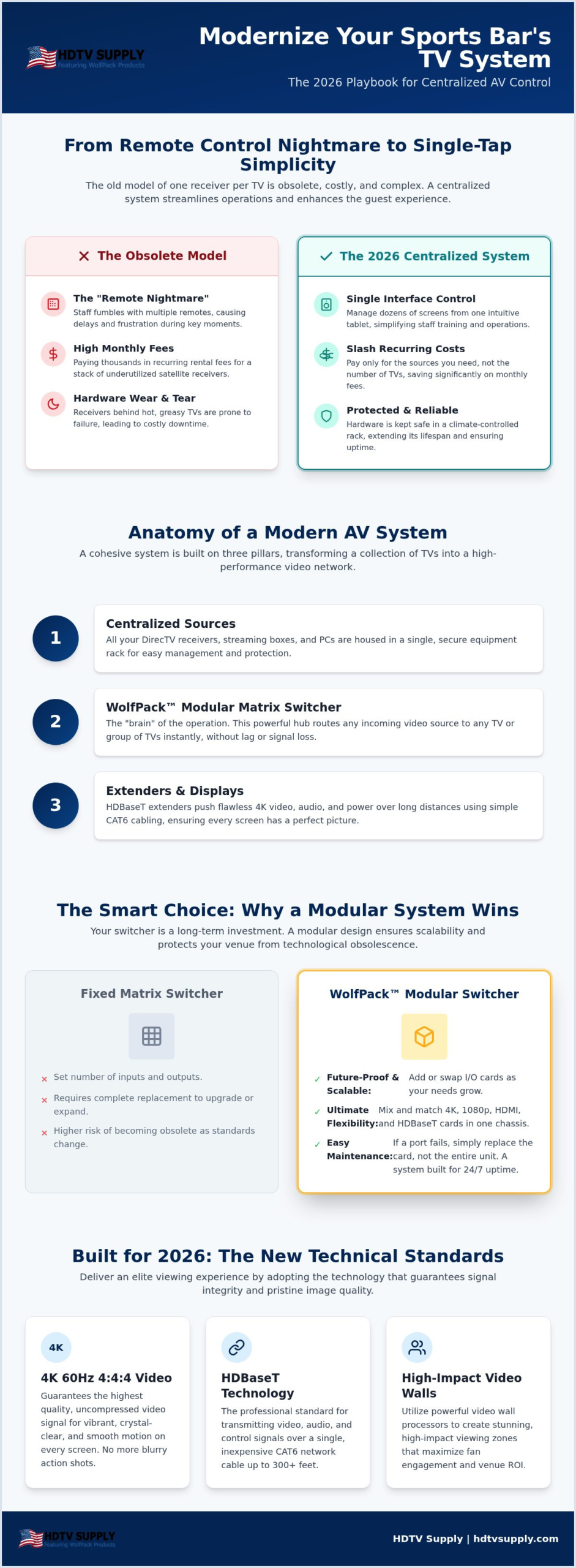
Technical Standards for 2026: 4K 60Hz, HDBaseT, and Signal Integrity
Sports bars in 2026 live or die by motion clarity. 4K at 60Hz has become the non-negotiable baseline for professional venues because it handles the rapid movement of a football or hockey puck without the motion blur seen in older 30Hz systems. Your sports bar TV distribution system must support the full 18Gbps bandwidth required for these signals. If your hardware bottlenecks at 10.2Gbps, your high-end displays will never reach their potential. You’re effectively paying for 4K screens while viewing a sub-par image.
Signal protection is another critical hurdle. Content providers utilize HDCP 2.2 to protect UHD signals. If any single component in your signal chain is outdated, the handshake will fail, resulting in a dreaded “black screen” during a live event. This is a common failure point for bars that attempt to mix legacy extenders with modern 4K sources. Ensuring end-to-end compatibility across your matrix, extenders, and displays is the only way to guarantee uptime during peak hours.
Chroma Subsampling (4:4:4 vs 4:2:0) Explained for Bars
Color compression impacts more than just the vibrancy of the grass on the field. It directly affects the readability of sports tickers, scoreboards, and on-screen text. While 4:2:0 compression is common in consumer gear, it often causes “ghosting” or color bleeding on sharp edges. WolfPackSecure technology is engineered to handle full bandwidth UHD without these artifacts. 4:4:4 provides uncompressed color for every pixel. This technical standard ensures that even the smallest text on a 100-inch display remains razor-sharp for your patrons.
Mastering EDID Management
EDID (Extended Display Identification Data) is the digital handshake that tells a source what resolution to output. Without active management, you’ll fall into the “lowest common denominator” trap. If you have one 1080p TV in a restroom or patio, a basic switcher might force every 4K TV in the building to downscale to 1080p to match it. This wastes your investment in premium hardware.
A professional sports bar TV distribution system allows you to “force” or “emulate” specific resolutions for different zones. You can maintain a 4K 60Hz feed for your main bar displays while simultaneously sending a 1080p signal to auxiliary areas. This granular control is essential for heterogeneous display environments. For a technical deep dive into these settings, review our guide on Mastering HDMI Matrix EDID Management for Pro AV Systems.
Transmission protocols also dictate your venue’s layout. HDBaseT 3.0 is the gold standard for uncompressed, zero-latency transmission over CAT6A cabling up to 328 feet. While AVoIP is an option for massive stadiums, HDBaseT remains the most reliable choice for sports bars needing synchronized video and audio. To secure your signal integrity, explore our WolfPackSecure 4K 60 4:4:4 HDMI Matrix Switchers for a professional-grade solution.
Planning Your Venue: Custom AV Design and Scalability
Strategic placement is about more than just mounting brackets. You need to create viewing zones that cater to different fan bases simultaneously. A centralized sports bar TV distribution system allows you to designate sections of your floor plan for specific games, ensuring that audio and video are synchronized for the right audience. This zoning strategy prevents audio overlap and keeps rival fan bases engaged in their respective corners of the bar. It’s the difference between a chaotic room and an organized sports destination.
Scalability should be baked into your initial hardware purchase. When selecting a WolfPack Modular Matrix Switcher, it’s a mistake to fill every slot on day one. We recommend choosing a larger chassis than your current needs dictate. If you have 24 TVs, install a 32×32 or 40×40 chassis and leave the remaining slots empty. This allows you to add new displays or sources in minutes as your business grows without re-engineering your entire rack or replacing your main switcher.
Creating High-Impact Video Walls
A “Hero Display” acts as the focal point of any top-tier venue. You can turn four 75-inch TVs into one massive 150-inch display using a video wall processor to draw in crowds for major events. Some select WolfPack matrix units include a “Free Video Wall” feature that handles basic 2×2 configurations internally. For more complex layouts or specialized bezel compensation, a dedicated HDMI Video Wall Processor provides the heavy-duty processing power needed for zero-latency, high-bandwidth UHD visuals on a massive scale.
The ROI of Professional AV Distribution
The financial argument for a centralized system is clear when you calculate the “Cable Box Break-even” point. Most venues pay a monthly rental fee for every receiver provided by their service. By consolidating to a sports bar TV distribution system, you reduce your receiver count to match your actual concurrent game needs rather than your total TV count. If you eliminate 15 receivers at typical commercial rates, the hardware often pays for itself in under 18 months through reduced monthly overhead.
Beyond hardware savings, you’re investing in operational efficiency. Staff members no longer waste time troubleshooting individual boxes behind TVs or hunting for lost remotes. This reduction in downtime directly improves the fan experience and allows your team to focus on service. To ensure your layout is optimized for maximum ROI, take advantage of Free Custom AV System Design from HDTV Supply. Our experts help you avoid common pitfalls like improper signal attenuation or under-specced cabling before you commit to a hardware purchase.
Future-Proof Your Venue with Professional AV Architecture
Scaling your sports bar in 2026 demands a shift from hardware management to strategic content distribution. By implementing a centralized sports bar TV distribution system, you eliminate the overhead of redundant receivers and the operational chaos of multiple remotes. Transitioning to 4K 60Hz 4:4:4 standards ensures your venue remains the premier destination for fans who expect uncompromised visual clarity. Modular systems provide the flexibility to swap cards and add displays without a total system overhaul, protecting your long-term investment and ensuring operational ROI.
HDTV Supply provides the technical depth and inventory to simplify this complex integration. We offer Free Custom System Design Services and global technical support to ensure your venue operates at peak efficiency from day one. Our WolfPack modular scalability ensures your system is ready for whatever the next season brings. Take the first step toward a more efficient, profitable floor plan today. Shop WolfPack Sports Bar TV Distribution Systems at HDTV Supply and transform your fan experience.
Frequently Asked Questions
How do I control 30 TVs in my sports bar from a single iPad?
You achieve this by integrating a WolfPad TV control system with your central matrix hardware. The app creates a visual map of your venue on the tablet screen. You simply tap a source and drag it to the desired TV icon to make an instant change. This eliminates the need for infrared remotes and specialized programming. It’s a plug-and-play solution that allows any staff member to manage the entire venue in seconds.
What is the difference between a commercial and consumer TV for a bar?
Commercial displays are engineered for 16/7 or 24/7 operation in high-heat, high-dust environments. They offer significantly higher brightness levels to combat ambient light and include specialized cooling systems. Consumer TVs are designed for only a few hours of daily use and usually have warranties that are voided if used in a business setting. While we don’t sell televisions, we always recommend professional-grade panels for long-term reliability and performance.
Do I need a separate cable box for every TV in my sports bar?
You don’t need a dedicated receiver for every screen when using a centralized sports bar TV distribution system. You only need enough cable or satellite boxes to cover the number of different channels you plan to show at once. For example, a bar with 40 TVs might only need 10 receivers to show all the day’s top games. This strategy slashes your monthly equipment rental fees and simplifies your equipment rack.
What is an HDMI Matrix Switcher and how does it work?
An HDMI Matrix Switcher acts as the electronic brain of your AV setup. It accepts multiple video inputs and routes them to any combination of output displays. Unlike a simple splitter that shows the same image on every screen, a matrix allows for independent routing. You can show one game on ten TVs, another game on five, and a third on the remaining screens. Everything is managed from a single centralized chassis.
How do I integrate streaming services like Everpass into my TV system?
You integrate streaming services by connecting the hardware box directly into an input port on your matrix switcher. The sports bar TV distribution system then treats that streaming feed exactly like a traditional satellite signal. This allows you to push exclusive streaming-only content to any TV in the building without relying on unstable smart TV apps. It ensures a consistent, high-quality viewing experience for high-stakes games and events.
What cable should I use for long-distance HDMI distribution?
For distances exceeding 50 feet, you should utilize shielded CAT6A cabling paired with HDBaseT extenders. This setup allows for uncompressed 4K video and power transmission over a single line. For extremely long runs or 2026-spec 4K 60Hz 4:4:4 signals, active optical HDMI cables are the preferred choice. These cables use fiber optics to prevent signal degradation and electromagnetic interference over distances that would cause traditional copper cables to fail. Our commercial HDMI extender for sports bar guide details exactly which extender technology is right for each cable run length and signal requirement.
Can I show one game on a video wall and different games on other TVs?
Yes, a modular system supports this configuration easily. You can use a dedicated HDMI Video Wall Processor to stitch four or more screens into a single “hero” display for the main event. Simultaneously, the rest of your matrix outputs can continue sending different games to individual TVs throughout the venue. This flexibility allows you to maximize the impact of big games while still catering to fans of other teams in different zones.
What is HDCP 2.2 and why does it matter for my 2026 AV setup?
HDCP 2.2 is the digital handshake required to play protected 4K content. If your matrix or extenders don’t support this standard, your 4K sources will simply display a black screen or downscale to 1080p. In a 2026 AV setup, end-to-end HDCP 2.2 compliance is mandatory to ensure compatibility with the latest receivers and streaming devices. It’s the only way to guarantee your high-end displays actually show the 4K content you’re paying for.
Leave a Reply
Want to join the discussion?Feel free to contribute!