
Commercial HDMI Extender for Sports Bar: 2026 Guide
A standard HDMI cable’s signal quality begins to degrade after just 25 feet. In a high-capacity venue, that is barely enough distance to reach the first booth, let alone a distributed wall of displays. You can’t afford screens blacking out or losing audio sync during the 2026 World Cup. Installing a high-performance commercial hdmi extender for sports bar applications is the only way to ensure every TV receives a pristine, lag-free signal regardless of the cable run’s length.
We understand that managing a complex array of sources and screens is a logistical challenge. You want a system that works every time without requiring a technician on standby for every kickoff. This guide details the critical shift toward HDBaseT 3.0 and AV over IP standards, offering the technical depth needed to eliminate signal drops and troubleshooting headaches. We’ll examine how WolfPack modular systems and WolfPad controls create a stable, future-proof network capable of handling 4K 60Hz and 8K standards. Discover the hardware configurations required to build a zero-latency distribution network that keeps your customers focused on the game.
Key Takeaways
- Learn why standard HDMI cables fail after 25 feet and how to utilize Cat6a or fiber cabling to maintain signal integrity across your entire venue.
- Identify the most reliable commercial hdmi extender for sports bar layouts, from compact single-zone pubs to massive multi-screen entertainment hubs.
- Master technical specifications like 4:4:4 chroma subsampling and sub-millisecond latency to ensure ultra-clear sports tickers and smooth live action.
- Explore the benefits of centralizing your network with WolfPack Modular Matrix Switchers and intuitive WolfPad control systems for effortless screen management.
- Future-proof your infrastructure for the 2026 World Cup by implementing 10G backbones and hardware that supports current 4K 60Hz and emerging 8K standards.
Understanding HDMI Extension Technology for Commercial Venues
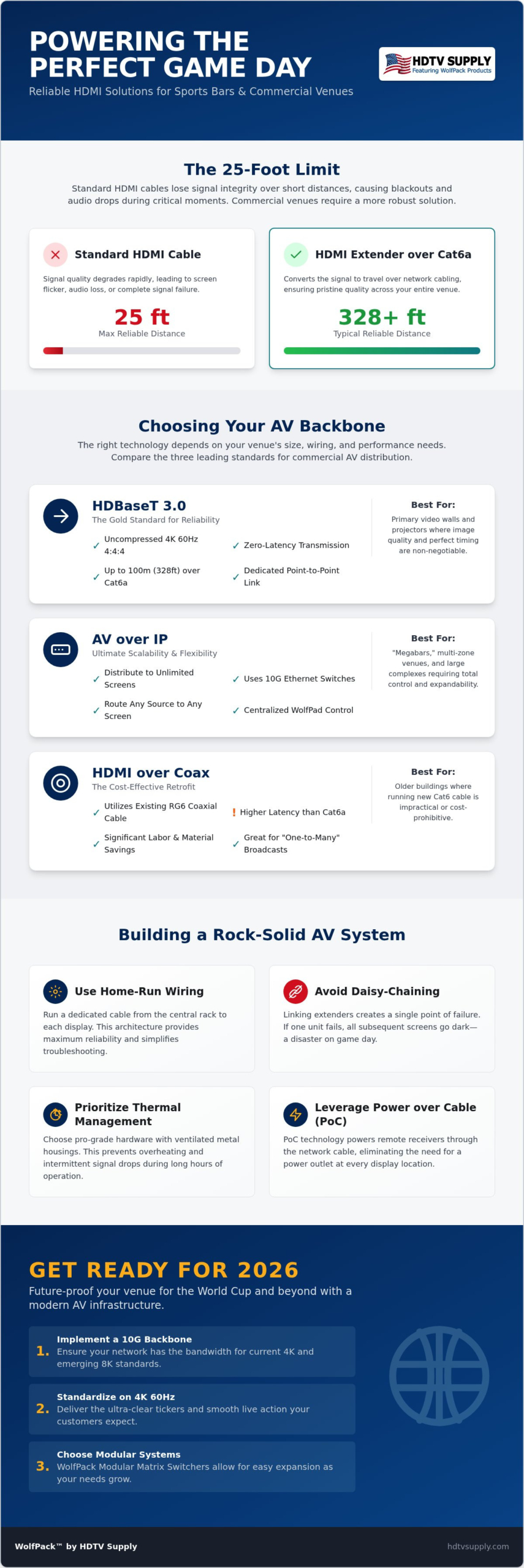
Professional AV systems require more than just a long cable. A standard HDMI cable’s signal quality begins to degrade after 25 feet, leading to the dreaded “blackout” during peak game times. To solve this, a commercial hdmi extender for sports bar environments converts the video signal into a format that travels over Category (Cat5e/6/7) or Coax cabling. This process maintains signal integrity across hundreds of feet, ensuring every fan sees the same play at the same time. While consumer kits might suffice for a home office, they lack the shielding and bandwidth needed for high-interference commercial zones.
Modern HDMI extension technology relies on active circuitry to rebuild the signal at the destination. Passive extenders, which don’t have a dedicated power source, are insufficient for the high-bandwidth demands of 2026 standards. Today’s benchmark is 4K 60Hz with 4:4:4 chroma subsampling and HDCP 2.3 compliance. This ensures that sports tickers and high-speed action remain sharp and clear. WolfPack systems utilize these professional standards to provide a stable alternative to unreliable consumer-grade hardware.
HDBaseT vs. AV over IP: The Battle for the Backbone
Selecting the right backbone depends on your venue’s size and existing infrastructure. HDBaseT Spec 3.0 is the gold standard for uncompressed, zero-latency transmission. It pushes 4K@60Hz 4:4:4 signals up to 100 meters (328 feet) over a single Cat6a cable. It’s the reliable choice for point-to-point runs where timing is critical and you want a dedicated physical link between the source and the display.
AV over IP (AVoIP) offers a different advantage: scalability. By utilizing 10G Ethernet switches, you can distribute video to an unlimited number of screens across a massive complex. While HDBaseT is limited by physical cable distance, AV over IP is limited only by your network’s reach. It’s the preferred architecture for “megabars” that require hundreds of displays and the ability to route any source to any screen via a centralized interface.
HDMI Over Coax: The Retrofit Solution
Renovating an older building often reveals miles of existing RG6 coaxial cable behind the walls. You don’t always need to pull new Cat6 to get a modern result. HDMI over Coax modulators allow you to broadcast a signal to every TV on the premises using that existing wiring. It’s a high-capacity, cost-effective retrofit strategy that saves significantly on labor and material costs.
There’s a trade-off with latency. Coax systems typically introduce more delay than HDBaseT or 10G IP solutions. They’re excellent for “one source to many TVs” scenarios, such as a single pre-game show playing on every screen simultaneously. For high-stakes live sports where every millisecond counts, prioritize modern category cabling to keep your audio and video perfectly synced across the entire network.
Choosing the Best HDMI Extender for Your Bar’s Layout
Your venue’s physical layout is the primary factor in hardware selection. A small neighborhood pub with eight screens has vastly different requirements than a multi-zone “megabar” featuring 50 or more displays. For maximum reliability, we recommend home-run wiring. This architecture ensures each receiver has a dedicated cable back to the central rack. While daisy-chaining might seem convenient for cable management, it creates a single point of failure. If one extender in the chain loses power, every subsequent screen goes dark. In a high-stakes commercial environment, this risk is unacceptable.
Environmental factors also play a critical role in system uptime. In a crowded AV rack, heat is the primary enemy of signal stability. Professional-grade hardware is designed with ventilated metal housings to meet AVIXA performance standards for thermal management. This prevents the intermittent signal drops common in consumer plastic kits that overheat during an eight-hour Saturday shift. Selecting a high-quality commercial hdmi extender for sports bar use means investing in hardware built for 24/7 operation under heavy thermal loads.
Point-to-Point Extenders for Single Feature Displays
High-impact displays, such as 4K projectors or primary video walls behind the main bar, benefit from dedicated point-to-point extenders. These units provide a direct, uncompressed link that ensures the highest possible image quality for your most visible screens. Most of these professional units feature Power over Cable (PoC) technology. PoC is a method to power receivers remotely via the transmitter using the existing category cable. This eliminates the need for unsightly power bricks and extra outlets behind wall-mounted TVs or ceiling-mounted projectors.
One-to-Many Distribution: The Power of AV over IP
If your growth plan involves scaling from 10 to 100 or more TVs, a Sports Bar TV Distribution System based on AV over IP is the most efficient choice. Unlike fixed-port hardware, IP-based systems allow you to add a new receiver for every new TV without replacing your core infrastructure. This architecture relies on managed network switches to prevent signal “ghosting” or data collisions. This limitless scalability is exactly why massive venues like stadiums and casinos prioritize IP-based extension over traditional point-to-point kits. The same AVoIP principles that power sports bars also underpin a robust casino video distribution system, where 200 or more screens must maintain 24/7 uptime across complex floor layouts. If you are currently mapping out a complex floor plan, our experts provide free audio and video design services from HDTV Supply to ensure your hardware matches your venue’s specific scale.
Comparing Performance: Latency, Resolution, and Reliability
Performance in a high-traffic venue is measured by more than just a picture appearing on the screen. For a sports bar, signal reliability and timing are everything. Choosing a commercial hdmi extender for sports bar use requires a deep dive into the technical specifications that separate professional hardware from consumer-grade kits. Adhering to AVIXA audiovisual standards ensures your system maintains peak performance and interoperability during high-traffic events. Reliability isn’t just about avoiding blackouts; it’s about maintaining a consistent, high-quality experience for every patron in the building.
Zero-Latency Requirements for Live Gameplay and Betting
Sports bettors and fanatical fans notice even a 2-second delay. This “Lag Factor” can ruin the atmosphere of your venue if the bar next door cheers for a goal before your screens show the play. HDBaseT technology operates at the physical layer, providing uncompressed transmission with sub-millisecond latency. HDBaseT offers the closest experience to a direct HDMI connection. While many budget IP-based systems use packetization that introduces variable delay, professional HDBaseT extenders ensure that every screen in your network is perfectly synchronized with the live broadcast.
Uncompressed 4K 60Hz: The 2026 Gold Standard
By 2026, 4K 60Hz at 4:4:4 chroma subsampling has become the professional benchmark for sports distribution. Standard 4:2:0 subsampling compresses color data, which often results in blurry text on sports tickers, betting odds, or player stats. WolfPack systems prioritize uncompressed 18Gbps video distribution to keep every score line perfectly sharp. To manage these high-bandwidth signals effectively, many installers pair these extenders with Modular HDMI Matrix Switchers: 2026 Pro AV Guide. This combination allows for precise control over resolution and signal routing across massive multi-screen networks.
Content protection and display communication are equally vital for system uptime. HDCP 2.3 compliance is mandatory to ensure modern 4K content isn’t blocked by digital rights management (DRM). Additionally, robust EDID management prevents a “lowest common denominator” resolution scenario. Without individual EDID control, a single older 1080p TV in your network could force every high-end 4K screen to downgrade its resolution. Professional extenders allow you to manage the “handshake” with each display independently, maintaining the highest possible resolution for every screen in the building regardless of the mixed hardware environment.
Integration and Control: Managing Your Extenders Seamlessly
Extenders are the delivery vehicles for your video signal, but they are only half the battle. A central matrix acts as the nervous system for your entire AV network. Selecting a commercial hdmi extender for sports bar use is only effective if it integrates flawlessly with your routing hardware. Without a centralized brain, your staff is forced to manually troubleshoot individual displays, leading to missed plays and frustrated customers. A unified system allows for remote monitoring. This means you can detect if a screen is down or a signal is dropping before your patrons even notice a blackout.
Efficiency is the primary goal for any high-volume venue. We focus on simplifying the “Bartender Experience” by implementing one-touch switching for game days. This removes the technical burden from your floor staff. It allows them to focus on service rather than AV troubleshooting. A well-integrated system ensures that shifting from the pre-game show to the main event takes seconds. No more fumbling with cords or complex settings in the middle of a rush.
WolfPack Modular Matrix Integration
WolfPack systems utilize internal extender cards that slide directly into a modular chassis. This approach significantly reduces rack space. It also minimizes the points of failure common with external power supplies and patch cables. You can mix and match HDBaseT, Fiber, and HDMI outputs within a single unit to accommodate various cable run lengths across your facility. For a deeper look at specific hardware configurations, read our guide on the Best Matrix Switcher for Sports Bar: 2026 Professional Roundup.
Tablet Control via WolfPad TV Systems
The days of the “bucket of remotes” are over. WolfPad TV Control Systems replace dozens of plastic controllers with a single, intuitive iPad interface. This system provides immediate visual feedback. You see exactly what content is playing on every TV from the palm of your hand. It eliminates the guesswork of routing signals in a dark, loud environment. Learn more about managing large-scale setups in How to Control 30 TVs from an iPad: The Professional Venue Guide (2026).
System integration is the difference between a collection of TVs and a professional sports entertainment network. If you need a reliable backbone for your venue, explore our Sports Bar TV Distribution System options to find the perfect fit for your layout.
Designing Your 2026 World Cup Ready AV System
Designing a video network for the 2026 World Cup requires immediate planning and technical precision. You can’t rely on guesswork when thousands of fans are watching. Follow these four steps to build a distribution network that handles the pressure of a global event without signal failure. Every component, from the source to the commercial hdmi extender for sports bar receivers, must be part of a cohesive, high-capacity architecture.
- Step 1: Map your venue. Identify every TV location and measure the exact cable run distances. Account for vertical rises and turns in the ceiling.
- Step 2: Select your backbone. Deploy Cat6a for uncompressed HDBaseT 3.0 runs or 10G Fiber for massive AV over IP distribution.
- Step 3: Plan for expansion. Always leave 20% “dark” capacity in your matrix switchers and cable trays. This allows you to add new displays or sources without overhauling your core infrastructure.
- Step 4: Consult the experts. Leverage the free audio and video design services from HDTV Supply to ensure your hardware matches your venue’s specific requirements.
Future-Proofing with HDBaseT 3.0 and 10G Networks
The late 2020s will bring a shift toward 8K resolution and high-frame-rate (HFR) content. Over-speccing your cabling now is the cheapest insurance policy you can buy. While Cat6 might work for current 4K 30Hz signals, it will fail under the bandwidth requirements of future standards. Uncompressed video is the gold standard in high-end hospitality. It provides the clarity and zero-latency performance that fanatical sports fans demand. By installing a high-bandwidth commercial hdmi extender for sports bar system today, you avoid the high labor costs of re-pulling cable in three years.
Professional Support and Bulk Ordering
Buying professional AV hardware from a specialized retailer offers significant advantages over general e-commerce platforms. We provide global technical support for installers and extended warranties designed for high-traffic, 24/7 commercial environments. When you order a Sports Bar TV Distribution System, you aren’t just buying parts; you’re securing a stable, global hub of expertise. Our team understands the nuances of system architecture and compatibility, ensuring your installation is ready for the first kickoff.
Explore WolfPack HDMI Extenders and Custom Sports Bar Solutions to begin building your professional video network today.
Secure Your Venue’s Digital Infrastructure for 2026
Reliability in a high-stakes sports environment is the result of intentional system architecture. Selecting the right commercial hdmi extender for sports bar applications is the difference between a seamless game day and a troubleshooting disaster. By prioritizing HDBaseT 3.0 for zero-latency runs or 10G AV over IP for massive scalability, you ensure your screens are ready for the 2026 World Cup and beyond. Centralizing these signals through specialized WolfPack hardware provides the professional stability required for 24/7 operation in high-traffic zones.
Don’t leave your video network to chance. Transitioning to uncompressed 4K 60Hz standards protects your investment and satisfies the most demanding sports fans. Our team provides global technical support and expertise to help you navigate these complex technical requirements. Get a Free Custom Sports Bar AV Design from HDTV Supply and leverage our free expert system layouts to build a future-proof venue today. Your fans deserve a blackout-free experience; we have the tools to deliver it.
Frequently Asked Questions
How far can I run an HDMI signal in a sports bar using an extender?
HDBaseT Spec 3.0 supports uncompressed 4K@60Hz signals up to 100 meters, which is approximately 328 feet, over a single CAT6a cable. If your venue requires greater distances, AV over IP solutions offer theoretically unlimited range by routing signals through network switches. Using a professional commercial hdmi extender for sports bar layouts is the only way to bypass the 25-foot limit of standard HDMI cables.
What is the difference between HDBaseT and AV over IP for live sports?
HDBaseT provides a dedicated physical layer connection with sub-millisecond latency, offering the closest experience to a direct HDMI cable. AV over IP uses packet-based distribution over 10G network switches, which allows for massive scalability. While HDBaseT is the gold standard for uncompressed, zero-lag performance, AV over IP is the preferred architecture for “megabars” that need to distribute video to hundreds of displays simultaneously.
Do I need a special network switch for HDMI over IP extenders?
Yes, you must utilize a managed 1G or 10G Layer 3 switch that supports IGMP snooping and Jumbo Frames. Unmanaged consumer switches cannot handle the high-bandwidth multicast traffic generated by 4K video distribution. This leads to signal dropouts and complete network congestion. Professional systems require these specific configurations to ensure your video data doesn’t interfere with your bar’s point-of-sale or guest Wi-Fi networks.
Why are some of my TVs slightly behind others during a live broadcast?
This “lag factor” typically occurs when different extension technologies or processing speeds are mixed within the same network. If one TV uses a zero-latency HDBaseT extender and another uses a budget IP-based modulator, the packetization delay on the IP unit causes a sync issue. Implementing a unified commercial hdmi extender for sports bar layout with a WolfPack matrix ensures every screen in the building remains perfectly synchronized.
Can I use existing Coax cables for 4K HDMI extension?
You can leverage existing RG6 cabling by implementing HDMI over Coax modulators. This is an efficient, cost-effective retrofit strategy for older buildings where pulling new Cat6a is physically impossible or too expensive. While Coax systems often introduce more latency than HDBaseT or fiber-based IP solutions, they’re highly reliable for broadcasting a single source to a massive number of displays across a large commercial facility.
What is PoC (Power over Cable) and why is it important for bars?
PoC technology allows the transmitter to send electrical power to the receiver over the same Category cable used for video data. This is vital for sports bars because it eliminates the need for bulky power adapters behind every wall-mounted TV. It simplifies your installation and reduces potential failure points. By using PoC-enabled hardware, you keep your display areas clean and professional without requiring extra electrical outlets at every screen.
How do I prevent my HDMI extenders from overheating in a rack?
Select extenders with ventilated metal housings and prioritize rack-mountable modular cards for your central system. Modular WolfPack systems integrate extender cards directly into a fan-cooled chassis, which is much more effective than stacking individual plastic units. Ensure your AV rack has at least 1U of spacing between high-density components. Use active ventilation to maintain a stable operating temperature during long game-day shifts when hardware runs at peak capacity.
Is there a limit to how many TVs I can add to an AV over IP system?
There is no hard physical limit to the number of displays in a properly configured AV over IP architecture. You can scale from 10 TVs to over 100 simply by adding more receivers and expanding your network switch capacity. This modularity makes IP-based distribution the primary choice for stadiums and casinos. As long as your network backbone has the necessary 10G bandwidth, you can continue adding displays without replacing your core hardware. For environments that demand even greater density and mission-critical uptime, the same architecture powers a full-scale casino video distribution system capable of managing hundreds of screens across an entire gaming floor.
Leave a Reply
Want to join the discussion?Feel free to contribute!