
Casino Video Distribution: 2026 Guide to Large-Scale AV
Maintaining 24/7 uptime on a casino floor with 200 screens isn’t just an IT challenge; it’s a mission-critical operation where a single black screen impacts the bottom line. You’ve likely dealt with the headache of signal degradation over long cable runs or the sheer complexity of routing 100 different sources to a massive array of displays. It’s frustrating when every minor system adjustment requires an expensive programmer and hours of downtime. You need a casino video distribution system that’s both robust enough for a stadium and simple enough for floor staff to manage via a tablet.
This 2026 guide provides the blueprint for designing high-density video networks that prioritize reliability and scalability. You’ll learn how to implement modular matrix switchers and AVoIP technology to achieve crystal-clear 4K video at every endpoint without the traditional technical overhead. We’ll explore how WolfPack hardware and WolfPad control systems allow you to build a custom, redundant architecture that handles hundreds of I/O points with ease. From expanding your sports book to managing a complex video wall, this technical breakdown covers the hardware and strategy needed for a future-proof installation.
Key Takeaways
- Architect a robust casino video distribution system capable of routing hundreds of 4K sources with zero signal degradation across vast floor plans.
- Evaluate the scalability of AVoIP versus the infrastructure requirements of RF modulation to determine the best fit for your venue’s network.
- Future-proof your hardware investment with WolfPack modular matrix switchers that support hot-swappable I/O cards for seamless technology upgrades.
- Eliminate the need for expensive custom programming by implementing WolfPad tablet-based interfaces for intuitive, real-time control of 100+ screens.
- Leverage free custom AV design services and direct sourcing to optimize system reliability while reducing traditional equipment markups.
What is a Casino Video Distribution System?
A casino video distribution system is a mission-critical infrastructure requiring 24/7 uptime and modular flexibility. This technology serves as a centralized network designed to route dozens or even hundreds of video sources to a vast array of displays across a gaming floor or stadium. Whether you’re distributing live sports, real-time betting odds, or high-impact digital signage, the architecture must maintain perfect signal integrity. It’s the backbone of the visual experience in any large-scale entertainment venue.
Core components of these systems include WolfPack Modular Matrix Switchers, encoders, decoders, and a centralized control interface like the WolfPad. Because casino environments often span tens of thousands of square feet, the hardware must handle long-distance signal transmission of 330ft or more without introducing visible latency. Reliability is the primary objective. If a display goes dark during a major betting event, the loss of revenue and engagement is immediate. You need a system that functions with the same industrial-grade stability as the gaming machines it surrounds.
Key Requirements for Casino and Stadium Environments
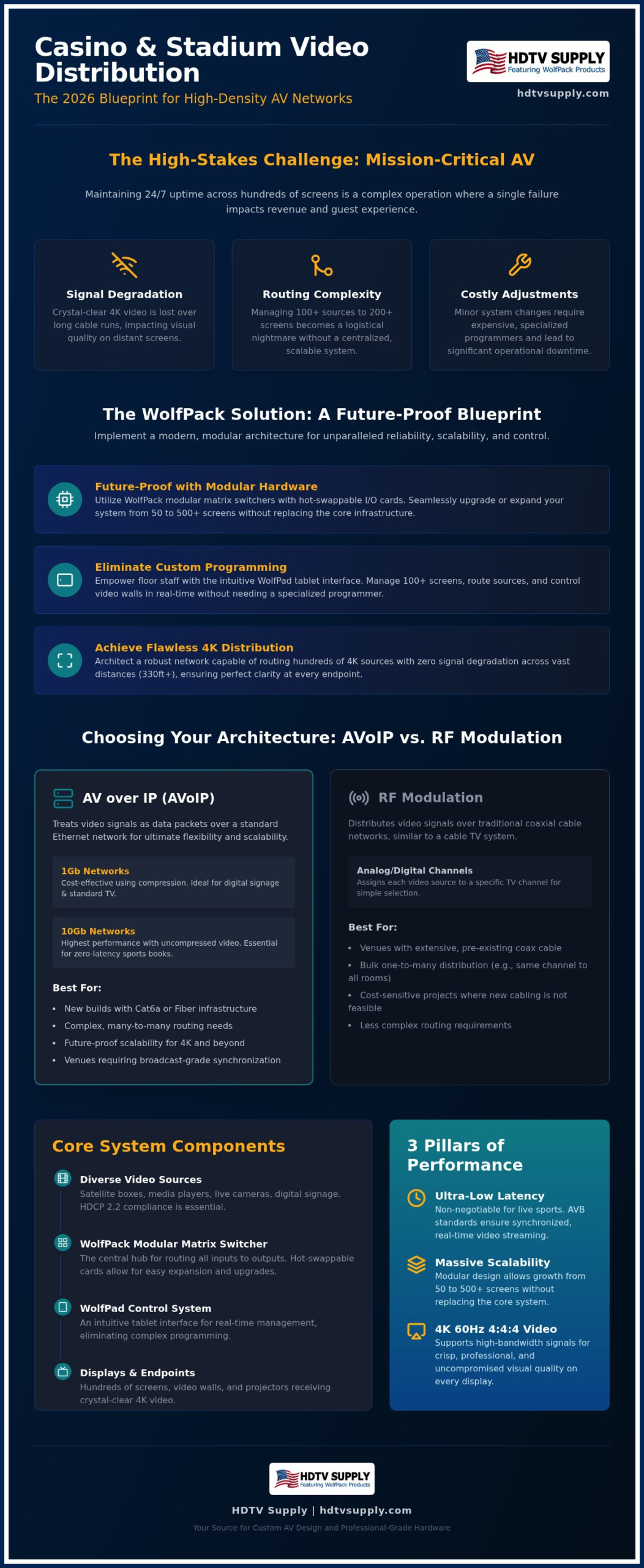
Performance in high-density environments depends on three technical pillars. First, ultra-low latency is non-negotiable for live sports and gaming events where every second counts. To achieve this, many modern architectures align with Audio Video Bridging (AVB) standards to ensure synchronized, low-latency streaming over standard Ethernet networks. This prevents the “cheer from the bar” happening before the action reaches the screens in the lounge.
Second, the system must offer massive scalability. A venue might start with 50 screens but eventually grow to 500. A modular approach allows for this expansion without replacing the entire core rack. Third, the hardware must support high-bandwidth 4K 60Hz 4:4:4 video signals. This ensures that the latest high-resolution content looks crisp and professional on every display, regardless of its distance from the source rack. Compression should be invisible to the naked eye.
The Role of Source Management
Effective distribution requires sophisticated management of diverse inputs. Your rack likely contains a mix of satellite boxes, dedicated media players, and live camera feeds. A professional casino video distribution system ensures all these sources are routed correctly while maintaining strict HDCP 2.2 compliance. Without this compliance, protected content from premium sports channels or movie studios won’t play, resulting in costly downtime.
Beyond entertainment, these systems integrate digital signage for promotions and emergency alerts. The ability to override every screen in the building for a jackpot celebration or a safety announcement is a vital operational feature. By centralizing these feeds, operators can manage the entire visual landscape from a single, intuitive interface. This level of control turns a collection of monitors into a cohesive communication tool.
AVoIP vs. RF Modulation: Choosing the Right Architecture
Selecting the backbone for your casino video distribution system requires a clear understanding of your venue’s physical infrastructure and long-term performance goals. Most modern facilities navigate a choice between AV over IP (AVoIP) and traditional RF Modulation. While AVoIP offers the highest level of flexibility, RF remains a powerhouse for bulk distribution over legacy coax. Your decision impacts everything from installation costs to the ability to deploy future-proof 4K content across the gaming floor.
AVoIP systems treat video signals as data packets on a standard Ethernet network. Using 1Gb or 10Gb switches, these networks provide virtually unlimited scalability. For professional environments, aligning with SMPTE standards for professional media ensures your IP-based architecture meets broadcast-grade synchronization and reliability metrics. This is particularly critical when managing high-resolution feeds across a stadium or multiple casino floors where timing is everything.
- 1Gb Networks: Highly cost-effective; utilizes compression like JPEG2000 to fit 4K video into standard pipes; ideal for general signage and standard TV distribution.
- 10Gb Networks: Highest performance; supports uncompressed or lightly compressed video; essential for zero-latency sports book environments where visual clarity is paramount.
When to Choose AV over IP
AV over IP is the superior choice for new builds where Cat6a or Fiber can be installed from the ground up. It’s specifically designed for many-to-many switching, allowing any source to reach any display instantly. If your venue requires complex video wall processing or multiview capabilities, AVoIP provides the necessary bandwidth and processing power. It supports advanced features like seamless switching, where transitions between sources occur without a black screen or flicker. For specialized sports books, this technology is essential for maintaining the visual quality of high-motion 4K 60Hz content.
The Case for RF Modulation and Coax
RF Modulation is often the most cost-effective solution for distributing basic television feeds to hundreds of screens simultaneously. It’s the ideal architecture for older casinos where pulling new Ethernet cable is physically difficult or cost-prohibitive. By utilizing existing coaxial infrastructure, you can deliver HD content without a massive overhaul of the building’s wiring. For a deeper technical dive into this method, consult the professional guide to HDMI modulators.
While RF lacks the many-to-many flexibility of IP, it excels in reliability for one-to-many broadcast scenarios. If you’re unsure which path fits your specific floor plan, you can request a free custom AV design from our engineering team to evaluate your options. Balancing these two technologies often results in a hybrid approach that maximizes both performance and budget efficiency.
The Benefits of Modular HDMI Matrix Switchers
Modular architecture is the gold standard for any high-stakes casino video distribution system. In an environment where every minute of downtime equals lost revenue, the ability to service hardware without taking the entire network offline is a critical advantage. Unlike fixed-chassis systems that require a full unit replacement if a single component fails, modular designs offer granular control. You can replace or upgrade specific components while the rest of the system remains operational. This design philosophy eliminates the catastrophic single point of failure that plagues cheaper, non-modular alternatives.
Investing in this technology provides long-term security against shifting standards. You can swap HDMI cards for SDI, Fiber, or HDBaseT as your venue’s technology evolves. If a single port fails on a massive 64×64 chassis, you don’t need to replace the entire unit. You simply slide out the affected card and insert a new one in seconds. It’s a pragmatic approach to hardware that prioritizes uptime. Modular HDMI matrix switchers provide the highest ROI for large venues by extending the lifecycle of the core infrastructure and reducing the need for total system overhauls.
Scalability for Stadiums and Large Venues
Scale is a defining factor in modern casino AV. Chassis sizes typically range from 16×16 to 160×160 and beyond, providing the density required for massive floor plans. Operators can mix and match signal types within a single box to accommodate different display requirements. For example, you might use Fiber cards for long-distance stadium runs and HDMI cards for local sportsbook displays. For truly massive installations, multiple matrix switchers can be linked. This creates a unified casino video distribution system that spans the entire property, from the hotel lobby to the high-limit lounge.
Reliability and 24/7 Performance
Reliability isn’t just a feature; it’s an operational requirement. WolfPack modular systems feature dual redundant power supplies to prevent system-wide failure if one unit loses power. Advanced cooling systems are integrated into the chassis to handle the heat generated in dense, 24/7 rack-room environments. Integrated EDID management ensures every screen displays the correct resolution instantly. This prevents the “handshake” issues that often plague large-scale deployments, ensuring that your screens never go dark during a critical game or event. It’s the dependable choice for technicians who value system integration and results.
Control Systems: Managing 100+ Screens Seamlessly
Managing a high-density casino video distribution system shouldn’t require a degree in computer science for your floor staff. Historically, large-scale venues relied on complex control systems that demanded expensive, specialized programming. Every time a new source was added or a display was moved, a certified programmer had to be called on-site. This created a bottleneck that hindered operational agility and significantly increased the total cost of ownership over the life of the system. In a 24/7 environment, waiting for a programming update isn’t a viable strategy.
The industry has shifted toward a “no-programming” revolution. Modern tablet-based interfaces allow operators to visualize the entire floor plan and manage content with simple gestures. Instead of typing lines of code, you simply drag a source icon to a display icon on an iPad. This intuitive approach ensures that any staff member can update the sportsbook or high-limit lounge in seconds. You can learn exactly how to control 30 TVs from an iPad using the WolfPad system, which eliminates the need for traditional, high-cost programming while maintaining professional-grade reliability.
WolfPad TV Control for Casino Staff
Floor staff need a user-friendly interface that requires zero technical training to operate during a busy shift. The WolfPad system provides this by simplifying complex routing into a visual map of the venue. Managers can create custom “scenes” for different times of day or specific events. For example, a “Morning Odds” scene can instantly route betting lines to every screen, while an “Evening Sports” scene switches to live game feeds with one tap. To maintain system integrity, secure access levels ensure that only authorized personnel can change sources in sensitive areas, preventing accidental disruptions.
Web GUI and Remote Management
While staff use tablets on the floor, IT professionals need deeper access for system maintenance. Any modern casino video distribution system should offer a robust Web GUI accessible via any standard browser. This allows for remote troubleshooting from a back office or even off-site. You can monitor signal status and port connectivity in real time to identify potential cable issues before they affect the guest experience. Cloud-based updates and system health alerts provide an additional layer of security, ensuring your hardware is always running the latest firmware and operating at peak efficiency.
If you’re ready to move away from expensive, proprietary programming, explore our WolfPad control solutions to see how we streamline complex AV management for large venues.
Designing Your System with HDTV Supply
Implementing a professional casino video distribution system requires more than just high-end hardware; it demands a strategic partnership with a supplier that understands the rigors of 24/7 commercial environments. Direct sourcing of AV equipment from HDTV Supply allows casinos and stadiums to bypass traditional dealer markups, saving thousands in project costs. This efficiency-driven approach ensures that your budget is spent on superior system architecture rather than middleman fees. We’ve built our reputation on providing immediate solutions to technical challenges, ensuring that your procurement process is as fast-paced as your floor operations.
With over 28 years of professional AV expertise since our founding in 1998, we function as a high-volume distributor and a reliable consultant for complex integrations. For high-use commercial hardware, we emphasize the importance of extended warranties. These protections are essential for mission-critical systems where equipment runs constantly. You can secure a free custom AV system design for your stadium or casino by working directly with our engineering team to map out your specific technical requirements. This service helps you avoid common pitfalls like signal latency or incompatible handshakes before you ever make a purchase.
Custom System Configuration
Every venue has unique challenges, from cable path limitations to specific display array configurations. Our specialists work with you to build a custom WolfPack matrix chassis tailored to your exact input and output counts. We help you select the precise mix of transmitters and receivers needed to bridge long distances without signal loss, whether you’re using Fiber, Cat6, or Coax. Before any hardware leaves our facility, we ensure all components are tested for compatibility. This rigorous pre-shipment verification reduces installation friction and guarantees that the system performs as expected the moment it’s racked. It’s about providing a “one-stop” resource that values technical mastery over aesthetic marketing.
Ongoing Support and Technical Resources
A successful deployment doesn’t end when the hardware arrives. We provide toll-free technical support specifically for installers and integrators who are navigating the nuances of large-scale networks. Our clients gain access to a comprehensive library of “How-to” guides and troubleshooting videos designed for quick reference in the field. This repository of technical knowledge helps your team resolve issues fast, maintaining the 24/7 uptime that a modern casino video distribution system demands. Before finalizing your equipment list, consider taking advantage of the free audio and video design services from HDTV Supply to map out signal flow, cable distances, and resolution requirements before any hardware is purchased. We prioritize practical application and system integration, giving you the tools to manage your network with total confidence.
Contact HDTV Supply today for your free stadium AV design! Our pragmatic experts are ready to help you integrate a scalable, results-oriented solution that grows with your venue.
Future-Proof Your Venue with High-Density Video Architecture
Building a casino video distribution system that stands the test of time requires a commitment to modularity and user-centric control. By prioritizing hot-swappable hardware and no-programming tablet interfaces, you eliminate the technical bottlenecks that traditionally plague large-scale venues. Whether you’re integrating AVoIP for uncompressed 4K or leveraging RF for legacy coax, the goal remains 24/7 reliability and zero-latency performance across every screen on your floor. You’ve seen how modular architecture and intuitive management turn complex routing into a streamlined, operational asset.
HDTV Supply offers the specialized expertise needed to navigate these complex requirements with our WolfPack 24/7 reliability and a massive catalog of 12,000+ Pro AV products in stock. We remove the guesswork from your next installation with our Free Custom AV Design Services, ensuring every endpoint delivers crystal-clear content without the high cost of custom programming. Our team is ready to provide immediate solutions for your most challenging technical requirements.
Browse Professional Video Distribution Systems at HDTV Supply and take the first step toward a more efficient, scalable media network today. We’re ready to help you build a system that grows alongside your business.
Frequently Asked Questions
How many TVs can a casino video distribution system handle?
A modern visual network can handle hundreds or even thousands of displays depending on the chosen architecture. While fixed-chassis systems have hard limits, modular WolfPack matrix switchers scale up to 160×160 I/O points in a single frame. For even larger deployments, AVoIP (Audio Video over IP) allows for virtually unlimited expansion by adding more network switches and decoders. This flexibility ensures your system grows alongside your gaming floor or stadium requirements.
What is the best way to distribute 4K video over 300 feet?
Distributing 4K video over distances exceeding 300 feet is best achieved using Fiber optic extenders or high-performance AVoIP solutions. Standard HDMI cables fail at these lengths due to signal attenuation. By converting the HDMI signal to Fiber or data packets over Cat6a, you maintain 4K 60Hz 4:4:4 integrity without latency. This approach is standard for large-scale venues where the central rack room is located far from the actual displays on the floor.
Do I need a professional programmer for a WolfPack matrix switcher?
You don’t need a professional programmer to manage a WolfPack matrix switcher when using the WolfPad control system. Traditional systems from legacy brands often require expensive custom coding for every change. In contrast, WolfPad offers a no-programming tablet interface that allows staff to route sources and manage screens through an intuitive drag-and-drop map. This reduces long-term costs and gives your team immediate control over the visual environment.
What is the difference between HDBaseT and AVoIP for stadiums?
HDBaseT is a point-to-point technology that sends uncompressed video over a single Cat6 cable, making it ideal for dedicated, high-speed connections. AVoIP utilizes your existing or dedicated network infrastructure to route video as data packets. For stadiums, AVoIP is often preferred because it offers superior scalability and allows for easier management of hundreds of endpoints across a massive facility. Both technologies support 4K, but AVoIP provides more flexibility for complex routing.
Can I control multiple video walls from a single tablet?
Yes, you can control multiple video walls and individual displays from a single tablet using the WolfPad interface. The system allows you to group displays into specific zones or treat a cluster of screens as a unified video wall. You can change layouts, switch sources, and adjust volume across different areas of the casino instantly. This centralized control is essential for creating high-impact visual moments during jackpots or major sporting events.
How does a modular matrix switcher prevent venue downtime?
A modular matrix switcher prevents venue downtime through its hot-swappable design and redundant components. If an individual input or output port fails, you simply replace the specific card without powering down the entire chassis. WolfPack systems include dual redundant power supplies to bolster reliability. If one power unit fails, the secondary unit takes over instantly. This hardware redundancy ensures that your casino video distribution system remains operational 24/7, even during maintenance or component failures.
Is HDCP 2.2 required for casino video systems?
HDCP 2.2 is absolutely required for modern systems that distribute 4K protected content from sources like satellite boxes or media players. If any component in your distribution chain isn’t compliant, the screen will likely display an error or remain black. Ensuring end-to-end compliance is a critical step in the design process. Every WolfPackSecure matrix switcher is built with these standards in mind to guarantee seamless playback across your casino video distribution system.
Can I mix different TV brands in a large distribution network?
You can mix different TV brands in a large distribution network, provided your matrix switcher has robust EDID management. Different displays have different resolution and timing requirements. A professional switcher like the WolfPack handles these handshakes automatically, ensuring the source sends a signal that every brand can display correctly. While mixing brands is possible, using displays with similar resolutions helps maintain a consistent visual experience across your casino or stadium floor.
Leave a Reply
Want to join the discussion?Feel free to contribute!