
Best Matrix Switcher for Sports Bar: 2026 Professional Roundup
The most critical piece of equipment in your venue isn’t the tap system; it’s the digital backbone that prevents a black screen during the final two minutes of a tied game. With the 2026 shift toward streaming-based delivery for commercial NFL Sunday Ticket through EverPass, your distribution system must handle high-bandwidth 4K signals without the lag or complexity of legacy hardware. You need a solution that empowers a busy bartender to manage 50 screens from a single interface without a single minute of technical training.
We understand that staff struggling with a dozen different remotes and proprietary control systems is a recipe for disaster during peak hours. That’s why finding the best matrix switcher for sports bar applications requires a focus on modular reliability and seamless integration. In this professional roundup, we examine the top-rated HDMI matrix switchers designed for zero-latency performance and one-touch iPad control. You’ll discover how WolfPack modular systems and WolfPad control interfaces provide a scalable, high-capacity solution that eliminates signal dropouts and simplifies your entire AV architecture for the 2026 season and beyond. We provide the technical specifications and system architecture insights you need to build a future-proof entertainment hub.
Key Takeaways
- Understand the fundamental difference between fixed and modular architectures to identify the best matrix switcher for sports bar environments based on your specific I/O requirements.
- Prioritize 4K 60Hz 4:4:4 chroma subsampling and HDBaseT integration to ensure crisp sports tickers and reliable signal transmission over long cable runs.
- Discover how “no-programming” iPad control interfaces like WolfPad eliminate the need for expensive proprietary control systems and simplify staff training.
- Learn the step-by-step process for auditing your current source variety and display count while planning for 20% future growth.
- Evaluate the benefits of WolfPackSecure modular systems for achieving zero-latency switching and high-bandwidth reliability in high-traffic commercial venues.
Why Matrix Switchers are the Heart of a Modern Sports Bar
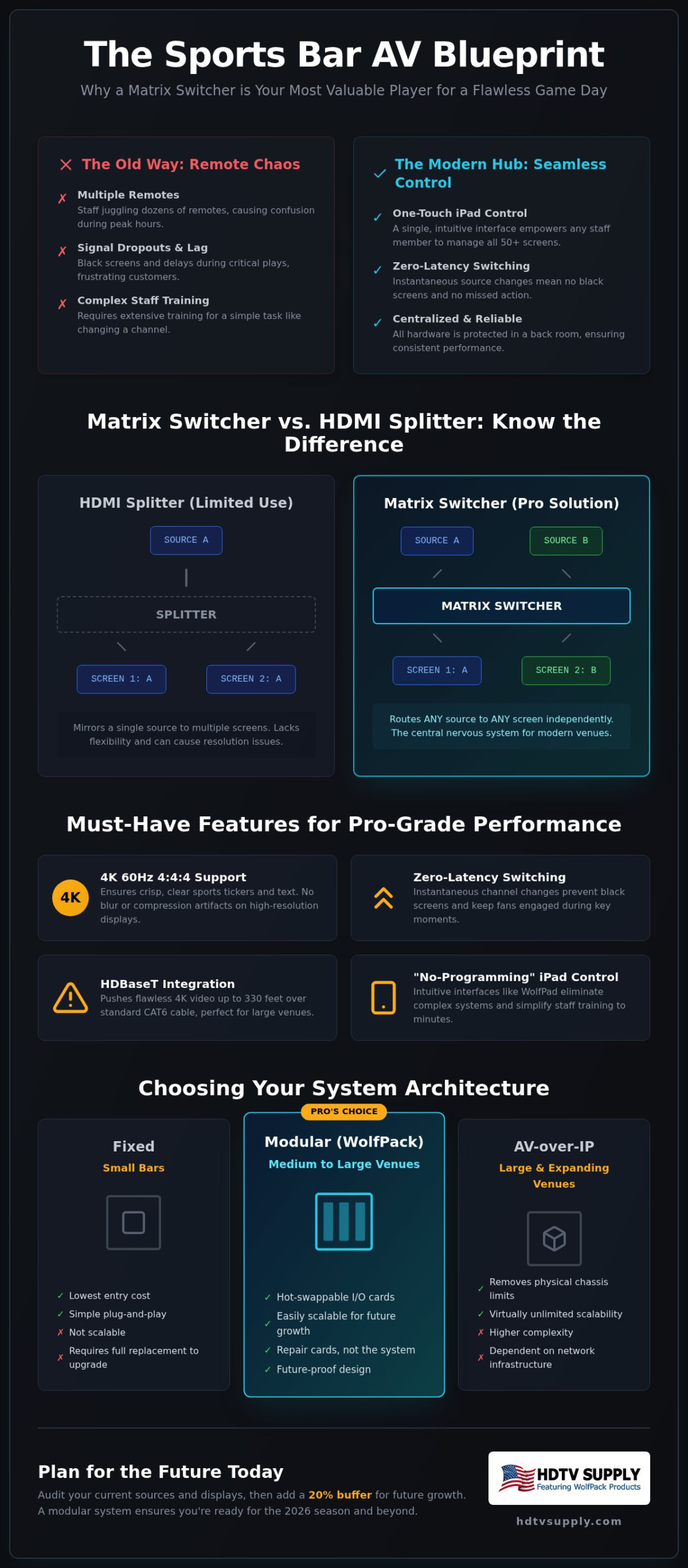
A matrix switcher is the central nervous system of your venue’s visual entertainment. Unlike a standard switch that simply toggles sources, a matrix provides independent routing. This means you can send a DirecTV feed to your main bar area, the NFL RedZone channel to your booths, and digital signage to your patio, all from a single piece of hardware. This flexibility is what defines the best matrix switcher for sports bar environments. It transforms a collection of disconnected screens into a cohesive, manageable network.
Centralizing your hardware in a back-of-house rack eliminates the “remote control chaos” that plagues many establishments. Instead of bartenders running around with five different remotes trying to hit an IR sensor on a high-mounted TV, all receivers and streaming boxes stay in one location. This setup preserves your interior aesthetics and protects expensive equipment from the heat and spills of a high-traffic bar. High-performance systems also solve the physical limitations of HDMI cabling. Standard copper cables often fail or drop signals beyond 50 feet. Professional matrix switchers utilize HDBaseT technology to push 4K video over CAT6 cables up to 330 feet, ensuring signal integrity across the largest floor plans.
Matrix Switcher vs. HDMI Splitter: Know the Difference
Relying on HDMI splitters is a common mistake for new owners. A splitter takes one source and mirrors it across multiple displays. It lacks the intelligence to handle different resolutions or content. A professional matrix switcher uses robust EDID management to communicate with every display individually. This ensures that a 4K screen at the bar receives a full UHD signal even if a legacy 1080p TV is connected elsewhere in the system. Investing in a matrix during your initial build-out prevents the high cost of tearing out cables and replacing hardware when you inevitably need to show multiple games at once.
The Impact of Zero-Latency Switching on Customer Experience
Patrons come to your bar for the atmosphere and the action. If a source change results in a five-second black screen, you’ve failed the customer experience. Professional-grade switchers prioritize zero-latency switching. They handle the complex HDCP handshaking process faster than any consumer-grade gear. This ensures that when a bartender switches a 16-screen video wall from a pre-game show to the kickoff, the transition is instantaneous. In a competitive market, providing seamless visual transitions keeps fans engaged and prevents them from missing the key plays that define the game.
Evaluating the Top 3 Sports Bar Video Distribution Architectures
Selecting the right architecture depends on your current display count and your five-year expansion plan. For most venues, the best matrix switcher for sports bar applications falls into one of three categories: fixed, modular, or IP-based. Each offers a specific balance of cost, reliability, and installation speed. Understanding these differences prevents the common mistake of buying a system that you’ll outgrow within a single season.
Fixed configuration switchers come with a predetermined number of inputs and outputs, such as 8×8 or 16×16. They’re ideal for small neighborhood bars with a set number of TVs. While they offer the lowest entry cost and simple plug-and-play setup, they lack scalability. If you decide to add a 17th TV to a 16×16 system, you’ll likely need to replace the entire chassis. For venues that prioritize uptime and flexibility, moving toward a customizable solution is often the smarter financial move.
Modular Matrix Switchers: Why Pros Choose WolfPack
Modular systems are the industry standard for medium to large venues. Unlike fixed units, WolfPack Modular Matrix Switchers utilize a chassis with customizable I/O cards. This “hot-swappable” design means you can mix HDMI, HDBaseT, and SDI inputs based on your specific source needs. If a single port fails, you replace a card rather than the whole system, preventing total downtime during a big game. This modularity also allows you to upgrade to 4K 60Hz or future standards by simply swapping internal components as technology evolves, making them a top contender for the best matrix switcher for sports bar owners who prioritize long-term reliability.
AV-over-IP: When to Go Beyond the Chassis
AV-over-IP (LAN) systems remove the physical limits of a metal chassis. By converting video signals into data packets, you can distribute content across a network infrastructure using standard CAT6 cabling. This architecture is best for massive venues or multi-building complexes where you need to support 80+ TVs. It offers virtually unlimited expansion, but it requires a dedicated AV network to prevent bandwidth congestion and stuttering. If you’re managing a high-volume venue, you can browse our Sports Bar TV Distribution System options to see which architecture fits your specific floor plan.
Reliability is highest in modular systems due to hardware redundancy and dedicated signal paths. AV-over-IP offers the most flexibility but involves more complex network configuration. Fixed switchers remain the go-to for budget-conscious, small-scale operations that don’t anticipate future growth.
Top Features to Look for in a Commercial-Grade Switcher
Identifying the best matrix switcher for sports bar environments requires looking beyond basic port counts. Commercial venues demand hardware that can withstand 24/7 operation while maintaining signal integrity across dozens of displays. Professional rack-mount systems utilize heavy-duty metal chassis and active cooling fans. These features prevent the thermal throttling and hardware failure common in consumer-grade plastic boxes. High-capacity venues also require HDBaseT integration. This technology allows you to send uncompressed 4K video, power, and control signals over a single CAT6 cable at distances up to 330 feet, drastically reducing installation complexity and cable clutter.
Independent audio routing is another non-negotiable feature for modern bars. Your matrix should allow you to “break away” the audio from a specific game and route it to your house sound system while the video remains on the screen. This allows you to play the commentary for a high-stakes playoff game over the loudspeakers while other TVs continue to show different matches silently. Without this capability, you’re forced to rely on internal TV speakers, which are insufficient for a noisy bar environment.
The Importance of 4K 60Hz 4:4:4 for 2026 Standards
In 2026, 4K 60Hz 4:4:4 has become the baseline for professional AV installations. While many budget switchers use 4:2:0 chroma subsampling to save bandwidth, this results in blurry text and color bleeding. Chroma subsampling is a compression method that reduces color data in an image to prioritize luminance. In a 4:4:4 system, no color data is discarded, ensuring that sports tickers, player stats, and digital menus remain perfectly crisp on large-format displays. For a deeper look at these technical specifications, consult our Modular HDMI Matrix Switchers: 2026 Pro AV Guide.
Integrating Everpass and Modern Streaming Sources
The shift toward streaming services like Everpass for NFL Sunday Ticket has changed the hardware requirements for commercial venues. Your matrix must be fully compliant with HDCP 2.2 or 2.3 to handshake with modern streaming boxes and satellite receivers. If your switcher lacks this compliance, you’ll face constant black screens or “content protected” errors. Professional WolfPack systems allow you to manage multiple DirecTV boxes and Everpass streamers from a centralized interface. This setup eliminates IR interference issues where one remote accidentally changes the channel on four different boxes simultaneously. By centralizing these sources, you ensure that every stream is stable and protected against unauthorized signal drops.
Selection Guide: Matching the System to Your Bar Scale
Matching hardware to scale prevents overspending on features you won’t use or underspending on a system that bottlenecks your operation. The best matrix switcher for sports bar environments is the one that accounts for both current needs and future expansion. Start by auditing your current display count. Always factor in a 20% growth buffer. If you have 12 TVs today, buy a system that supports at least 16. This prevents the costly replacement of a fixed chassis when you decide to add screens to your patio or private dining area.
Next, determine your source variety. A modern 2026 setup typically includes a mix of DirecTV or cable boxes, EverPass streaming devices, and digital signage players. Your switcher must handle these varying signals without cross-talk or IR interference. You must also evaluate your cable run distances. While standard HDMI is limited to short distances, HDBaseT technology carries signals up to 330 feet over CAT6. If your venue is a multi-story complex or a large stadium, you’ll need to look at fiber optic outputs to maintain 4K 60Hz 4:4:4 integrity over even longer distances.
Solutions for Small to Mid-Sized Venues (Up to 16 TVs)
For neighborhood bars or gastropubs with up to 16 screens, fixed configuration WolfPack systems are highly cost-effective. These units provide the same high-bandwidth performance as modular systems but in a set I/O format. Because these venues often use a mix of newer 4K TVs and older 1080p displays, Mastering HDMI Matrix EDID Management is critical. Proper EDID settings ensure the switcher sends the correct resolution to each display, preventing the “lowest common denominator” effect where one old TV forces the entire bar into standard definition. Owners can manage these systems via a simple PC interface or a hardware remote.
Enterprise Solutions for Stadiums and Large Casinos
Large-scale venues require the industrial-grade reliability of 32×32 or 64×64 modular chassis. These enterprise systems often integrate HDMI Video Wall Processors to create high-impact viewing zones for marquee events. Reliability is the priority here. Look for chassis that include dual redundant power supplies and hot-swappable fan modules. These features ensure that the system remains operational even if a component fails during a high-revenue event. You can view our full inventory of WolfPack modular systems to find a chassis that meets your specific architectural requirements.
Why WolfPack Systems Define the Gold Standard for Sports Bars
WolfPack systems represent the industry standard for high-capacity video distribution. While consumer-grade alternatives often fail under the thermal stress of 24/7 operation, WolfPackSecure hardware is engineered specifically for commercial reliability. Every chassis utilizes 4K 60Hz 4:4:4 as the baseline specification. This ensures your venue is prepared for the highest quality broadcasts available in 2026. By choosing a modular architecture, you secure the best matrix switcher for sports bar applications, providing a system that is as dependable as it is scalable. It’s the choice of professionals who prioritize technical mastery and system uptime over experimental boutique solutions.
Beyond the hardware, the value of a WolfPack system lies in its immediate accessibility. Staff can manage dozens of screens without navigating complex menus or multiple remotes. This efficiency is supported by direct access to toll-free expert assistance from HDTV Supply technicians. If an installer has a question during a critical setup or a manager needs help reconfiguring a zone before a championship game, our seasoned industry veterans are available to provide immediate solutions. We function as both your distributor and your technical consultant, ensuring your system integration is seamless from day one. This high level of readiness is essential for maintaining the fast-paced environment of a modern venue.
WolfPad: Tablet Control Without the Complexity
The WolfPad TV Control System is a “no-programming” solution that eliminates the need for expensive proprietary automation contracts. Traditional control systems often require thousands of dollars in custom coding and ongoing maintenance fees. WolfPad changes this dynamic by offering an intuitive, drag-and-drop iPad interface. Bartenders simply pick a source and slide it to a specific TV on a custom floor plan view. This visual approach makes TV management second nature for waitstaff, reducing training time and eliminating errors during busy shifts. For a detailed breakdown of this technology, read our guide on How to Control 30 TVs from an iPad.
Free Custom AV Design Services
We don’t just ship boxes; we design integrated environments. HDTV Supply provides free custom AV system design services to help owners layout their distribution network before making a purchase. Our technicians create professional wiring diagrams that you can hand directly to your electrician or installer. This precision reduces “buyer’s remorse” and ensures that every cable run and port configuration is optimized for your specific floor plan. By identifying the exact I/O requirements early, we help you build a scalable system that grows with your business, ensuring you never pay for capacity you don’t need while remaining ready for the next expansion phase. This methodical approach ensures your hardware investment delivers results immediately upon power-up.
Future-Proof Your Venue for the 2026 Season
Selecting the best matrix switcher for sports bar operations is a decision that impacts your venue’s efficiency and customer satisfaction for years. Modular architectures provide the scalability needed to handle the modern shift toward streaming content. High-bandwidth 4K 60Hz 4:4:4 standards ensure your displays remain crisp and professional for every kickoff. By centralizing your hardware and adopting intuitive control, you eliminate the technical hurdles that lead to game-day downtime and staff frustration.
HDTV Supply provides the resources you need to deploy these systems with total confidence. We offer Free Custom AV System Design to ensure your wiring is correct from the start. Our WolfPad No-Programming Control saves you thousands in labor costs compared to proprietary systems. If you run into issues, our Toll-Free Technical Support ensures expert help is always available to keep your screens live. Don’t let complex technology slow your business down. Take control of your distribution network today and Browse Our WolfPack Sports Bar Matrix Systems to find your ideal configuration. Your staff and your patrons will appreciate the seamless viewing experience.
Frequently Asked Questions
What is the best HDMI matrix for a sports bar with 20+ TVs?
WolfPack Modular Matrix Switchers are the industry standard for venues with 20 or more displays. These systems support custom I/O configurations and can scale to support over 80 TVs. For high-capacity environments, these modular units provide the hardware reliability and redundancy needed to prevent total system failure. Using a modular chassis ensures you can add more screens as your business grows without replacing the entire unit.
Can I control my sports bar TVs from an iPad?
Yes, you can manage your entire display network using the WolfPad TV Control System. This iPad-based interface uses a no-programming approach, allowing you to drag and drop sources to specific TVs on a custom floor plan. It eliminates the need for expensive proprietary control systems and complex staff training. You can pick a game and slide it to a TV in seconds, making it ideal for busy bartenders.
Do I need HDBaseT for my sports bar TV distribution?
You need HDBaseT if your cable runs exceed 50 feet. While standard HDMI cables lose signal integrity over long distances, HDBaseT allows you to send 4K video, power, and control signals over a single CAT6 cable up to 330 feet. This technology is essential for sports bars where the equipment rack is located in a back room far from the displays. It ensures a clean, reliable signal across the venue.
How do I prevent signal lag between multiple TVs in my bar?
Prevent signal lag by using a zero-latency matrix switcher and avoiding consumer-grade splitters. Professional-grade hardware handles HDCP handshaking and EDID management much faster than budget alternatives. To ensure all TVs show the same play at the exact same moment, use a system that prioritizes high-bandwidth throughput, such as the WolfPackSecure 4K 60 4:4:4 series. This architecture eliminates the black screen delays often seen during source switching.
What is the difference between a fixed and modular matrix switcher?
A fixed matrix switcher has a set number of inputs and outputs, while a modular matrix switcher uses a chassis with swappable cards. Fixed units are cost-effective for small venues with static TV counts. Modular systems are the gold standard for scalability, allowing you to mix HDMI, HDBaseT, and SDI ports. If a single port fails on a modular unit, you replace the card rather than the entire chassis.
Can a matrix switcher handle 4K 60Hz sports broadcasts?
Yes, professional commercial-grade switchers are designed specifically to handle 4K 60Hz sports broadcasts. The best matrix switcher for sports bar applications in 2026 should support 4K 60 4:4:4 chroma subsampling. This ensures that sports tickers and player statistics remain perfectly sharp on large-format screens. Lower-end 4:2:0 systems may cause color bleeding or blurry text, which detracts from the high-end viewing experience patrons expect.
How do I integrate DirecTV with my matrix switcher control?
Integrate DirecTV by connecting your receivers to the matrix inputs and using a centralized control interface like WolfPad. This setup allows you to manage all your satellite boxes from a single tablet rather than using multiple IR remotes. By centralizing the receivers in an equipment rack, you avoid IR interference and ensure that changing the channel on one box doesn’t accidentally affect other TVs in the bar.
Is it better to use HDMI over Coax or HDMI over CAT6 for my bar?
HDMI over CAT6 is the superior choice for modern sports bars due to its higher bandwidth and support for 4K 60Hz signals. While coax was common in legacy installations, it cannot reliably carry the data required for 2026 video standards. CAT6 cabling used with HDBaseT or AV-over-IP systems provides a more flexible, future-proof infrastructure. It supports bidirectional control and power, making it the more efficient choice for professional installations.
Leave a Reply
Want to join the discussion?Feel free to contribute!