
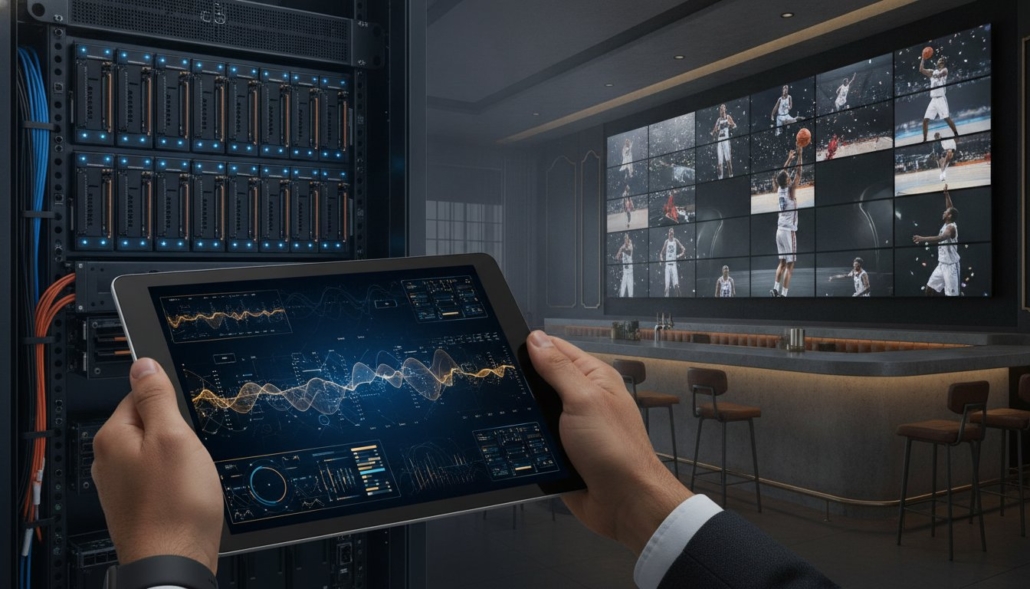
2026 Pro AV HDMI Distribution System Buyer’s Guide
A single signal dropout in a high-stakes commercial venue is more than a technical glitch. It is a total failure of the guest experience that directly impacts your bottom line. You understand that maintaining a professional HDMI distribution system is a constant battle against HDCP handshake errors, EDID version mismatches, and the physical degradation of signals over long distances. Staff often struggle with complex interfaces, leading to downtime when you can least afford it.
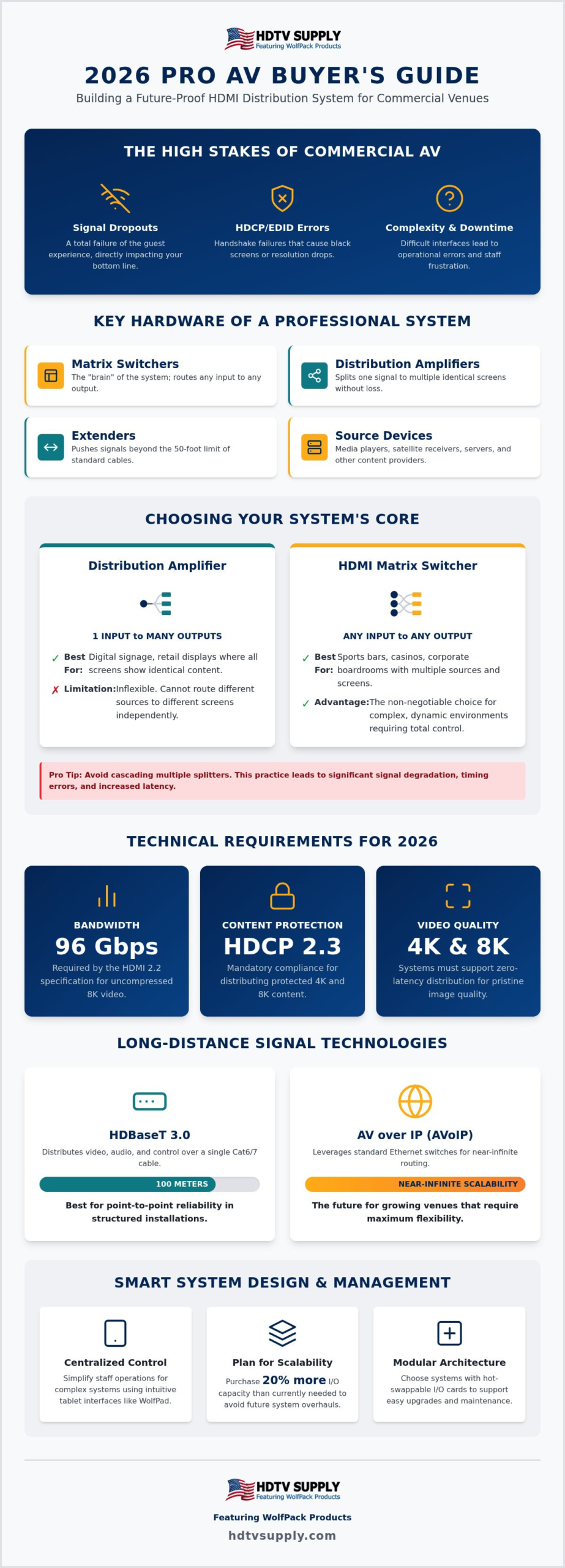
This 2026 buyer’s guide provides the technical roadmap to master these challenges. You will learn to build a high-performance network capable of zero-latency 4K and 8K distribution for any commercial scale. We cover the shift to 96Gbps bandwidth requirements under the HDMI 2.2 specification and the necessity of HDCP 2.3 compliance. We also preview modular hardware solutions like WolfPack matrix switchers and centralized WolfPad tablet control. This guide ensures your infrastructure remains future-proof, scalable, and easy for any team member to operate. From HDBaseT 3.0 integration to AV-over-IP scalability, get the facts needed to deploy a reliable, high-capacity system today.
Key Takeaways
- Identify the essential hardware required to maintain signal integrity across a professional HDMI distribution system, including matrix switchers, extenders, and distribution amplifiers.
- Evaluate the advantages of modular vs. fixed architectures to ensure your infrastructure supports future hardware upgrades and hot-swappable I/O configurations.
- Learn how to manage massive TV arrays in high-scale venues like sports bars using centralized iPad control for simplified staff operation.
- Master the technical requirements for 2026, including HDCP 2.3 compliance and the bandwidth management needed for zero-latency 4K and 8K video.
- Leverage custom AV design services to eliminate configuration errors and secure the most efficient hardware layout for your specific commercial venue.
Key Components of a Professional HDMI Distribution System
A professional HDMI distribution system is a structured network of hardware engineered to route high-definition sources to multiple displays without signal degradation. Unlike simple home setups, these systems manage complex signal paths across large commercial venues. The foundation of this technology is the High-Definition Multimedia Interface (HDMI), which serves as the global standard for transmitting uncompressed video and audio data.
Successful installations rely on four core hardware categories:
- Source Devices: Professional media players, satellite receivers, or servers that provide the raw content.
- Matrix Switchers: The central brain that routes any input to any output simultaneously.
- Distribution Amplifiers: Specialized hardware that splits a single signal to multiple screens without losing voltage.
- Extenders: Essential devices that push signals beyond the 50-foot limit of standard copper cables.
Consumer-grade splitters often overheat or fail during continuous 24/7 operation. They lack the robust cooling and active signal equalization required for commercial stability. When a consumer device fails, it’s usually due to poor heat dissipation or an inability to maintain the constant signal handshake required by modern displays.
Understanding HDCP and EDID Management
Content protection is mandatory for commercial playback. HDCP 2.2 and 2.3 are the current standards for 4K and 8K distribution. If one device in your chain doesn’t support the required version, the system defaults to a lower resolution or a black screen. Effective HDMI matrix switcher EDID management ensures the source sends a signal that every connected display can actually render. Professional systems perform a “handshake” with diverse display types simultaneously, preventing the “lowest common denominator” resolution drop seen in cheaper hardware.
The Role of HDBaseT and AVoIP
Long-distance runs require more than basic copper. HDBaseT technology allows you to distribute video, audio, and control signals over standard Cat6 or Cat7 cables up to 100 meters. While HDBaseT is excellent for point-to-point reliability, many venues are transitioning to AV over IP. AVoIP represents the future of scalable HDMI distribution for 2026 by leveraging standard Ethernet switches to create near-infinite routing possibilities. This shift allows for easier expansion as your venue grows, since you aren’t limited by the physical ports on a single fixed chassis.
Distribution Amplifiers vs. HDMI Matrix Switchers
Choosing the right hardware for a professional HDMI distribution system depends entirely on your routing logic. Distribution amplifiers (DAs), commonly known as splitters, are linear tools. They take one signal and duplicate it across multiple displays. This is the cost-effective choice for digital signage or retail environments where every screen shows identical content. However, DAs lack flexibility. You cannot change sources independently for different screens.
Matrix switchers provide the many-to-many routing necessary for complex venues. They allow any connected source to be sent to any connected output. This level of control is non-negotiable for sports bars, casinos, or corporate boardrooms. While you might be tempted to cascade multiple splitters to save money, avoid this practice. Cascading leads to significant signal degradation, timing errors, and increased latency. A single, high-capacity matrix maintains signal integrity much better than a daisy-chain of smaller devices in a professional HDMI distribution system.
Selecting the Right Matrix Size
Matrix configurations typically start at 4×4 and scale up to massive 32×32 arrays. When deciding between 16×16 vs. 32×32 HDMI matrix switchers, always factor in future expansion. Industry veterans recommend purchasing 20% more I/O capacity than your current requirement. This prevents the need for a total system overhaul when you add a few more displays next year. Larger chassis sizes also offer better rack cooling and more robust power distribution, which are critical for hardware longevity.
Bandwidth Requirements for 4K60 and 8K
Modern distribution requires massive throughput. Distributing 4K at 60Hz with 4:4:4 chroma subsampling requires a consistent 18Gbps. If your venue targets 8K or high-refresh-rate gaming, you must adhere to the official HDMI 2.1 specification. This standard supports up to 48Gbps per port. Ensure your matrix switcher is rated for these speeds to avoid flickering or total signal loss. For those planning a new build, it’s wise to browse our 4K 60Hz 4:4:4 matrix switchers to ensure your hardware meets 2026 standards.
Chroma subsampling is often overlooked. While 4:2:0 compression reduces bandwidth needs, it can blur fine text in presentation environments. A professional system should handle 4:4:4 uncompressed video to ensure every pixel remains sharp on every display.
Evaluating Modular vs. Fixed Distribution Architectures
Choosing between a fixed or modular chassis is a critical decision when designing a professional HDMI distribution system. Fixed chassis systems are cost-effective and reliable for static environments where you don’t expect to add displays or change source types. These units arrive with a pre-set number of inputs and outputs, such as an 8×8 or 16×16 configuration. However, if a single port fails on a fixed unit, you often have to replace the entire motherboard or the whole matrix, leading to significant downtime.
Modular systems offer a superior maintenance path and long-term versatility. Since inputs and outputs are housed on individual cards, you can swap a single failed port in minutes without taking the entire system offline. This architecture also supports hybrid signal types. You can mix HDMI, SDI, and HDBaseT cards in a single frame to accommodate legacy hardware alongside modern 4K sources. This ensures your professional HDMI distribution system remains adaptable as your venue’s hardware requirements change.
Why Professionals Prefer Modular HDMI Matrix Switchers
Longevity is the primary driver for modularity. As video standards evolve from 4K to 8K and beyond, you simply upgrade the internal cards rather than the entire chassis. This flexibility allows for non-standard configurations. If your venue requires a 12×20 or 14×18 setup, modularity allows you to build exactly what you need without paying for unused ports. Modularity significantly reduces long-term TCO by extending the hardware lifecycle and simplifying repairs.
WolfPack Modular Ecosystem Features
The WolfPack series represents the industry standard for modularity and reliability. For mission-critical or high-security environments, WolfPackSecure 4K 60 4:4:4 matrix switchers provide the necessary encryption and signal purity. These systems feature seamless switching technology. This eliminates the “blink” or black screen often seen when changing sources on lesser hardware, ensuring a smooth transition for viewers.
Integration is seamless across the WolfPack ecosystem. All hardware supports direct control via third-party systems like Crestron, Control4, and Savant. This ensure your distribution network fits into existing automation workflows without requiring proprietary workarounds or complex custom programming. You get an authoritative solution that values efficiency and technical mastery over aesthetic marketing.
Designing Systems for High-Scale Venues (Sports Bars & Casinos)
Managing 30+ displays in a high-traffic venue like a sports bar or casino requires more than just high-bandwidth hardware. It demands a logic-driven professional HDMI distribution system that minimizes human error. When staff are busy, they don’t have time to troubleshoot signal dropouts or navigate complex menus. Reliability at scale depends on centralized management and robust signal paths that can withstand 24/7 operation.
Large venues often use HDMI video wall processors to turn multiple screens into a single massive display. This creates a focal point for high-profile events. Simultaneously, audio de-embedding is required to strip the audio from the HDMI signal and send it to a separate house amplifier. This ensures the sound matches the visual without relying on low-quality built-in TV speakers. Efficiency is the goal. You need a system that works every time a guest walks through the door.
Sports Bar TV Distribution Essentials
Maintaining a high-traffic venue also involves protecting the physical structure from environmental hazards. For facility managers in cold climates, check out Utah Heat Cable to discover how specialized snow melt systems can prevent ice dams and protect your commercial investment.
Control is the primary bottleneck in hospitality. Integrating multiple DirecTV or cable boxes into a single interface is mandatory. Using WolfPad TV systems, managers can preview sources on an iPad before pushing content to the main screens. This prevents the wrong game from appearing on the big screen during a live event. Game Day presets allow you to change 50 TVs with one tap. This level of automation reduces the training time required for new staff and eliminates the need for dozens of individual remote controls.
Long-Distance Signal Integrity
Physical distance is the enemy of signal quality. For runs over 50 feet, you must choose between active optical cables (AOC) and HDBaseT extenders. AOC is often preferred for 48Gbps runs where physical space in conduits is limited. In high-EMI environments like casinos, shielded Cat6a or Cat7 cabling is essential to prevent interference from nearby electronics and lighting systems. If you encounter flickering or handshake failures, refer to our guide on HDMI matrix switcher troubleshooting for professional signal fixes.
Ready to scale your venue? You can explore our Sports Bar TV Distribution Systems to find the right configuration for your project. Our team provides the technical mastery needed to ensure your system is both future-proof and easy to manage.
Implementing a Pro AV Solution with WolfPack Technology
Deploying a professional HDMI distribution system requires a partner that understands the high stakes of commercial operations. WolfPack Technology is the industry standard for integrators because it balances modular flexibility with extreme reliability. You get direct-to-installer pricing that protects your project margins and global technical support that ensures you’re never stranded on a job site. For mission-critical 24/7 environments like casinos or broadcast centers, the availability of extended warranties provides the necessary security for your high-value hardware investments.
Success in Pro AV isn’t just about the initial install. It’s about the support that follows. We provide immediate solutions to technical challenges through a team of seasoned experts. This readiness ensures your venue stays online, even when hardware standards or source requirements change unexpectedly. You need a system that is as resilient as it is capable.
The HDTV Supply Advantage
Access to more than 12,000 Pro AV products makes us a true one-stop-shop for your entire equipment rack. You don’t have to waste time sourcing extenders from one vendor and matrix switchers from another. Our technical support is available via toll-free phone calls for immediate assistance. You’ll talk to veterans who understand system architecture and can troubleshoot signal paths in real-time. Our global shipping capabilities mean international integrators get the same immediate access to inventory as domestic firms, maintaining a fast-paced project rhythm and minimizing downtime.
Building Your Custom System
Our online configurators simplify the process of building a modular WolfPack matrix. You can select the exact input and output cards needed to meet 2026 standards, including 48Gbps HDMI 2.1 or HDBaseT 3.0. This tool eliminates guesswork and ensures total compatibility before any hardware leaves our warehouse. If you’re managing complex routing logic, take advantage of our free custom AV system design services. Our specialists help you map out the signal paths to reduce buyer anxiety and prevent costly configuration errors during the installation phase.
The movement from a technical need to a specific solution should be seamless. By utilizing our design services and modular hardware, you’re investing in a system that grows with your business requirements. Browse our full range of professional HDMI distribution systems today to secure the hardware your venue needs for long-term success.
Future-Proof Your Commercial AV Infrastructure
Building a high-performance professional HDMI distribution system requires a focus on scalability and technical precision. You’ve learned that modular architectures like the WolfPack series provide the best long-term value by allowing for easy card upgrades as 8K standards become the norm. Centralized control via WolfPad systems ensures your staff can manage massive screen arrays without technical errors, while proper bandwidth management prevents the signal dropouts that ruin the guest experience.
Efficiency is the key to a successful installation. We offer over 12,000 Pro AV products in stock to ensure you have every component needed for a seamless deployment. If you’re feeling overwhelmed by complex routing requirements, take advantage of our free custom AV design services. Our industry experts provide toll-free technical support to guide you through every hardware selection and configuration challenge. Don’t leave your venue’s uptime to chance. Shop Professional HDMI Distribution Systems at HDTV Supply today and deploy a solution built for 2026 and beyond. Your venue is ready for the next level of integration.
Frequently Asked Questions
How do I prevent HDMI signal loss over long distances?
Use HDBaseT extenders or Active Optical Cables (AOC) to maintain signal integrity beyond 50 feet. Standard copper cables suffer from voltage drop at long distances. HDBaseT carries video, audio, and control over a single Cat6 or Cat7 cable up to 100 meters. For high-bandwidth 8K signals in 2026, AOC provides a reliable path without the interference issues common in traditional wiring. Always prioritize shielded cabling in environments with high electrical noise.
What is the difference between an HDMI splitter and a matrix switcher?
An HDMI splitter duplicates one source to multiple screens, making it ideal for simple digital signage. A matrix switcher allows any input to be sent to any output simultaneously. This routing flexibility is the core of a professional HDMI distribution system. While splitters are cost-effective for identical content, matrix switchers are mandatory for venues like sports bars where different zones require different games or media sources at the same time.
Does my professional HDMI distribution system need to be HDCP 2.2 compliant?
Compliance with HDCP 2.2 and the newer HDCP 2.3 is mandatory for distributing 4K and 8K protected content. If any component in your signal chain lacks the correct version, the source will likely output a black screen or downscale to 1080p. Ensure your matrix switcher, extenders, and displays all support current standards to avoid handshake failures. This protection is critical for playing satellite, cable, or streaming content in commercial spaces.
Can I control 30 or more TVs from a single iPad?
You can easily manage 30 or more displays using the WolfPad TV Control System. This interface allows staff to preview sources on the tablet before pushing them to specific TVs or groups. It eliminates the need for dozens of remote controls and simplifies complex routing into a few taps. You can create presets for “Game Day” or special events, changing every screen in the venue instantly without navigating complicated hardware menus.
What is EDID management and why is it important for pro AV?
EDID management is the process of communicating display capabilities back to the source device. It prevents “black screen” errors by ensuring the source sends a resolution and audio format that every connected display can actually play. Professional systems allow you to “copy” the EDID of a specific display or use a “mixed” mode. This is vital when your professional HDMI distribution system includes a mix of older 1080p screens and modern 4K or 8K displays.
When should I choose AVoIP over a traditional matrix switcher?
Choose AV over IP (AVoIP) when you need near-infinite scalability or need to distribute signals across an existing 10Gb network. Traditional matrix switchers are better for localized racks where ultra-low latency and simplified hardware management are priorities. AVoIP is the preferred solution for 2026 projects that require 100 or more endpoints or those spanning multiple floors. It allows you to add displays by simply adding another receiver to your network switch.
Do I need a modular matrix switcher or a fixed one?
Select a modular matrix switcher if you anticipate future expansion or need to mix different signal types like HDMI, SDI, and VGA. Modular chassis allow you to swap input and output cards individually, which simplifies maintenance and reduces long-term costs. Fixed switchers are better for static environments with a set number of screens and sources. If a port fails on a fixed unit, you often have to replace the entire device.
How do I handle audio distribution in a multi-TV sports bar setup?
Handle audio by using matrix switchers with built-in de-embedding features. This hardware strips the audio signal from the HDMI stream and provides a separate analog or digital output. You can then route this audio to a dedicated house amplifier or mixer for better sound quality. This is essential for sports bars where you want game audio to play through ceiling speakers rather than the low-quality speakers built into the television sets.
Leave a Reply
Want to join the discussion?Feel free to contribute!