
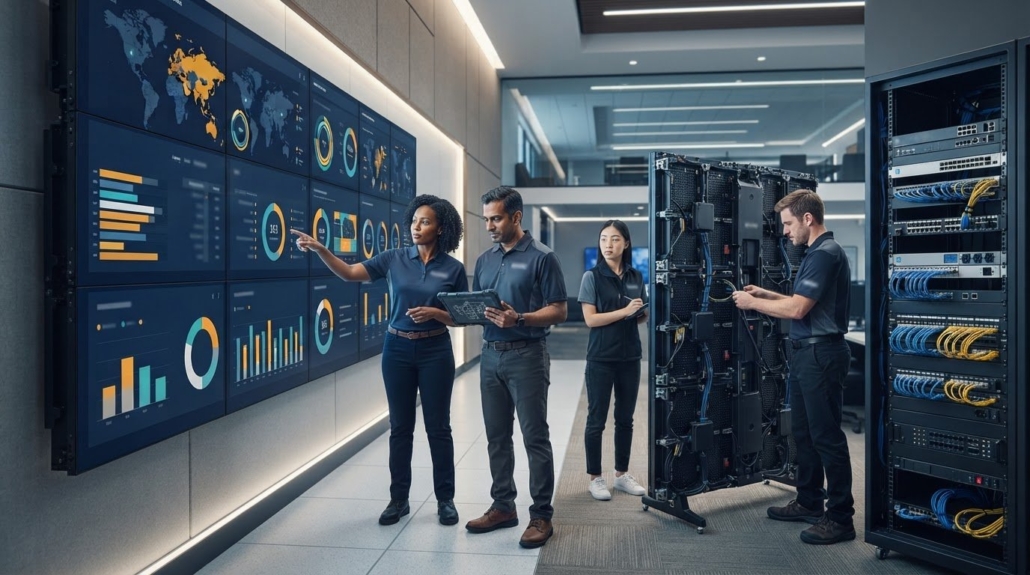
Video Wall Hardware Cost: 2026 Commercial Buyer Guide
Display panels always command the spotlight during commercial procurement, but processing architecture quietly dictates your true video wall hardware cost. Most buyers focus almost exclusively on display glass, pixel pitch, and ultra-narrow bezel specs, only to watch budgets unravel once signal distribution and switching enter the equation. You aren’t alone if the operational division between panels, dedicated controllers, and physical mounting infrastructure feels frustratingly blurry.
This 2026 commercial guide strips away the guesswork. You’ll discover how to accurately itemize every critical hardware tier before issuing a procurement quote, from signal extenders and heavy-duty pop-out mounts to high-capacity distribution frames. We’ll clarify the performance trade-offs between simple display daisy-chaining and dedicated HDMI video wall processors, showing you how layout complexity and I/O density shape your bottom line. Ahead, we break down system architectures, controller capacities, and structural requirements so you can engineer a scalable display deployment with total confidence.
Key Takeaways
- Pinpoint the true video wall hardware cost by budgeting across all structural tiers rather than pricing display glass alone.
- Compare display daisy-chaining against dedicated HDMI video wall processors to determine multi-source canvas flexibility and latency requirements.
- Protect panel alignment and streamline display maintenance by factoring commercial pop-out mounting brackets into initial hardware allocations.
- Calculate upstream switching requirements, including modular matrix switchers and active signal extenders, to maintain signal integrity from distant headend racks.
- Bypass traditional integrator equipment markups by sourcing commercial-grade distribution and processing hardware directly.
Core Hardware Cost Drivers: What Makes Up a Video Wall System?
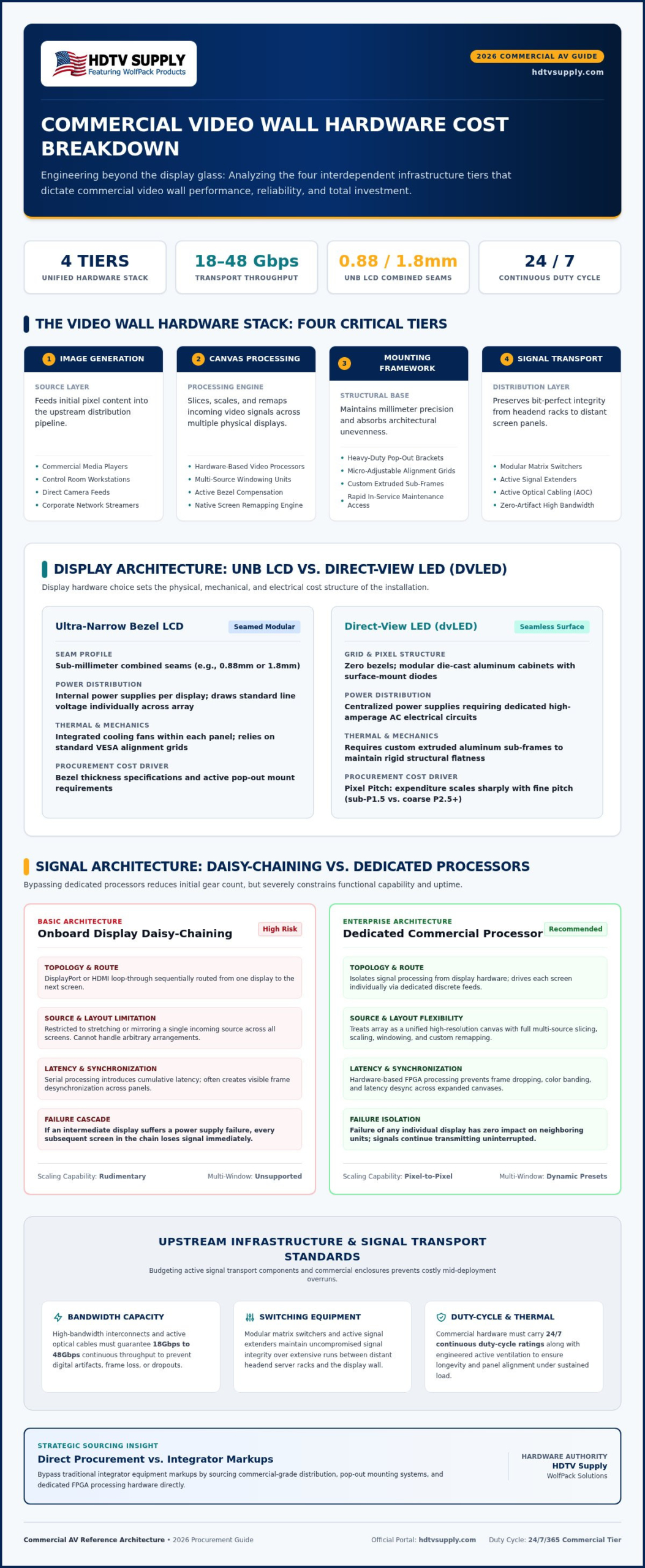
Procuring a multi-screen array requires looking beyond the display surface. In commercial AV engineering, an enterprise video wall functions as a unified ecosystem containing four interdependent hardware tiers: the visual panels, the processing engines, the precision mounting structural framework, and upstream signal distribution equipment. Treating these elements as an afterthought leads to budget shortfalls, because raw panels represent only a portion of your capital outlay. Dedicated processing hardware is necessary to prevent resolution loss, frame dropping, and color banding across expanded visual canvases.
Display Technology: Ultra-Narrow Bezel LCD vs. Direct-View LED
Your choice of screen architecture establishes the mechanical and electrical baseline for the entire installation. Each technology presents distinct physical constraints that impact your baseline video wall hardware cost:
- Ultra-Narrow Bezel (UNB) LCD: Built around commercial-grade liquid crystal panels with sub-millimeter combined bezel profiles (such as 0.88mm or 1.8mm seams). These panels require integrated cooling fans, internal power supplies per display, and standardized VESA alignment grids.
- Direct-View LED (dvLED): Eliminates grid bezels entirely using modular die-cast aluminum cabinets packed with surface-mount diodes. Expenditure scales sharply with fine pixel pitches (sub-P1.5 vs. coarse P2.5+), as tighter diode spacing requires substantially higher component density per square foot.
- Structural and Power Overhead: dvLED architectures centralize power supplies and require high-amperage, dedicated AC circuits alongside custom extruded aluminum sub-frames, whereas LCD panels draw standard line voltage individually across the array.
Component Categorization Across the Video Wall Hardware Stack
Every commercial visual display stack splits into functional tiers that demand disciplined hardware budgeting:
- Image Generation: Media players, control room workstations, camera feeds, and corporate network streamers.
- Canvas Processing: Slicing, scaling, and windowing hardware that remaps multi-source video feeds into native screen resolutions. Review our comprehensive guide to video wall processors for architectural planning.
- Mounting Framework: Precision micro-adjustable brackets designed to absorb building tolerances and eliminate uneven panel edges.
- Signal Transport: Certified high-bandwidth interconnects, active optical cables, and distribution hardware capable of 18Gbps to 48Gbps throughput without introducing digital artifacts or dropouts.
Commercial hardware must carry enterprise duty-cycle ratings (typically 24/7 continuous operation) and engineered thermal ventilation. Omitting active transport components or commercial enclosures from initial calculations will skew your total video wall hardware cost before the first rack screw gets tightened.
Video Wall Processors vs. Daisy-Chaining: Processing Hardware Costs
Signal management represents a major inflection point in your total video wall hardware cost. Commercial flat panels frequently feature built-in DisplayPort or HDMI loop-through capabilities, leading some planners to bypass dedicated controllers. While loop-through architectures reduce initial equipment counts, they restrict your visual array to stretching or mirroring a single incoming source across all screens. Choosing between onboard looping and an external processor determines whether your wall behaves like a giant television or a dynamic operational workspace. For organizations planning high-stakes monitoring facilities, visit Activu Corporation to see how dedicated video wall platforms serve mission-critical control room environments.
Limitations of Onboard Display Daisy-Chaining
Daisy-chaining routes video sequentially from one display to the next. This serial topology introduces cumulative latency across larger arrays, often creating visible frame desynchronization between the primary panel and downstream units. Onboard scalers offer rudimentary bezel adjustment, but they lack the processing bandwidth to correct for non-standard aspect ratios or handle arbitrary screen arrangements. If an intermediate display in the chain suffers a power supply failure, every subsequent screen loses signal immediately.
Capabilities of Dedicated Commercial Video Wall Processors
Purpose-built controllers isolate signal processing from display hardware, treating the entire screen array as a unified high-resolution canvas. Hardware-based, FPGA-driven engines operate without conventional operating systems, eliminating software crash risks, virus vulnerabilities, and unexpected reboot cycles in 24/7 commercial environments. These chassis process uncompressed 4K 60Hz 4:4:4 video streams with real-time, sub-frame latency across every connected output.
Reviewing institutional AV benchmarks, such as this higher-education Sample AV System Pricing documentation, shows why commercial facilities budget for dedicated video management rather than basic display chaining. Dedicated hardware delivers critical operational advantages:
- Multi-Window Canvasing: Display independent inputs simultaneously using picture-in-picture, side-by-side feeds, and overlapping window layers.
- Modular Expansion: Utilize field-swappable input and output cards to accommodate system upgrades without replacing the entire processing chassis.
- Precision Pixel Mapping: Compensate for physical bezels with pixel-accurate alignment, asymmetrical panel layouts, and custom output timings.
If your project demands uninterrupted multi-source routing, zero latency, and custom layout presets, review high-reliability HDMI video wall processors to ensure your backend infrastructure matches your operational demands.
Mounting Systems and Structural Infrastructure Hardware Expenses
Physical mounting infrastructure represents a critical hardware investment that directly impacts display longevity and visual alignment. As AVIXA details in its technical guides covering essential hardware components, multi-screen framing requires engineering tolerances far stricter than individual display mounts. Sub-millimeter gaps between LCD bezels or dvLED cabinets leave zero margin for structural sag or surface unevenness. Skimping on mounting systems compromises the entire visual plane and inflates long-term maintenance overhead.
Pop-Out and Micro-Adjustable Video Wall Brackets
Precision alignment across multi-screen arrays requires specialized commercial brackets with integrated multi-axis micro-adjustments. These mechanisms let technicians tune height, depth, and tilt independently at every corner using dedicated adjustment knobs, eliminating visible seam offsets across the display surface. Commercial pop-out hardware utilizes heavy-duty scissor-arm assemblies that extend forward with a gentle push. This functionality is mandatory for routine maintenance, allowing technicians to service or replace a failed display inside a dense grid without disassembling adjacent panels. High load ratings are vital, as commercial-grade displays incorporate robust internal chassis and active cooling components that quickly exceed standard consumer mount limits.
Freestanding, Ceiling, and Recessed Structural Frames
Building geometry and structural wall capacity dictate whether standard wall framing will suffice:
- Freestanding Structural Pedestals: Heavy-gauge extruded aluminum and steel floor mounts distribute the physical load directly to floor slabs, bypassing non-structural drywall, decorative partition walls, or glass curtain structures.
- Recessed Wall Housings: In-wall architectural niches deliver a clean, flush appearance but require integrated thermal management. Enclosed cavities trap heat, demanding rack-grade exhaust fans and integrated cable raceways to protect power supplies and receiver boards.
- Seismic and Overhead Bracing: High-impact public spaces and transit hubs require certified seismic locking hardware and ceiling suspension tethers to comply with commercial building safety regulations.
Factoring precision brackets and mechanical framing into your initial video wall hardware cost ensures seamless panel registration, protects internal electronics from thermal stress, and guarantees straightforward service access over the operational life of the system.
Signal Distribution and Switching: Matrix Switchers and Extenders
High-resolution video walls rarely operate in isolation. In enterprise control rooms, conference spaces, and high-traffic hospitality venues, visual canvases depend on a centralized equipment rack located dozens or hundreds of feet away. Feeding multiple live sources to a display processor requires upstream matrix switching and robust signal extension hardware. Overlooking these signal routing pathways will lead to an incomplete assessment of your true video wall hardware cost.
Integrating Matrix Switchers into the Hardware Pipeline
A video wall processor slices and formats incoming video across multiple screens, but upstream routing hardware manages which feeds reach those processor inputs. Multi-source venues rely on cross-point matrix switchers to route media players, live camera feeds, and dedicated computers across diverse display zones. Facilities managing multi-screen layouts can explore how modular HDMI matrix switchers deliver flexible I/O configurations that scale alongside evolving input counts.
Commercial hospitality builds face similar architectural demands. Large entertainment facilities benefit from the high-capacity routing architectures detailed in our guide to sports bar TV distribution. Seamless matrix routing hardware prevents embarrassing black screens, frame tearing, and EDID handshake delays during live input changes. Hardware-level HDCP 2.2 management ensures uninterrupted playback of copy-protected content across high-bandwidth commercial feeds.
Signal Extension: HDBaseT Transmitters vs. Fiber Optics
Passive HDMI cables degrade rapidly over distances exceeding 15 to 25 feet, causing sparkle artifacts, frame drops, or total signal dropouts. Transporting uncompressed 4K signals from headend AV racks out to the visual array requires specialized active hardware:
- HDBaseT Extender Sets: Utilize category cable (Cat6 or Cat6A) to send 4K video, embedded multi-channel audio, bi-directional control signals (RS-232 and IR), and power over cable (PoC) across runs up to 330 feet.
- Fiber Optic Transmitters: Deliver galvanic electrical isolation and virtually unlimited bandwidth headroom. Fiber hardware eliminates electromagnetic interference (EMI) risks in industrial plants and easily handles point-to-point runs spanning thousands of feet.
- Active Optical Cables (AOC): Combine copper conductors for handshake communication with glass cores for high-speed video data, offering plug-and-play simplicity for mid-distance rack-to-wall interconnections.
Centralizing your switching and active extension equipment protects signal purity, prevents costly site redesigns, and keeps long-term hardware expenses predictable. Explore our enterprise-grade distribution catalog at HDTV Supply to select the modular switchers and signal extenders engineered for your facility.
Optimizing Commercial Video Wall Hardware with HDTV Supply
Direct hardware procurement transforms commercial project budgets. Traditional AV deployment models frequently burden buyers with compounding equipment markups through layered dealer channels. Sourcing distribution and routing gear directly from a specialized hardware distributor keeps your baseline video wall hardware cost predictable, allowing tech managers and systems integrators to retain precise control over system design and component quality. Just as commercial trade contractors rely on dedicated wholesale partners like solcontrol.com for high-performance films and professional installation tools, purchasing AV infrastructure directly avoids unnecessary markups while maintaining strict standards.
Tailored Processing Hardware for High-Impact Installations
HDTV Supply stocks high-performance canvas management gear engineered for continuous commercial duty cycles:
- Dedicated WolfPack Video Wall Processors: Pure FPGA hardware architectures eliminate operating system crashes and deliver real-time, cross-screen scaling with zero frame latency.
- Versatile Display Configurations: Drive standard 2×2, 3×3, and 4×4 panel matrices, or establish custom visual presentations like panoramic ribbons and vertical column arrays.
- Simplified Canvas Management: Pair processors with WolfPad TV Control Systems to trigger windowing presets, switch source inputs, and reconfigure screen divisions instantly from an intuitive interface.
Procurement Advantages for Commercial Integrators and Facilities
Modular hardware platforms let commercial facilities deploy the exact I/O capacity they need today while preserving a clear expansion path for tomorrow. Field-swappable input and output cards prevent entire processing frames from becoming obsolete when display resolutions or source quantities increase. Independent integrators and in-house engineering teams secure distinct operational advantages when engineering system distribution:
- Extensive Commercial Catalog: Access over 12,000 professional audio-visual hardware items to build out complete headend infrastructure.
- Technical Integration Support: Dial toll-free phone support to consult experienced technicians on signal bandwidth, I/O count matching, and EDID handshake requirements prior to purchasing.
- Direct Hardware Protection: Secure mission-critical operations with optional extended warranty coverage added directly at point of purchase.
Eliminating middle-tier supply markups while prioritizing modular FPGA architecture protects your long-term video wall hardware cost. Explore commercial video wall hardware solutions to select the processors, switchers, and extenders that match your installation specs.
Build a Scalable, High-Performance Video Wall Infrastructure
Controlling your overall video wall hardware cost comes down to engineering the complete signal chain rather than budgeting for display panels alone. High-impact commercial installations depend on dedicated FPGA processing to eliminate screen latency, precision pop-out mounting for rapid serviceability, and active matrix distribution to maintain pure 4K signal integrity from distant headend racks.
Direct procurement puts technical authority and budget management back in your hands. With an extensive catalog exceeding 12,000 professional audio-visual components, HDTV Supply provides dedicated WolfPack hardware processing platforms engineered for zero-latency canvas control and seamless source switching. You don’t have to navigate signal distribution variables alone; take advantage of our toll-free expert technical support to audit your system architecture and verify bandwidth compatibility before issuing your procurement order. Explore commercial video wall processors and AV hardware at HDTV Supply to equip your facility with dependable, broadcast-grade performance.
Frequently Asked Questions
What is the most expensive hardware component in a commercial video wall?
The physical display panels or dvLED cabinet arrays typically account for the largest single share of your baseline video wall hardware cost. High-density dvLED modules with sub-millimeter pixel pitches demand precision manufacturing that drives up physical equipment expenses. However, advanced enterprise FPGA video wall processors and active modular matrix switchers can rival display investments in mission-critical environments requiring multi-windowing, ultra-low latency, and high I/O density.
Can I build a video wall using standard consumer televisions to reduce hardware costs?
You shouldn’t use consumer TVs for commercial video wall arrays. Consumer displays feature wide, uneven plastic bezels that disrupt image alignment and lack commercial cooling systems required for continuous operation. They also omit RS-232 or IP LAN control ports, lockable power connectors, and standardized VESA alignment tolerances. Commercial-grade ultra-narrow bezel displays ensure seamless visual registration, thermal longevity, and reliable communication with upstream video wall processors.
How does a dedicated video wall processor differ from a standard HDMI matrix switcher?
A standard HDMI matrix switcher routes whole video inputs to designated outputs on a one-to-one or one-to-many basis without modifying pixel geometry. In contrast, a dedicated hardware video wall processor captures source signals, deconstructs the raster, and scales window slices across multiple screens to create a unified visual canvas. Processors deliver advanced canvas mapping, bezel compensation, multi-source layering, and overlapping picture-in-picture zones that standard switches can’t execute.
Why do commercial video wall mounts cost significantly more than standard TV brackets?
Commercial video wall brackets incorporate multi-axis micro-adjustment mechanisms and heavy-duty scissor-arm assemblies that standard consumer TV mounts lack. Technicians require precise mechanical knobs to adjust depth, height, and plumb at each corner to align sub-millimeter LCD bezels. Pop-out push-release mechanisms let installers extend individual recessed panels forward for maintenance without dismantling surrounding displays, saving hours of labor and preventing accidental screen damage.
Does higher resolution content increase the cost of video wall processing hardware?
Yes, processing higher resolution content increases hardware requirements across your distribution architecture. Delivering uncompressed 4K 60Hz 4:4:4 video streams requires wide internal backplane bandwidth, advanced FPGA chips, and HDMI 2.0 or 2.1 chipset architectures. Scaling from 1080p to true 4K quadruples the data throughput, demanding high-throughput processing cards, certified interconnects, and robust active extension hardware to maintain frame synchronization across multi-screen canvases without dropped packets.
What extra hardware is required when locating video sources away from the video wall?
Locating playback sources in a centralized headend rack requires dedicated signal extension hardware to prevent digital degradation. Passive HDMI cables fail over extended lengths, so systems require HDBaseT transmitter and receiver sets operating over shielded category cable, or active optical cables (AOC). For extreme distances or electrically noisy industrial environments, fiber optic extenders convert video signals into light pulses, ensuring lossless Ultra HD video transmission directly to the display processor.
How do pixel pitch specifications affect the total hardware expenditure for LED video walls?
Pixel pitch directly dictates surface diode density, which serves as the primary driver of LED video wall hardware cost. A sub-P1.2 fine-pitch cabinet packs exponentially more surface-mount diodes, driver ICs, and multi-layer PCBs per square foot than a coarse P2.5 or P4.0 panel. Tighter diode spacing requires higher-capacity power supplies and advanced processing controllers capable of addressing massive pixel counts across the resulting visual canvas.
Leave a Reply
Want to join the discussion?Feel free to contribute!