

AV over IP vs. HDBaseT Comparison 2026: Choosing the Right Pro AV Architecture
What if the choice between a matrix switcher and a network-based system had nothing to do with video quality and everything to do with your building’s physical footprint? For years, installers debated whether Ethernet could ever match the zero-latency performance of a dedicated copper category cable. In this AV over IP vs HDBaseT comparison 2026, it’s clear that both technologies have reached a technical maturity where uncompressed 4K/60 4:4:4 is no longer the primary differentiator. You’re likely feeling the pressure of choosing an architecture that won’t be obsolete by next year, especially when facing the headaches of managed switch configurations or the distance limitations of traditional HDMI.
We understand that a sports bar requires different scalability than a corporate campus, and you need a solution that balances immediate ROI with long-term flexibility. This guide helps you master the technical and financial nuances between these two heavyweights. We’ll break down the recent launch of the IPMX open standard, compare the latency of SDVoE against HDBaseT 3.0, and provide a scalable blueprint for your next high-performance distribution system. Whether you require the rock-solid reliability of WolfPack modular matrix switchers or the infinite expansion of an IP-based network, you’ll find the data needed to make an authoritative decision.
Key Takeaways
- Identify why uncompressed 4K/60 4:4:4 is now the baseline for both HDBaseT 3.0 and SDVoE architectures in 2026.
- Evaluate this AV over IP vs HDBaseT comparison 2026 to determine if your facility requires zero-frame latency or the infinite scalability of a 10GbE network.
- Learn why WolfPack modular matrix switchers remain the most reliable choice for sports bar configurations up to 32×32 endpoints.
- Discover how the new IPMX open standard allows for interoperable, high-quality video distribution across standard 1GbE corporate networks.
- Master the financial shift where AV over IP becomes more cost-effective than traditional matrix switching as your system exceeds 16 endpoints.
The Pro AV Landscape in 2026: Signal Distribution Challenges
The era of simple HDMI splitters and basic point-to-point extenders has evolved into a landscape of complex, high-bandwidth ecosystems. In 2026, professional AV architects no longer just run a cable; they design integrated distribution networks that must handle massive data loads without failure. This AV over IP vs HDBaseT comparison 2026 highlights a critical shift: the industry has moved beyond 1080p and even basic 4K. We’re now in the age of uncompressed 4K/60 4:4:4 as the standard requirement for any commercial installation.
Traditional HDMI cables are effectively dead for long-distance commercial runs. Copper HDMI signals degrade rapidly after 25 feet, making them useless for large venues. Installers now face the core challenge of balancing signal integrity with extreme cable distances and tightening budgets. To solve this, the industry relies on HDBaseT technology and network-based IP protocols to push high-resolution video hundreds of feet through a building’s infrastructure. Choosing between these two involves understanding how they handle the 18Gbps bandwidth required for modern HDR content.
Understanding the 4K/60 4:4:4 Performance Standard
Chroma subsampling is often the most overlooked factor in system design. While 4:2:0 compression works for consumer movies, it crushes text clarity and color accuracy in professional settings. For digital signage, spreadsheets, or corporate presentations, 4:4:4 ensures every pixel of color is preserved. This requires a significant jump in bandwidth from the older 10.2Gbps standard to at least 18Gbps. Modern hardware must also maintain HDCP 2.3 compliance to ensure compatibility with 2026 streaming hardware and encrypted content sources. Without this bandwidth headroom, your system will experience flickering, handshake issues, or total signal loss.
The Rise of Distributed Video in Commercial Venues
Large venues are abandoning the traditional centralized closet model. Instead of housing every source in a single rack, sports bars and stadiums now utilize decentralized nodes to reduce cable clutter and improve cooling. This shift is driven by the demand for 4K sports broadcasts and the integration of high-bandwidth streaming services. Implementing a modern sports bar TV distribution system allows owners to manage dozens of displays without the signal loss associated with legacy hardware. By moving the processing closer to the display or leveraging a robust network, venues achieve the uptime and quality that 2026 audiences expect.
HDBaseT vs. AV over IP: Technical Architecture and Mechanism
Understanding the physical architecture is essential for an accurate AV over IP vs HDBaseT comparison 2026. HDBaseT functions as a point-to-point powerhouse. It creates a direct, dedicated physical link between the source and the display using standard Cat6a cabling. In contrast, AV over IP leverages standard IT infrastructure. It breaks video signals into data packets that travel across managed network switches. This fundamental difference dictates how your system scales and how much latency you’ll encounter during high-stakes events.
Traditional systems rely on “fixed” or “modular” matrix switching. A fixed matrix has a set number of inputs and outputs, like an 8×8 or 16×16 chassis. Modular systems, such as WolfPack Modular Matrix Switchers, offer more flexibility. They allow you to swap input and output cards to meet specific port counts without replacing the entire unit. AV over IP introduces “virtual” switching. In this model, your matrix size isn’t restricted by a chassis; it’s only limited by the number of ports on your network switch.
HDBaseT: The Uncompressed Advantage
HDBaseT 3.0 is the current gold standard for uncompressed signal delivery. It pushes 18Gbps of data up to 100 meters without the need for heavy compression algorithms that might introduce visual artifacts. It’s the “plug-and-play” king for environments where zero-latency performance is non-negotiable. You can explore a wide range of these high-performance systems at HDTV Supply to find the right fit for your facility. The 5Play feature set remains its defining characteristic, allowing multiple signals to share a single cable:
- Uncompressed 4K/60 video and high-resolution audio
- 1Gbps Ethernet for network pass-through
- Control signals including RS-232, IR, and CEC
- USB 2.0 support for KVM and touchscreens
- Up to 100W of Power over HDBaseT (PoH)
AV over IP: The Scalability Champion
AV over IP uses encoders at the source and decoders at the display to turn video into data packets. These packets travel over 1Gbps or 10Gbps networks. The system’s “brain” is an IGMP-capable managed switch. This switch ensures that high-bandwidth multicast traffic only goes where it’s needed, which prevents network congestion. While HDBaseT is capped at 100 meters, AV over IP can span entire corporate campuses. By using fiber optic cabling and standard networking gear, you can distribute content across multiple floors or buildings without signal degradation.
Power management also differs between the two architectures. HDBaseT uses PoH, which is a specialized standard for its point-to-point links. AV over IP utilizes standard Power over Ethernet (PoE). This allows you to power encoders and decoders directly from a PoE-enabled network switch. It simplifies cable management and reduces the need for local power outlets at every display location. Choosing the right power standard is just as vital as choosing the video resolution for long-term reliability.
Performance Benchmarks: Latency, Resolution, and Real-World Costs
Performance in 2026 is measured by how a system handles the massive 18Gbps required for uncompressed 4K/60 4:4:4 video. In this AV over IP vs HDBaseT comparison 2026, the distinction between zero-frame and sub-frame latency remains the primary technical hurdle. HDBaseT 3.0 continues to offer true zero-latency performance because it doesn’t require packetization or heavy compression. For live environments where every millisecond counts, this architecture ensures that the action on the screen matches the live audio perfectly. While SDVoE (Software Defined Video over Ethernet) has pushed IP latency down to under 100 microseconds, other IP standards like JPEG2000 or H.264 can introduce significant delays that frustrate viewers during fast-paced events.
Choosing an architecture also requires a deep dive into compression algorithms. SDVoE is the only IP standard that truly competes with HDBaseT for 4K/60 4:4:4 quality, but it requires a 10Gbps network backbone. If you opt for 1Gbps IP solutions, you must accept higher compression ratios, which can lead to visible artifacts in high-detail scenes. Beyond the hardware, don’t ignore the hidden costs of AV over IP. You’ll need IT staff or specialized contractors to configure IGMP snooping, VLANs, and jumbo frames on managed switches. These labor costs often offset the perceived savings of using standard network gear.
Latency and Video Sync in Multi-Screen Environments
In massive installations, “video wall drift” is a common failure point for poorly configured IP systems. If your decoders aren’t perfectly synced, one screen in a video wall might lag several frames behind its neighbor, shattering the visual illusion. HDBaseT avoids this by using a dedicated physical clock for every link, ensuring perfect synchronization across 30 or more displays. For complex layouts, a dedicated video wall processor provides the frame-accurate timing necessary to keep your content fluid and professional. This is especially vital in sports bars where multiple TVs must show the same game without a distracting “echo” effect between screens.
Budgeting for Long-Term Scalability
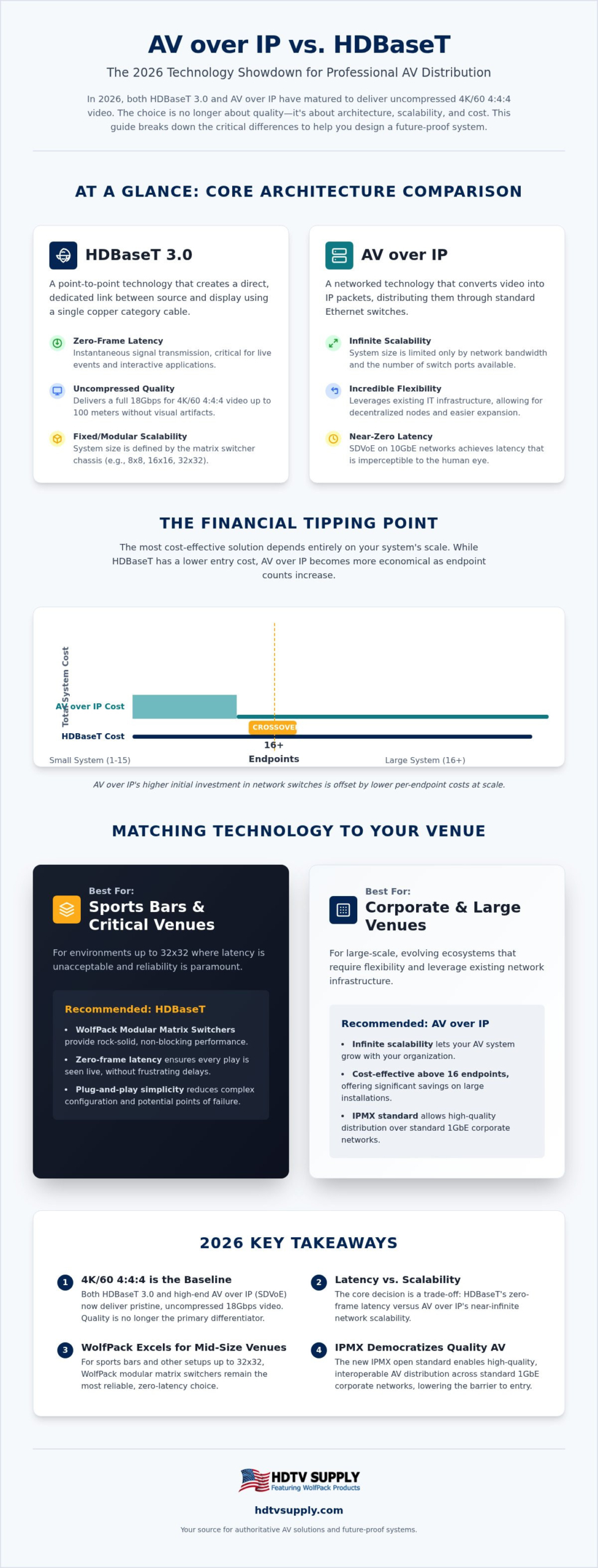
The financial tipping point for these technologies usually occurs at the 16×16 port mark. For smaller setups, a fixed HDBaseT matrix is almost always more cost-effective. However, as you scale toward 32 or 64 endpoints, the cost-per-port for AV over IP drops because you only need to add individual decoders rather than replacing a massive chassis. If you’re stuck in the middle, modular HDMI matrix switchers offer the best of both worlds. They allow you to scale your HDBaseT inputs and outputs incrementally, providing a predictable growth path without the complexity of a fully networked IP infrastructure.
Application Guide: Matching Technology to Your Venue
Selecting the right architecture depends on your facility’s physical layout and total endpoint count. In this AV over IP vs HDBaseT comparison 2026, we see that venue type dictates the hardware choice more than resolution alone. Sports bars typically fall into the “Golden Circle” of 32×32 setups. For these environments, WolfPack Modular Matrix Switchers offer unmatched reliability and zero-frame latency. Conversely, corporate campuses with displays spread across multiple floors require the distance-defying capabilities of AV over IP to maintain signal integrity over long runs.
High-end residential cinemas often favor HDBaseT for its ability to handle uncompressed 8K-ready signals without the network overhead. In educational settings, IP-based systems are the preferred choice for campus-wide digital signage and lecture capture. These systems allow administrators to push content to any classroom via the existing 1GbE network infrastructure. Each environment has specific needs that make one architecture a clear winner over the other.
Optimizing Sports Bar TV Distribution
Managing a high-traffic venue requires simplicity and speed. You can oversee 50 or more displays using a tablet-based WolfPad TV control system. This interface eliminates the need for complex remote controls or manual switching at the rack. Many successful venues now use a hybrid approach. They deploy HDBaseT for the main bar area to ensure zero latency for the big game, while using AV over IP for satellite seating or outdoor patios. This setup requires careful attention to HDMI matrix switcher EDID management to ensure a mix of 1080p and 4K displays function without handshake errors.
Command Centers and Large-Scale Video Walls
Mission-critical environments like command centers demand maximum flexibility. AV over IP allows for dynamic source-to-window mapping on large-scale video walls. For these applications, 10Gbps IP infrastructure is mandatory. It provides the bandwidth necessary for uncompressed data visualization where every pixel of information is vital. Unlike fixed chassis systems, an IP-based video wall can grow as your data sources increase. You can simply add an encoder for every new source and a decoder for every new display.
If you’re ready to build a system that scales with your business, browse our full inventory of WolfPack matrix and IP distribution hardware today.
Future-Proofing Your System with HDTV Supply Solutions
Future-proofing in 2026 requires more than just high resolution; it demands hardware that can handle the shifting standards of content protection and color depth. The WolfPackSecure 4K 60 4:4:4 HDMI Matrix Switchers provide the necessary bandwidth to support full chroma subsampling, ensuring that every pixel of data is preserved for mission-critical displays. As you finalize your AV over IP vs HDBaseT comparison 2026, prioritize systems that offer HDCP 2.3 compliance and HDMI 2.1 features. These specifications are mandatory for compatibility with the latest generation of media players and gaming consoles. By selecting hardware with these capabilities now, you avoid the costly cycle of mid-project upgrades when new source devices are introduced.
Protecting your investment involves more than just picking the right specs. We provide free custom AV system design services to help you map out your architecture before you purchase a single component. This ensures your signal path is optimized for the specific distances and display types in your venue. Every system is backed by global technical support and extended warranty options, giving you the dependability of a seasoned industry veteran. Whether you’re building a massive distribution network or a localized matrix, our team ensures your system remains operational and efficient for years to come.
Selecting Between WolfPack HDBaseT and IP Modules
The WolfPack modular architecture is designed for ultimate flexibility, allowing you to customize your input and output cards based on your specific needs. You can mix SDI, HDMI, and HDBaseT cards within a single chassis to bridge the gap between legacy sources and modern displays. This modularity means you don’t have to choose just one technology for your entire facility. The Hybrid Approach is the ultimate 2026 strategy for venues that demand both localized zero-latency performance and campus-wide distribution flexibility. This method allows you to use HDBaseT for high-stakes viewing areas while leveraging IP modules for secondary zones.
Final Decision Matrix: Which Should You Buy Today?
When making your final choice, apply the ‘3-Year Rule’ to your planning. Consider where your resolution needs will be by 2029 and whether your current cabling can support that jump. If you expect to double your display count within that window, the scalability of AV over IP is the logical path. For fixed installations where stability is the priority, HDBaseT remains the gold standard. Direct procurement is another vital factor; buying pro AV gear online through our platform typically saves installers 20-30% on total project costs compared to traditional local dealers. This budget surplus can be reinvested into higher-quality endpoints or better control hardware.
Ready to finalize your system architecture? Contact our expert consultants at 800-841-9230 for a custom quote and a comprehensive system review today.
Designing Your 2026 AV Infrastructure for Maximum ROI
Selecting the right architecture for your facility is a calculated business decision that balances immediate performance with long-term scalability. This AV over IP vs HDBaseT comparison 2026 proves that while both technologies now deliver uncompressed 4K/60 4:4:4, your physical footprint remains the ultimate tie-breaker. Use modular matrix switchers for high-speed, zero-latency clusters in sports bars or conference rooms. Scale with IP-based networks for multi-floor distribution or systems exceeding 16 endpoints.
Don’t risk your project’s success on guesswork or incompatible hardware. We offer expert technical support on all modular matrix switchers and maintain over 12,000 professional AV products in stock for immediate deployment. Take advantage of our free custom system design for bars and restaurants to ensure your 2026 rollout is flawless from the start.
Build Your Custom WolfPack System with HDTV Supply today and secure a high-performance foundation for your venue’s future. You’ve got the technical insights; now it’s time to execute with confidence.
Frequently Asked Questions
Is AV over IP better than HDBaseT for gaming and live sports?
HDBaseT is technically superior for gaming because it offers zero-frame latency, which is critical for interactive response times. While SDVoE-based AV over IP is incredibly fast, even sub-frame latency can be felt in competitive gaming scenarios. For live sports, both architectures are excellent. However, HDBaseT physical clocking ensures that multiple screens show the action in perfect synchronization without the drift sometimes seen in poorly configured networked systems.
Can I run AV over IP on my existing office Wi-Fi network?
You cannot run professional AV over IP on a standard office Wi-Fi network. High-performance video distribution requires a dedicated, wired 1Gbps or 10Gbps infrastructure to maintain signal stability. Wireless networks lack the sustained bandwidth and packet priority needed for uncompressed 4K/60 4:4:4 video. Attempting to use Wi-Fi will result in significant lag, pixelation, and total signal drops that ruin the viewing experience in a commercial environment.
What is the maximum distance for an HDBaseT 3.0 signal in 2026?
The maximum distance for an uncompressed HDBaseT 3.0 signal in 2026 remains 100 meters, or approximately 328 feet, over a single Cat6a cable. This standard supports full 18Gbps bandwidth for 4K/60 4:4:4 video without quality loss. If your installation requires distances beyond this 100-meter limit, you should consider using fiber optic extenders or transitioning to an AV over IP architecture that leverages network repeaters to span greater distances.
Do I need a special network switch for AV over IP distribution?
Yes, AV over IP requires a managed network switch with IGMP snooping and multicast support. These specialized switches ensure that massive video data packets reach the correct displays without flooding the rest of your network. Standard unmanaged switches cannot handle this traffic and will likely crash under the load. For a successful AV over IP vs HDBaseT comparison 2026, remember that the network switch is the most critical hardware component in an IP-based system.
How do I control 30+ TVs if I choose an AV over IP system?
Controlling 30 or more displays is best handled through a tablet-based interface like the WolfPad TV Control System. This software allows you to drag and drop sources to any screen or group of TVs instantly. It eliminates the need for a box full of remote controls or complex IR aiming. Whether you use a matrix switcher or an IP network, a centralized control hub is essential for managing high-endpoint counts with professional efficiency.
Is HDBaseT becoming obsolete due to network-based video?
HDBaseT is not becoming obsolete; it’s simply specializing. While network-based video excels in massive campus-wide deployments, HDBaseT remains the gold standard for zero-latency, point-to-point reliability in smaller setups. It’s often the more cost-effective choice for 16×16 or 32×32 configurations. Its plug-and-play simplicity means you don’t need an IT background to get a high-performance system running, making it a reliable staple for conference rooms and sports bars.
What are the power requirements for a large WolfPack matrix switcher?
Large WolfPack Modular Matrix Switchers are designed with high-capacity internal power supplies to handle multiple input and output cards simultaneously. Most units feature redundant power options to ensure your system stays online even if one supply fails. They typically require a standard 110V or 220V AC outlet. Because these units process massive amounts of data, you must provide adequate rack ventilation and cooling to prevent thermal throttling or hardware damage over time.
Can I mix HDBaseT and AV over IP in the same building?
You can definitely mix both technologies in the same building to create a hybrid distribution system. Many installers use a WolfPack matrix for the main cluster of TVs in a bar area to guarantee zero latency for the primary audience. They then use AV over IP decoders to push that same content to satellite displays in outdoor patios or secondary floors. This approach leverages the strengths of both architectures while keeping your total infrastructure costs manageable.
Leave a Reply
Want to join the discussion?Feel free to contribute!