
WolfPackSecure vs. WolfPack Modular Matrix Switchers: The 2026 Comparison Guide
Your 4K60 video wall is only as reliable as the chroma subsampling your matrix can actually handle. You’ve likely experienced the screen flickering or “handshake” delays that occur when a system is pushed to its 18Gbps limit. Installers often realize too late that “4K compatible” is a vague term that often masks failures in uncompressed 4:4:4 color depth. Selecting the right WolfPackSecure vs WolfPack Modular matrix switcher is the difference between a seamless deployment and a system that requires a total hardware overhaul in two years.
We understand that future-proofing your Pro AV environment against evolving HDCP 2.3 standards is a non-negotiable priority for 2026. This comparison guide clarifies the critical technical architecture and bandwidth capabilities of both series. You’ll gain the technical confidence to select a chassis that handles mission-critical signal paths without compromise. We’ll examine real-world performance metrics, field-expandability, and WolfPad control system integration to ensure your hardware investment remains stable and compatible with your existing infrastructure.
Key Takeaways
- Identify the critical bandwidth gap between 10.2Gbps and 18Gbps to ensure your system supports uncompressed 4K60 4:4:4 signal integrity.
- Evaluate the WolfPackSecure vs WolfPack Modular matrix switcher based on your environment’s specific needs for either maximum port density or mission-critical color accuracy.
- Learn how to leverage modular chassis flexibility to scale your AV distribution from an 8×8 setup to massive 160×160 configurations without full hardware replacements.
- Discover how the WolfPad control system simplifies complex matrix switching via iPad, eliminating the need for expensive third-party programming.
- Verify compatibility with 2026 standards like HDCP 2.3 to protect your hardware investment with extended warranty options up to 5 years.
The Evolution of Video Distribution: Why Modular Architecture Wins in 2026
The Pro AV industry has shifted. By 2026, fixed-port hardware is often a liability rather than an asset for growing enterprises. Modern video distribution relies on a video matrix switch that offers field scalability through a modular chassis-and-card architecture. This design allows technicians to populate a frame with specific input and output cards, adapting to the exact needs of a facility. Whether you’re managing a corporate boardroom or a massive sports bar, the choice between a WolfPackSecure vs WolfPack Modular matrix switcher determines how easily you can adopt emerging standards like 8K-ready infrastructure and HDMI 2.1.
The primary driver for this evolution is technical longevity. In previous years, upgrading a system meant decommissioning a functional chassis just to gain a new port type. Today, the modular approach allows you to swap a single card for a fraction of the cost of a full system replacement. This flexibility is the cornerstone of the WolfPack ecosystem. It provides a clear path from standard 1080p distribution to the high-bandwidth Secure series, which is specifically engineered for uncompressed 4K60 4:4:4 signal integrity across complex networks.
Fixed vs. Modular: A Quick Comparison
Fixed systems offer a lower entry cost, but they lack the scalability required for growing sports bars and commercial venues. If a single port fails on a fixed unit, the entire system often requires factory repair or a total replacement. Modular systems demand a higher initial investment but offer 10-year technical longevity. In a busy commercial environment, serviceability is paramount. Using a modular HDMI matrix switcher means that if a card fails, you can replace it in the field without taking the entire venue offline. This reduces downtime and protects your operational bottom line.
The Role of WolfPack in Modern AV Design
WolfPack systems are built for variety and scale. We provide chassis sizes ranging from compact 8×8 units to massive 160×160 configurations. This range ensures that your hardware can grow alongside your business requirements. Customization is the secondary advantage. You aren’t locked into a single signal type. You can mix HDMI, HDBaseT, SDI, and Fiber inputs within the same frame. This allows for a hybrid design that handles local sources and long-distance runs simultaneously. It’s this adaptability that makes the WolfPackSecure vs WolfPack Modular matrix switcher comparison so vital for professionals who need to balance immediate budgets with long-term performance.
WolfPack Modular Ecosystem: Scalability and Versatility
The “Standard” WolfPack Modular series serves as the primary workhorse for the Pro AV industry. While the Secure series targets high-bandwidth 4:4:4 requirements, the standard modular range provides the essential framework for the majority of commercial installations. This ecosystem allows you to build a system that matches your current display count while leaving room for immediate growth. When evaluating a WolfPackSecure vs WolfPack Modular matrix switcher, you must determine if your priority is massive port density or uncompressed color depth.
Field expansion is a core technical advantage. You can start with a partially populated chassis and add input or output cards as your venue grows. This “pay-as-you-grow” model prevents over-investment in unused ports. Control is equally flexible. While standard RS232 and Web GUI options are available, the proprietary WolfPad interface offers a streamlined iPad control experience. This eliminates the need for complex, expensive third-party programming, making it a favorite for the Sports Bar TV Distribution System market.
Chassis Sizes and Port Density
System design begins with the chassis selection. Small-scale solutions like the 8×8 or 9×9 chassis are ideal for boutique retail or high-end residential projects. For standard sports bars, medium-scale solutions such as the 16×18 or 36×36 chassis provide the perfect balance of coverage and cost-efficiency. Large-scale enterprise needs, including casinos and stadiums, are met with massive 72×72 or 160×160 frames. These high-capacity units ensure that even the largest global hubs can manage hundreds of sources and displays from a single, centralized rack.
Input/Output Card Variety
The true versatility of the WolfPack ecosystem is found in its card-based architecture. HDMI 2.0 cards handle local sources and nearby displays with ease. For long-distance signal distribution, HDBaseT cards extend 4K video up to 330 feet over standard CAT6 cabling. Specialized environments require specialized cards. SDI cards cater to broadcast professionals, while Fiber cards provide zero-latency long-haul transmission for mission-critical applications. Comparing the card capabilities of the WolfPackSecure vs WolfPack Modular matrix switcher reveals that both series offer incredible flexibility for diverse signal types. You can explore our full inventory of modular components to customize your system architecture to your exact specifications. This adaptability ensures your hardware remains relevant as your technical requirements evolve.
WolfPackSecure vs. WolfPack Modular: Decoding the Technical Performance Gap
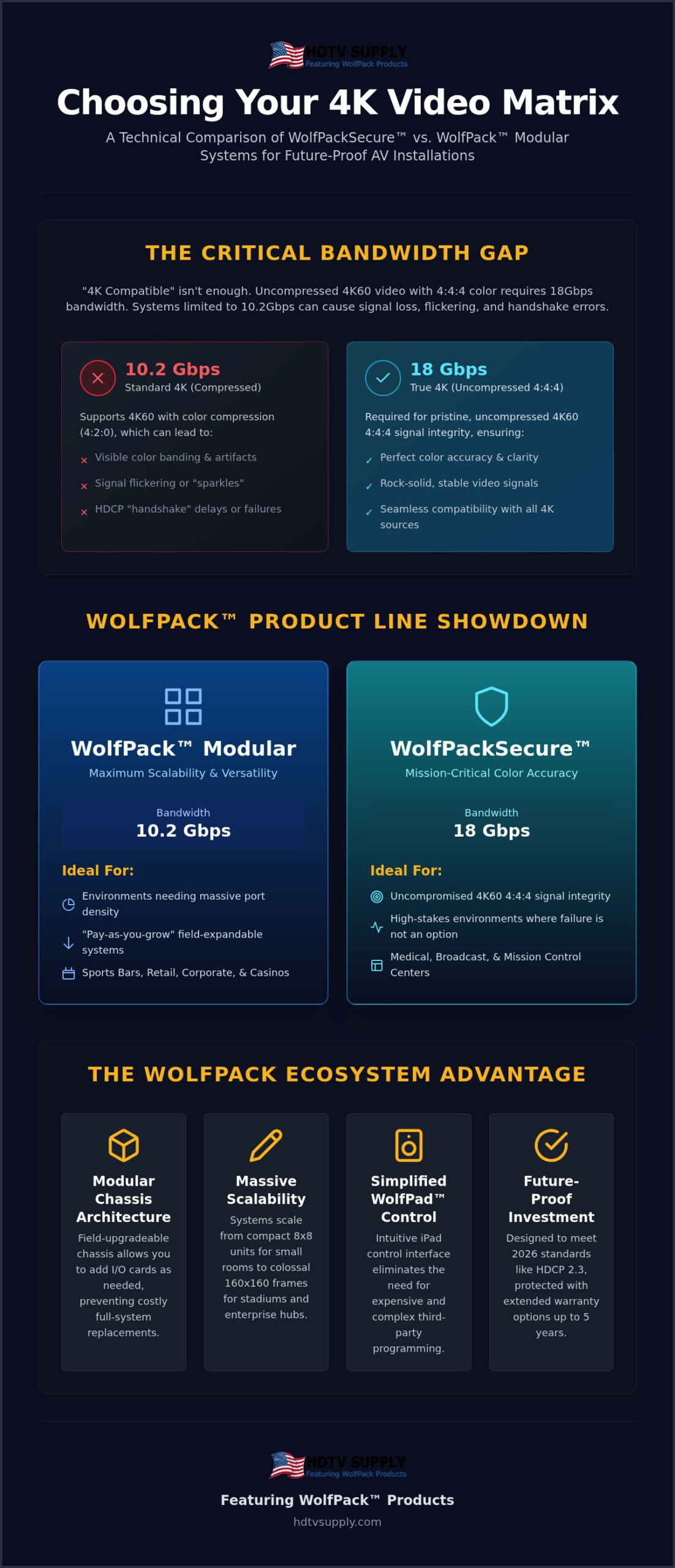
The primary technical divide in the WolfPackSecure vs WolfPack Modular matrix switcher comparison lies in the available bandwidth per port. Standard modular systems typically operate at 10.2Gbps. This is sufficient for 1080p and 4K at 30Hz; however, it hits a hard technical ceiling when attempting 4K60 with full color depth. The WolfPackSecure series elevates this performance to 18Gbps. This extra headroom isn’t just a luxury; it’s a requirement for uncompressed 4K60 4:4:4 signal paths. Without this bandwidth, the system must compress the signal, which often results in visible artifacts or the dreaded “black screen” when the handshake fails under heavy data loads.
Signal integrity is the second major differentiator. When you push a standard 10.2Gbps card to its limit, you risk intermittent blackouts during high-motion scenes or when switching between varied source resolutions. The Secure line is engineered with higher-grade chipsets that maintain a stable 18Gbps throughput. This ensures that mission-critical environments, like surgical suites or live broadcast booths, don’t experience signal drops at pivotal moments. By choosing the Secure series, you’re investing in the stability required for 24/7 commercial operations where downtime isn’t an option.
Chroma Subsampling: 4:4:4 vs. 4:2:0
Chroma subsampling is the compression of color information to save bandwidth. While 4:2:0 subsampling is common in consumer streaming services, it often looks blurry or fuzzy on large 4K displays in a professional setting. This is particularly noticeable around the edges of text or fine lines. In command centers or corporate boardrooms where spreadsheets and high-resolution maps are displayed, 4:4:4 is non-negotiable. Every pixel retains its unique color data, ensuring that text remains sharp and perfectly legible. If your installation involves digital signage or detailed data visualization, the Secure series’ ability to handle uncompressed 4:4:4 is the deciding factor for visual clarity.
Security and Encryption Standards
As we move into 2026, compatibility with HDCP 2.2 and 2.3 is essential for any professional installation. The Secure line features enhanced HDCP management that ensures seamless communication with the latest 4K streaming sources and media players. This prevents the “HDCP Error” messages that plague older or less robust hardware. Deploying a professional-grade HDCP 2.2 matrix switcher is the most reliable way to bridge the gap between legacy hardware and modern 18Gbps content without losing signal integrity. Effective HDMI matrix switcher EDID management is also built into the Secure architecture. This allows the system to pre-negotiate the “handshake” between the source and the display, dramatically reducing switching times and preventing delays when you transition between different video sources. This level of secure switching is what separates professional-grade distribution from entry-level hardware.
Application Matrix: Choosing the Right Switcher for Your Environment
Selecting the correct hardware requires a rigorous audit of your source material and viewer expectations. A high-volume sports bar has vastly different technical requirements than a surgical suite or a government command center. While the underlying modular architecture remains consistent, the choice between a WolfPackSecure vs WolfPack Modular matrix switcher depends heavily on whether your environment prioritizes massive port density or uncompressed color accuracy. You must align your hardware investment with the specific visual standards of your industry to avoid system obsolescence.
The Sports Bar Scenario: Scalability vs. Resolution
For most commercial dining and entertainment venues, the standard WolfPack Modular series is the industry workhorse. If your facility primarily distributes 1080p or 4K30 content across a large number of displays, the standard chassis provides exceptional value. It handles the high port counts required for massive Sports Bar TV Distribution System projects without the added cost of high-bandwidth chipsets. Most patrons won’t notice chroma subsampling differences on a game broadcast while sitting thirty feet from the screen.
The tipping point for an upgrade occurs when you move into high-end HDR10 sports broadcasts or premium viewing lounges. If you’re marketing a “best-in-class” visual experience, the Secure series ensures your 4K60 signals remain uncompressed. Managing these complex systems is simplified through our free iOS and Android apps. You can control 30 or even 100+ TVs from a single tablet, making daily operations efficient for staff. If you’re unsure which tier fits your venue, you can contact our specialists for a free system design to ensure your port count and resolution needs are perfectly balanced.
Mission-Critical Environments
Mission-critical facilities operate under a different set of rules where signal failure or visual distortion can have severe consequences. In medical imaging, 4:4:4 color accuracy is a non-negotiable requirement for diagnostic displays. Standard 4:2:0 compression can blur fine details in X-rays or surgical feeds, making the WolfPackSecure series the only viable choice. These environments also demand hardware redundancy. The Secure chassis options often include dual power supplies to ensure continuous operation even if a primary power source fails.
Government and secure facilities prioritize the “Secure” designation for procurement and data integrity. These installations often require strict adherence to encryption standards and stable EDID management to prevent unauthorized access or signal leakage. In these scenarios, the WolfPackSecure vs WolfPack Modular matrix switcher debate is settled by the need for 18Gbps reliability and enhanced HDCP 2.3 compatibility. Corporate boardrooms also find value here. When presenting detailed spreadsheets or architectural renderings, the text legibility provided by uncompressed 4:4:4 ensures that every attendee sees the data with perfect clarity.
Future-Proofing Your Investment: Warranty, Support, and System Integration
Investing in a high-capacity matrix switcher is a significant capital expenditure. Whether you finalize your choice between a WolfPackSecure vs WolfPack Modular matrix switcher, the hardware is only one part of the equation. Long-term success depends on system integration, ease of use, and a robust support structure. We provide free custom AV system design services to ensure your chassis configuration meets your current port requirements while providing a logical expansion path. This proactive approach eliminates the guesswork from complex Pro AV installations.
Protecting your investment is a priority for commercial operators. We offer extended warranty options that cover your hardware for up to 5 years. In a 24/7 environment like a casino or sports bar, this coverage is essential for maintaining a high ROI and mitigating the risk of unexpected component failure. Our global network of installers and integrators ensures that technical assistance is available regardless of your facility’s location. You don’t have to worry about being left without support after the initial sale.
WolfPad: Control Without Programming
Traditional control systems often require expensive third-party programming from specialists. The WolfPad TV Control Systems change this dynamic by offering a drag-and-drop iPad interface that your existing staff can master in minutes. It simplifies complex switching tasks into intuitive visual commands. You can create custom presets for ‘Game Day’ or ‘Night Shift’ modes; this allows for instant reconfiguration of your entire display network with a single tap. This level of accessibility ensures that your technology serves your business rather than creating a technical hurdle for your team.
Procurement and Long-Term Support
Securing a custom quote for a WolfPackSecure system is a straightforward process. Our specialists analyze your specific signal requirements and environment to build a tailored bill of materials. We handle global shipping and provide dedicated technical support for international integrators, ensuring local installation teams have the data they need for a successful rollout. HDTV Supply has been an industry leader since 1998. This nearly three-decade presence provides the stability you need when selecting a long-term technology partner. When comparing the WolfPackSecure vs WolfPack Modular matrix switcher, remember that you aren’t just buying a box. You’re gaining access to a comprehensive support ecosystem designed for the rigors of modern video distribution. For project managers sourcing hardware at scale, our guide on buying commercial AV equipment online outlines how to ensure 100% system compatibility and eliminate integrator overhead during the procurement process.
Securing Your Pro AV Infrastructure for 2026
Balancing immediate port density with long-term signal integrity is the foundation of a successful 2026 installation. The choice between a WolfPackSecure vs WolfPack Modular matrix switcher ultimately hinges on your need for uncompressed 4K60 4:4:4 color depth and mission-critical reliability. While the standard modular series offers unmatched scalability for high-volume venues, the Secure line provides the 18Gbps bandwidth required for diagnostic clarity and data-intensive environments. You’ve seen how modular architecture prevents hardware obsolescence by allowing simple card swaps instead of total system replacements as technology evolves.
We maintain over 12,000 products in stock to ensure immediate availability for your next project. Our experts provide free custom AV design services and toll-free technical support to guide you through complex system architectures. Your installation deserves a stable, high-capacity hub backed by nearly three decades of industry experience. Take the next step in optimizing your video distribution network with a partner that values technical mastery and efficiency.
Design Your Custom WolfPack System Today and build a distribution network that stands the test of time.
Frequently Asked Questions
What is the primary difference between WolfPackSecure and WolfPack Modular?
The primary difference when comparing a WolfPackSecure vs WolfPack Modular matrix switcher is the total per-port bandwidth. The Secure series operates at 18Gbps; this is required for uncompressed 4K60 4:4:4 video signals. Standard modular systems generally provide 10.2Gbps bandwidth. This makes the standard series ideal for 1080p or 4K30 content, while the Secure series is engineered for mission-critical clarity and high-motion 4K60 video without signal artifacts.
Do I need 4K60 4:4:4 for a standard sports bar?
Most standard sports bars don’t strictly require 4K60 4:4:4 for television broadcasts. Sports content is typically transmitted in formats that 10.2Gbps systems handle with ease. However, if your venue features high-end gaming zones or premium video walls displaying detailed text and HDR10 content, the upgrade becomes necessary. For typical game-day viewing, the standard modular chassis provides the port density you need without the additional expense of high-bandwidth Secure chipsets.
Can I mix and match WolfPackSecure cards in a standard WolfPack Modular chassis?
You cannot mix WolfPackSecure cards with standard modular components within the same chassis. The internal backplane of a standard WolfPack Modular frame is designed for 10.2Gbps throughput and can’t handle the 18Gbps data rates required by Secure series cards. To achieve uncompressed 4K60 4:4:4 performance, you must utilize a dedicated WolfPackSecure chassis. This ensures that every signal path maintains the integrity needed for high-resolution distribution across your entire facility.
How do I control a 32×32 WolfPack matrix switcher from an iPad?
Controlling a 32×32 matrix is accomplished using the WolfPad TV Control Systems interface on your iPad. Unlike traditional systems that require expensive third-party programming, WolfPad uses an intuitive drag-and-drop layout. You simply select your source on the tablet and slide it to the desired display or zone. This visual approach allows staff to manage complex switching tasks instantly. It eliminates the need for physical remotes or complicated command-line entries during busy shifts.
What is the maximum distance I can run a 4K signal using a modular switcher?
The maximum distance depends on the specific card type you install in your modular chassis. Using HDBaseT output cards, you can reliably transmit 4K signals up to 330 feet over a single CAT6 cable. If your installation requires longer runs, you should utilize Fiber cards, which support zero-latency transmission over several kilometers. This flexibility allows a single modular switcher to manage both local displays and remote monitors located in different areas of a large campus.
Does the WolfPackSecure line support HDCP 2.2?
The WolfPackSecure line fully supports HDCP 2.2 and the latest HDCP 2.3 standards as of 2026. This ensures complete compatibility with modern 4K streaming devices, media players, and gaming consoles that require high-level encryption. By maintaining these standards, the Secure series prevents the “handshake” errors and black screens that often occur when using legacy hardware with new sources. It provides a stable, future-proof connection for all your protected high-definition content.
Is a modular matrix switcher more reliable than a fixed-port switcher?
Modular matrix switchers offer significantly higher reliability than fixed-port units due to their card-based architecture. If a single port fails on a fixed switcher, the entire chassis must be sent for repair, causing total system downtime. With a modular system, you simply swap the affected input or output card in the field. This minimizes operational disruptions and extends the technical life of your investment, making it the preferred choice for 24/7 commercial environments.
How does the WolfPad control system differ from a standard web GUI?
A standard web GUI is primarily a technical tool used by IT professionals for initial system configuration and EDID management. In contrast, the WolfPad control system is designed for daily user interaction. It replaces complex menus with a visual, iPad-based interface featuring custom presets and “one-tap” scene changes. While the web GUI handles the background architecture, WolfPad empowers your staff to manage the venue’s displays without needing specialized technical training or assistance.
Leave a Reply
Want to join the discussion?Feel free to contribute!