
Professional Sports Bar AV Equipment List & Proposal Template (2026)
A sports bar with pixelated screens or audio lag isn’t just a technical failure; it’s a direct threat to your venue’s peak-hour revenue. You understand that modern fans demand an immersive, high-definition experience that mirrors the stadium atmosphere. When signal loss occurs over long cable runs or your control system requires a degree in computer science to operate, the guest experience suffers. This is why having a meticulously planned sports bar AV equipment list is the foundation of any successful high-capacity installation.
We’ve developed this resource to bridge the gap between complex engineering and practical, reliable deployment. You’ll gain access to a professional-grade proposal template designed to impress stakeholders and secure project approval. This article outlines how to achieve a zero-latency video distribution system using WolfPack modular matrix switchers and WolfPad TV control systems. We’ll examine the technical specifications required for 4K 60Hz 4:4:4 standards and provide a categorical breakdown of the commercial-grade hardware necessary to eliminate compatibility issues. From system architecture to final hand-off, this guide ensures your infrastructure is built for 2026 standards and beyond.
Key Takeaways
- Learn why zero-latency switching is mandatory for commercial venues and how residential gear creates unacceptable lag during critical game moments.
- Build a high-performance sports bar AV equipment list using WolfPack Modular Matrix Switchers and WolfPad TV Control Systems for seamless iPad management.
- Evaluate the efficiency of HDBaseT versus AV over IP architectures to minimize cost-per-port while maintaining 4K 60Hz 4:4:4 signal integrity.
- Use our professional proposal template to map input/output matrices and present a clear technical roadmap to venue stakeholders.
- Access free custom system design services to ensure your hardware selection provides 99.9% uptime in demanding 24/7 environments.
The Anatomy of a High-Performance Sports Bar AV System
Building a reliable sports bar AV equipment list requires moving beyond consumer-grade logic. A high-performance venue operates as a centralized network where every source must reach every display without hesitation. Unlike a home setup, a commercial system handles dozens of inputs and outputs simultaneously. This architecture relies on a “source-to-screen” path that preserves signal integrity through every junction. If your switching hardware isn’t designed for zero-latency performance, your guests will hear the crowd roar at the bar across the street before the play happens on your screens.
Commercial vs. Consumer AV Gear
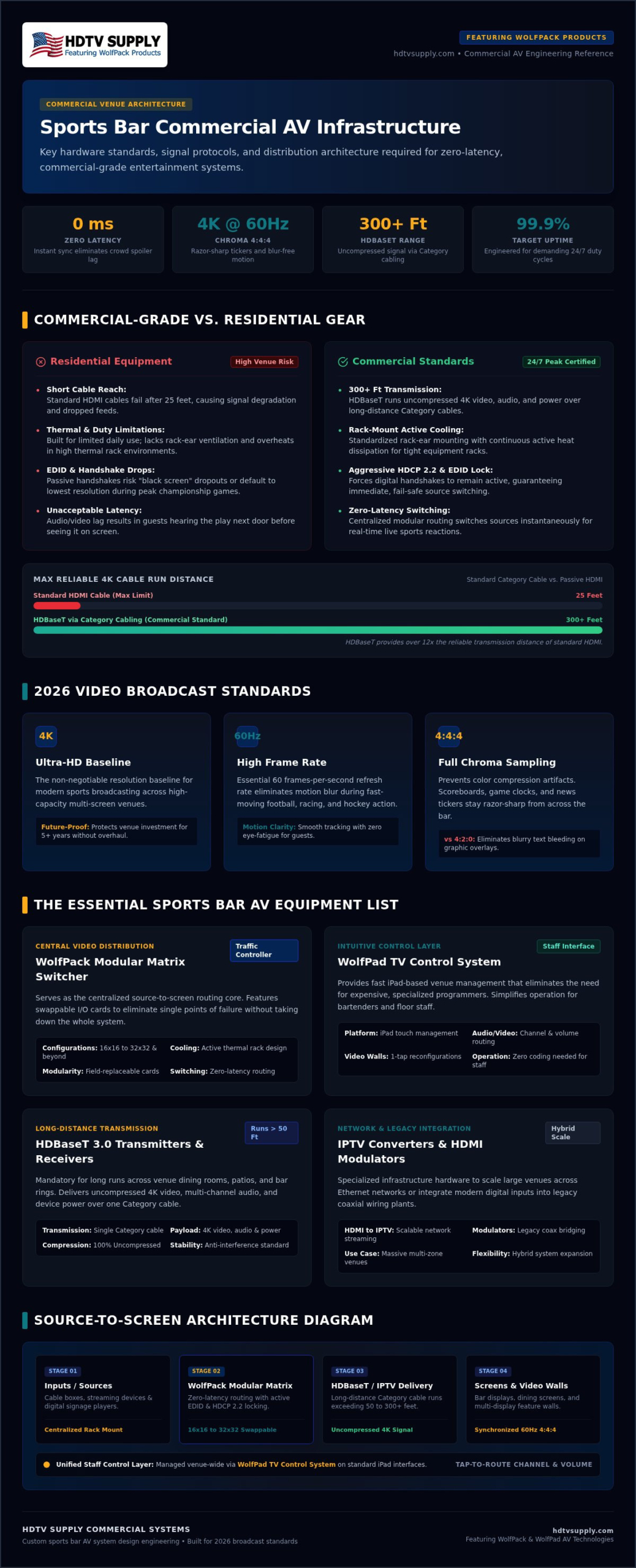
Residential equipment is built for limited duty cycles and short cable runs. In a professional environment, hardware must withstand 24/7 operation and the high thermal loads of a packed equipment rack. Commercial-grade components, such as WolfPack modular matrix switchers, feature active cooling and standardized rack-ear mounting for organized ventilation. Reliable long-distance signal management is also mandatory. While a standard HDMI cable fails after 25 feet, professional systems utilize HDBaseT transmission standards to push 4K video over 300 feet via Category cabling.
Maintaining uptime also requires aggressive HDCP 2.2 and EDID management. These protocols act as the digital handshake between your cable boxes and your displays. Without professional EDID (Extended Display Identification Data) control, your system might default to the lowest common resolution; or worse, trigger a “black screen” during a championship game because of a failed handshake. Commercial systems force these connections to remain active, ensuring immediate switching between sources.
The 2026 Standards: 4K, 60Hz, and Chroma 4:4:4
By 2026, 4K at 60Hz is the non-negotiable baseline for sports broadcasting. High-motion content like football or racing requires a 60Hz refresh rate to eliminate motion blur. Equally critical is Chroma 4:4:4 subsampling. This specification ensures that the fine text on scoreboards and news tickers remains razor-sharp. Systems that compress chroma to 4:2:0 often result in “bleeding” text that’s difficult to read from across the room. Future-proofing your sports bar AV equipment list means selecting hardware that supports these high-bandwidth requirements today. This ensures your investment remains relevant for the next five years of broadcast evolution without requiring a total infrastructure overhaul.
The Essential Sports Bar AV Equipment List
Efficiency is the priority. Your sports bar AV equipment list must prioritize hardware that eliminates single points of failure while providing immediate accessibility for staff. A professional installation requires a combination of high-bandwidth distribution and intuitive user interfaces. Without these core components, your system remains a collection of disconnected screens rather than a unified entertainment environment.
Centralized Management Hardware
The WolfPack Modular Matrix Switcher serves as the traffic controller for your entire venue. It manages signals from cable boxes, streaming devices, and digital signage players, routing them to any display in the building. Modularity is its greatest strength. By utilizing swappable input and output cards, you minimize potential downtime. If a single port encounters an issue, you simply replace the card instead of decommissioning the entire system. This architecture supports configurations from 16×16 to 32×32 and beyond, ensuring scalability as your venue grows.
Managing these sources requires a robust control layer. The WolfPad TV Control System provides iPad-based management that eliminates the need for expensive, specialized programming. Your staff can change channels, adjust volumes, or reconfigure video walls with a single tap. This level of control is often the missing piece in standard equipment lists, yet it’s the most critical for daily operations.
Display and Audio Integration
Stable signal delivery over distance is non-negotiable. For runs exceeding 50 feet, HDBaseT 3.0 transmitters and receivers are mandatory. These devices leverage HDBaseT transmission standards to deliver uncompressed 4K video, audio, and power over a single Category cable. For massive venues, HDMI to IPTV converters allow for virtually unlimited scaling across an existing network infrastructure. If you’re working with legacy coax systems, professional-grade HDMI modulators can bridge the gap between digital sources and older wiring.
Don’t overlook the audio component. Audio de-embedders are essential for pulling sound from HDMI sources to feed into your house sound system. This ensures the commentary on the “big game” is synchronized with the visuals across every zone. For those seeking a tailored solution, you can explore our free custom AV system design services to verify your specific hardware requirements. Finally, dedicated HDMI Video Wall Processors allow you to combine multiple displays into a single jumbo screen, creating a visual centerpiece that defines the venue’s atmosphere.
AV over IP vs. HDBaseT vs. Matrix Switching: Architecture Comparison
Selecting the right architecture is a technical decision that dictates the long-term performance of your sports bar AV equipment list. While several distribution methods exist, the choice usually comes down to a balance of latency, cost-per-port, and scalability. Live sports require zero-latency switching. Traditional matrix systems route signals through a dedicated internal cross-point, eliminating the processing lag common in lower-end IP encoders. If your venue features screens within the same line of sight, even a half-second delay between displays can ruin the fan experience.
Cost-per-port analysis often favors modular matrix switching for mid-sized venues. These systems are plug-and-play, requiring no specialized network configuration. In contrast, AV over IP requires high-bandwidth managed switches and rigorous VLAN management to prevent signal dropouts. Beyond the video, you must consider accessibility. Meeting ADA effective communication guidelines is a federal requirement for hospitality venues. This includes integrating assistive listening systems and ensuring captioning is available across your distribution network to accommodate all guests.
When to Choose a Modular Matrix Switcher
Modular matrix switchers are the ideal choice for bars with 8 to 40 displays located in a concentrated area. The primary benefit is “one box” maintenance. All troubleshooting happens at the central rack, where you can swap input or output cards without deconstructing the entire system. This hardware-based approach is inherently more stable than software-driven network solutions. It provides a reliable foundation for your infrastructure while maintaining 99.9% uptime. For a deeper dive into these systems, consult our Modular HDMI Matrix Switchers: 2026 Pro AV Guide.
When to Implement AV over IP
Scalability is the primary driver for AV over IP. This architecture is best suited for stadiums, casinos, or multi-floor venues where cable runs exceed the limits of traditional HDBaseT. By utilizing existing Cat6 cabling infrastructure, you can expand the system indefinitely by adding more encoders and decoders. However, you must account for the bandwidth requirements of 2026 standards. Distributing 4K 60Hz video requires a robust 10G network to maintain signal integrity and avoid visual artifacts. If your project involves hundreds of displays spread across a massive footprint, the networking complexity of an IP-based system becomes a necessary trade-off for its infinite flexibility.
The AV System Proposal Template: A Step-by-Step Breakdown
A professional proposal transforms a conceptual design into a technical blueprint that stakeholders can approve with confidence. It serves as a contract of expectations between the designer and the venue owner. Your finalized sports bar AV equipment list must be organized into logical sections that address both the hardware requirements and the operational workflow. This structure ensures that every component is accounted for and that the system’s logic is transparent to the end user.
The first section of your proposal is the Executive Summary and Venue Goals. Clearly state the total TV count and source count. This provides an immediate sense of the project’s scale. Section two introduces the Input/Output (I/O) Matrix. This technical grid maps specific cable boxes, streaming devices, and media players to designated bar zones. It’s the most critical part of the document for understanding signal flow. Section three provides the exhaustive Hardware Specifications, listing every switcher, extender, and cable required. Finally, section four defines the Control Strategy. It explains the staff’s interaction with the system, specifically how they will execute channel changes and volume adjustments during a busy shift.
Defining Your Zones and Sources
Organize your venue by categorizing displays into ‘Main Bar,’ ‘Dining,’ and ‘Outdoor’ zones. This segmentation allows you to group screens that will typically show the same content, simplifying the routing process. Don’t overlook local inputs. Your system should accommodate temporary sources like laptops for trivia nights or gaming consoles for private parties. EDID management is the handshake that ensures every source matches every screen’s resolution. Proper zone mapping ensures that your sports bar AV equipment list accounts for the specific environmental challenges of each area, such as high-brightness screens for outdoor patios or specialized audio de-embedders for the dining room’s house sound. Clear physical identification is just as vital; organizing patch bays, switchers, and cable runs with professional labeling systems from DuraFast Label Company ensures technicians can troubleshoot connections quickly without confusion.
Calculating Cable and Accessory Needs
Reliability often depends on the components that are hidden from view. Determine the correct length and gauge for 4K-rated HDMI cables to avoid signal dropouts or digital artifacts. Your infrastructure must include professional rack shelves, power conditioners, and active cooling fans. High-density racks generate significant heat; without proper ventilation, your modular matrix switchers may suffer from thermal throttling. For detailed insights on expanding your system, see 2026 Sports Bar TV Distribution: Scaling for Success. If you need technical validation for your specific configuration, contact HDTV Supply for a comprehensive system review before you finalize your hardware order.
Finalizing Your Equipment List with HDTV Supply
Moving from a technical proposal to a live installation requires a procurement partner with a comprehensive inventory and deep engineering expertise. Your sports bar AV equipment list is only as effective as the hardware that supports it. At HDTV Supply, we provide access to a catalog of over 12,000 professional AV products, ensuring you find the exact modular cards, extenders, and processors required for your specific venue. Beyond simple distribution, we offer free custom AV system design services to verify your architecture before you place an order. This technical audit prevents costly compatibility errors and ensures your system achieves the 99.9% uptime your business demands.
Performance in 2026 is defined by bandwidth. Our WolfPackSecure 4K 60 4:4:4 HDMI Matrix Switchers are engineered for the highest broadcast standards, delivering uncompressed video without the artifacts seen in lower-tier systems. We understand that a sports bar is a high-stress environment for electronics. To protect your investment, we provide extended warranties and lifetime technical support on our core systems. This authoritative approach to hardware ensures that your venue remains a leader in the local market, capable of handling future broadcast shifts without a total infrastructure replacement.
The WolfPad Control Experience
The most common failure point in large-scale installations is a control system that is too complex for the staff to operate. The WolfPad system solves this by eliminating the need for expensive third-party programmers and proprietary code. It provides a clean, iPad-based interface that your team can master in minutes. You can customize the layout to match your specific zones, allowing for seamless drag-and-drop management of over 100 screens. This level of accessibility ensures that channel changes happen instantly during peak hours, keeping your customers engaged and your staff focused on service. For hospitality venues looking to mirror that operational speed across front-of-house workflows, integrating tools from Shift4 POS UK ensures fast order processing and seamless guest service during the busiest matchdays.
Ordering and Technical Support
We position ourselves as the direct source for installers and venue owners, allowing you to bypass the significant markups of traditional integration firms. This maximizes your project margins while providing direct access to commercial-grade hardware. Our commitment to your success extends beyond the shipping dock. You have access to 24/7 technical support for configuration assistance and real-time troubleshooting. Whether you are scaling a single location or a national franchise, our team provides the stability and resources of a global hub. To ensure your hardware selection is optimized for your venue, contact our experts for a free AV system design review today. We will help you refine your sports bar AV equipment list to ensure a flawless execution on opening day.
Master Your Venue’s Digital Infrastructure
Successful sports bar installations rely on more than just high TV counts; they require a balanced architecture that prioritizes zero-latency switching and intuitive staff control. You’ve learned how modular systems like WolfPack and WolfPad eliminate the complexity of traditional integration while maintaining the high-bandwidth requirements of 2026 broadcast standards. By organizing your sports bar AV equipment list into a structured proposal, you ensure technical clarity and project approval from the start. This methodical approach minimizes downtime and prepares your venue for future technological shifts.
Ready to finalize your design? Build Your Custom Sports Bar AV System with HDTV Supply and leverage our inventory of over 12,000 professional products. Our team provides free custom AV design services and 24/7 technical support to ensure your installation performs flawlessly on opening day. Don’t leave your venue’s uptime to chance. Access the commercial-grade hardware and expert consultation needed to create an unrivaled atmosphere for every fan.
Frequently Asked Questions
What is the best way to distribute 4K video to 20+ TVs in a sports bar?
The most efficient method to distribute 4K video to 20 or more displays is through a WolfPack Modular Matrix Switcher. This hardware serves as the core of your sports bar AV equipment list, providing a centralized hub where any source can be routed to any screen. Unlike consumer splitters, these professional systems maintain signal integrity and 4K 60Hz resolution across every output, ensuring that high-motion sports content remains fluid and sharp for every guest.
Can I control my bar’s TVs from an iPad without a monthly subscription?
You can absolutely control your venue’s television network from an iPad without incurring recurring monthly subscription costs. The WolfPad TV Control System is a hardware-driven solution that provides a one-time purchase model for venue management. It eliminates the need for expensive programming and SaaS fees, allowing your staff to manage channel changes and video walls through a simple interface that resides on your local network rather than a cloud-based service.
Do I need a matrix switcher or an AV over IP system for my bar?
Choosing between these architectures depends on your venue’s scale and latency requirements. A modular matrix switcher is the superior choice for most bars because it offers zero-latency switching, which is critical for live sports. AV over IP is better suited for massive installations like stadiums where you need to scale beyond 40 displays. For a standard sports bar AV equipment list, the plug-and-play nature of a matrix system usually provides better reliability.
How do I prevent signal loss on long HDMI cable runs?
Preventing signal loss over distances exceeding 50 feet requires moving away from standard HDMI cables and utilizing HDBaseT technology. By using HDBaseT transmitters and receivers, you can send uncompressed 4K video and control signals over a single Cat6 cable for up to 330 feet. This method bypasses the attenuation issues common with long-run copper cables, ensuring that every display in your venue receives a clean signal without artifacts or digital dropouts during the game.
What is the difference between a video wall processor and a matrix switcher?
A matrix switcher routes multiple video sources to multiple individual displays, while a video wall processor takes a single source and stretches it across multiple TVs to create one large image. While a matrix switcher is essential for showing different games on different screens, a dedicated HDMI Video Wall Processor is what creates the jumbo screen effect. Some advanced modular matrix systems can perform both functions, giving you maximum flexibility for your venue’s layout.
Is HDCP 2.2 compatibility necessary for sports bar TV systems?
HDCP 2.2 compatibility is mandatory for any modern sports bar system. This content protection standard is required to display 4K video from sources like cable boxes, satellite receivers, and streaming devices. If any component in your signal chain lacks this compatibility, the digital handshake will fail, resulting in a black screen or a downgraded 1080p image. Ensuring every switcher, extender, and display is HDCP 2.2 compliant is critical for maintaining a high-definition experience.
How can I manage different audio sources in a multi-zone bar?
Managing multiple audio zones requires using matrix switchers with audio de-embedding capabilities or dedicated audio breakout ports. This allows you to pull the sound from any HDMI source and route it directly to your house sound system or specific amplifiers. You can then assign different audio sources to different zones, such as the main bar or patio, ensuring the commentary for the big game is heard exactly where it’s needed without interference.
Does HDTV Supply provide on-site installation for their equipment?
HDTV Supply does not provide on-site installation services. We function as a high-volume distributor and technical consultant, specializing in the direct sale of professional-grade hardware to installers and venue owners. While we don’t perform the physical setup, we provide 24/7 technical support and free custom system design services to assist you throughout the configuration process. This direct model allows you to avoid the high markups associated with full-service integration firms.
Leave a Reply
Want to join the discussion?Feel free to contribute!