

4K Video Distribution Over IP: Pro AV Guide 2026
Why are you still tethering your facility to the rigid port limits of traditional hardware when your network switch offers infinite scalability? The fixed-port matrix switcher is quickly becoming a bottleneck in modern Pro AV design. You’ve likely dealt with the frustration of signal dropouts on long cable runs or the high costs of proprietary 4K extenders that refuse to play nice with your gear. It’s a common challenge for installers who need to deliver a reliable 4k video distribution over IP system with visually lossless 4K 60Hz 4:4:4 performance without the headache of complex network configurations or crippling latency in live environments.
This guide will help you master the technical architecture and hardware requirements needed to deploy a scalable video network that grows alongside your venue. You’ll learn how to bypass the limitations of legacy systems to achieve a future-proof installation. We’ll break down the latest standards for 2026, explain how to manage multiple screens from a single WolfPad TV Control System interface, and detail the specific hardware, such as WolfPackSecure 4K 60 4:4:4 HDMI Matrix Switchers, required for professional-grade results. From local networks to wide area deployments, this is your roadmap to high-capacity video distribution.
Key Takeaways
- Eliminate the 100-meter distance limitations of traditional HDBaseT cabling by transitioning to a flexible, Ethernet-based backbone.
- Ensure visually lossless performance for high-detail text and video by prioritizing 4K 60Hz 4:4:4 standards across your infrastructure.
- Optimize system stability using IGMP Snooping and Layer 3 managed switches to prevent network flooding and signal dropouts.
- Leverage 4k video distribution over IP with WolfPackSecure hardware to build a modular system that scales infinitely beyond fixed port limits.
- Centralize management of massive display arrays using the WolfPad tablet interface for seamless, single-point control of every screen.
Understanding 4K Video Distribution Over IP (AVoIP)
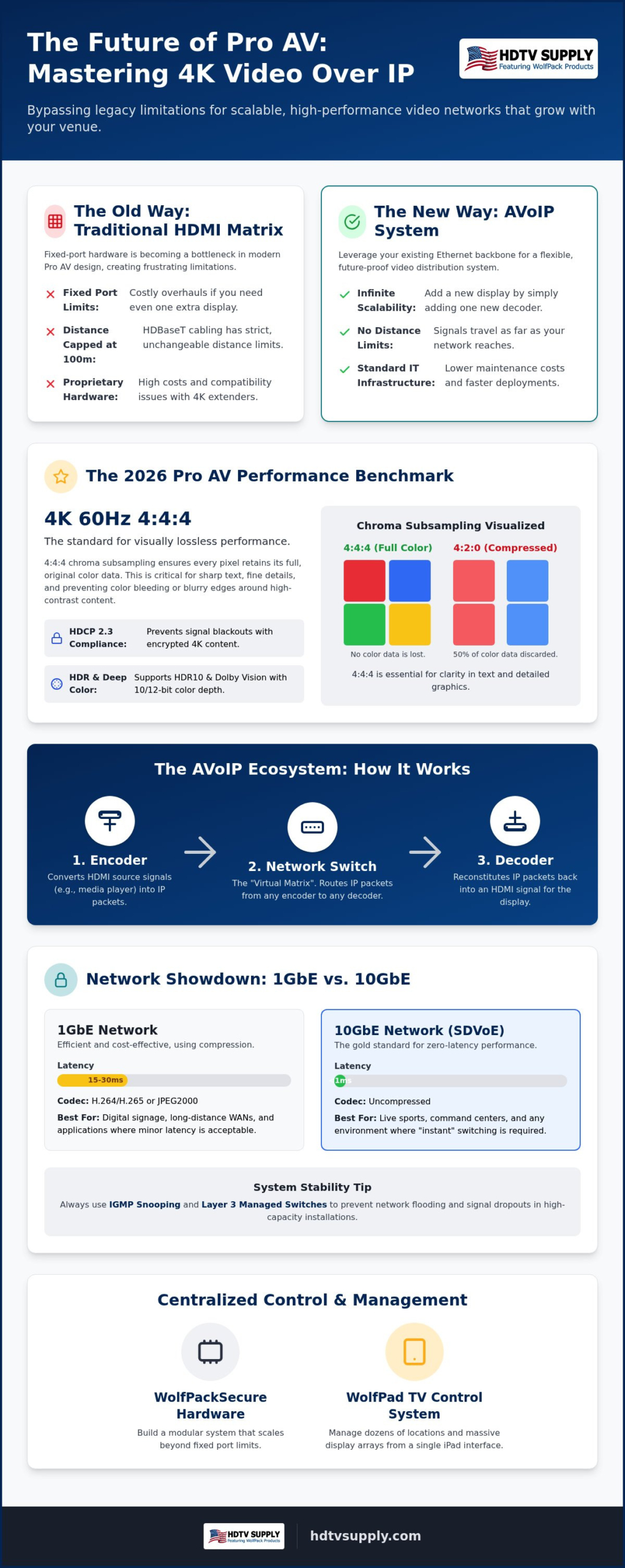
AVoIP represents a fundamental shift from proprietary cabling to standard IT infrastructure. It’s the transmission of audio-visual signals over standard Ethernet networks. Unlike traditional HDBaseT setups, which are physically tethered by a strict 100-meter distance limit, 4k video distribution over IP allows signals to travel as far as your network reaches. By 2026, this technology has reached a critical tipping point. High-performance 4K 60Hz video is now the baseline requirement for professional installations, achievable over both 1GbE and 10GbE networks. While 1GbE utilizes sophisticated compression to fit high-resolution data into smaller pipes, 10GbE enables uncompressed or SDVoE performance with zero latency. As price parity between these standards continues to narrow, the choice between them now depends entirely on your specific bandwidth and latency tolerances.
The Core Components of an IP Video Network
The AVoIP ecosystem relies on three primary hardware layers to function. Encoders sit at the source, converting HDMI signals into synchronized IP packets. Decoders reside at the display, reconstituting those packets back into a high-quality HDMI stream for the viewer. The network switch acts as the “Virtual Matrix” for the entire system. It handles all routing and signal distribution, replacing the bulky, fixed-chassis hardware of the past. This architecture ensures that your signal path is only limited by the capacity of your network switch, rather than the physical ports on a single piece of hardware.
Benefits of Scalability and Flexibility
Traditional matrix switchers often force you into a “fixed port” corner. If you invest in a 16×16 matrix and later require a 17th TV, you’re looking at a costly and complex system overhaul. 4k video distribution over IP breaks this barrier entirely. Adding a new display only requires the addition of a single decoder to the existing network. This modular approach is essential for high-capacity venues such as sports bars, stadiums, and casinos where screen counts frequently grow over time.
Centralized management is another major advantage. Systems like WolfPack Modular Matrix Switchers allow you to integrate these components into a cohesive unit that is easy to maintain. When paired with the WolfPad TV Control System, you can manage dozens of diverse locations from a single iPad interface. This setup eliminates the need for complex control programming and provides a streamlined way to verify signal integrity across a massive facility. For professionals, this means faster deployments and significantly lower long-term maintenance costs compared to legacy point-to-point systems.
Technical Standards: 4K 60Hz, 4:4:4, and Bandwidth
High-end Pro AV installations require precision. 4K 60Hz 4:4:4 performance is the benchmark for 2026. Chroma subsampling at 4:4:4 ensures every pixel keeps its original color data. This is critical for sharp text in boardrooms and fine architectural details in casinos. Lower standards like 4:2:0 often cause color bleeding or blurry edges around high-contrast content. When you deploy 4k video distribution over IP, verify HDCP 2.3 compliance. This prevents signal blackouts when streaming encrypted 4K content from media players or satellite boxes.
Bandwidth dictates your latency levels. 1GbE networks rely on sophisticated compression to manage data. This often introduces 15 to 30 milliseconds of latency. While acceptable for digital signage, it’s often perceptible in live sports environments. In contrast, 10GbE networks support uncompressed streams with sub-millisecond performance. This provides the “instant” switching experience that professional users expect. Choosing the right infrastructure depends on whether your priority is bandwidth efficiency or raw, uncompressed speed.
Codec Comparison: H.264, H.265, and JPEG2000
H.264 and H.265 codecs offer high efficiency. They’re ideal for distributing 4K video over long-distance WANs where bandwidth is limited. JPEG2000 serves as the middle ground for high-quality LAN distribution. It offers a balance between image quality and manageable bitrates. SDVoE remains the gold standard for zero-latency applications. SDVoE (Software Defined Video over Ethernet) is an industry standard that requires a 10Gbps network to deliver uncompressed 4K video with zero latency.
HDR and Deep Color Support over IP
Modern displays demand HDR10 and Dolby Vision support to provide high-contrast visuals. Maintaining this metadata through an IP network requires encoders and decoders capable of processing 10-bit or 12-bit color depth. Heavy compression can strip this metadata or cause “banding” in professional grading environments. For mission-critical displays, utilizing WolfPackSecure 4K 60 4:4:4 HDMI Matrix Switchers ensures that color depth and HDR metadata remain intact from source to screen. This level of signal integrity is what separates a professional 4k video distribution over IP system from a consumer-grade workaround.
AVoIP vs. Traditional HDMI Matrix Switchers
Choosing between a physical matrix and a network-based system depends on your venue’s growth trajectory. Traditional HDMI matrix switchers rely on a fixed chassis. If you purchase a 16×16 matrix, you’re locked into those 16 ports. Expansion requires replacing the entire unit, creating a technical dead end for growing venues. In contrast, 4k video distribution over IP utilizes a network backbone. You simply add an encoder or decoder to the switch to expand. This eliminates the need for bulky HDMI or Cat6 bundles. A single fiber or copper trunk carries all signals, significantly reducing wiring complexity and labor costs during installation.
Reliability also favors the distributed nature of IP. A traditional matrix is a single point of failure; if the main board dies, the entire system goes dark. IP networks offer inherent redundancy. If one decoder fails, only that specific display is affected. You can also deploy redundant network switches to ensure 100% uptime in mission-critical environments. From a cost perspective, the price per port for IP distribution becomes more attractive as the system grows. While a small matrix might be cheaper initially, the scalability of IP systems provides a lower total cost of ownership for any facility planning to expand beyond 32 endpoints.
When to Choose a Modular Matrix Switcher
Pure hardware switching remains the best choice for small-to-medium installs where sub-millisecond timing is non-negotiable. WolfPack Modular Matrix Switchers provide a “Zero Latency” advantage by routing signals through a high-speed internal backplane rather than packetizing data. These systems are ideal for boardrooms or sports bars that don’t require complex IT management. Setup is simplified because there’s no network configuration or IGMP snooping required. You get plug-and-play reliability with field-replaceable parts, ensuring the system stays operational without needing an IT specialist on standby.
The Case for Video Over IP in Large Venues
Large-scale deployments in stadiums, casinos, or multi-floor corporate offices make IP the only viable path. Scaling beyond a 32×32 or 64×64 footprint with traditional hardware is physically cumbersome and prohibitively expensive. A 4k video distribution over IP ecosystem allows you to integrate over 100 screens and multiple video walls into a single, cohesive network. You gain the flexibility to change sources and destinations via software without ever touching a cable. This architecture also allows you to blend digital signage and live video feeds across the same infrastructure, maximizing your hardware investment while maintaining 4K 60Hz 4:4:4 performance across the entire facility.
Network Requirements for 4K Video Distribution
A reliable 4k video distribution over IP system is only as strong as the underlying network infrastructure. For professional environments, Layer 3 managed switches are the standard. While Layer 2 switches can handle small, isolated setups, Layer 3 hardware provides the advanced routing capabilities needed to manage traffic between different VLANs. You must also prioritize switches that support Power over Ethernet (PoE). This allows you to power your encoders and decoders directly through the network cable, eliminating the need for local power outlets at every display. By 2026, Cat6a cabling has become the minimum requirement for these installations. It provides the necessary shielding and bandwidth to support 10Gbps data rates over longer distances without signal degradation.
IGMP Snooping is a mandatory requirement for any multicast video network. Without it, the switch treats multicast video streams like broadcast traffic, sending data to every single port. This quickly leads to network flooding and total system collapse. Enabling IGMP Snooping ensures that video data is only sent to the specific decoders requesting it. This efficiency preserves bandwidth for other critical network functions and maintains the integrity of your 4K 60Hz signals.
Configuring Your Network for Multicast
Proper configuration prevents common performance bottlenecks. Follow these steps to prepare your switch for high-capacity video traffic:
- Enable IGMP Snooping and Querier: This allows the switch to track which ports belong to which multicast groups. The Querier manages the membership tables to keep traffic flowing to the correct endpoints.
- Configure VLANs: Isolate your video traffic onto its own Virtual LAN. This prevents high-bandwidth video streams from interfering with your primary data network or VoIP systems.
- Enable Jumbo Frames: Set your MTU to 9000 bytes or higher. 4K video packets are significantly larger than standard data packets; Jumbo Frames allow the switch to process this data more efficiently with less CPU overhead.
Bandwidth Management and Bottlenecks
You must calculate your total throughput requirements before selecting hardware. For example, if you’re running 20 streams at 800Mbps each, your network must handle a continuous 16Gbps load. This makes 10Gbps uplinks vital when stacking multiple switches together. A standard 1Gbps link between switches will immediately bottleneck your system. A non-blocking backplane is critical for AVoIP switches to ensure every port can transmit at full wire speed simultaneously without internal congestion. To ensure your hardware meets these rigorous demands, consider the specialized performance of WolfPackSecure 4K 60 4:4:4 HDMI Matrix Switchers for your next deployment.
Scaling with WolfPack and WolfPad Solutions
Scaling a 4k video distribution over IP system requires hardware that can keep pace with 2026 standards. WolfPackSecure 4K 60 4:4:4 hardware is engineered specifically for this high-bandwidth environment. It handles the 18Gbps throughput needed for visually lossless performance without the stuttering or artifacts found in consumer-grade gear. These units integrate directly into your network backbone, allowing you to build massive video walls using only standard IP decoders. You don’t need a standalone video wall processor because the software inside the decoders manages the bezel correction and signal splitting across multiple screens. This modularity ensures your system remains flexible as your venue’s needs evolve.
HDTV Supply simplifies these complex deployments by offering “no-programming” solutions. Traditional AV systems often require weeks of custom coding and expensive onsite specialists. By contrast, WolfPack systems are designed for rapid deployment. The hardware arrives ready to communicate with your managed switches, reducing the technical friction that often stalls large-scale Pro AV projects. This efficiency is critical for installers who need to move quickly from one project to the next while maintaining high performance standards.
The WolfPad TV Control System
Managing a complex network shouldn’t require a computer science degree. The WolfPad TV Control System provides a visual drag-and-drop interface on an iPad that simplifies every interaction. Staff in sports bars, restaurants, or casinos can change sources across 30 or more TVs in seconds. You can create “Game Day” presets that update every screen in the venue with a single tap. This eliminates the need for expensive third-party control programmers who charge for every minor system adjustment. It’s an intuitive way to manage 4k video distribution over IP without the administrative overhead of legacy control systems.
Reliability and Support for Pro Installers
Professional installers need more than just a box of hardware; they need a reliable partner. HDTV Supply provides expert technical support specifically for IP configuration, helping you navigate the VLAN and multicast setups mentioned earlier. Every WolfPack system features field-replaceable parts to minimize downtime and protect your investment. Extended warranties and service contracts are available for mission-critical environments where a signal blackout isn’t an option.
Explore WolfPack 4K Video over IP Solutions to see how these systems can transform your next high-capacity installation. From global technical support to a catalog of over 12,000 products, you have the resources needed to deliver a world-class video network.
Future-Proof Your AV Infrastructure Today
Transitioning to a network-based architecture is the only way to ensure your facility remains competitive through 2026 and beyond. By prioritizing 4K 60Hz 4:4:4 standards and configuring your network with Layer 3 switches and IGMP snooping, you eliminate the physical bottlenecks of legacy hardware. You’ve seen how WolfPack modular technology provides the field-replaceable reliability that professional installers demand. Implementing a robust 4k video distribution over IP system doesn’t just solve today’s signal distance issues; it provides an infinite growth path for your venue. Whether you’re managing a sports bar or a massive casino, the flexibility of IP-based routing ensures you’ll never be limited by a fixed number of ports again.
With over 12,000 Pro AV products in stock and toll-free technical support for installers, HDTV Supply is ready to assist with your next deployment. Shop Professional 4K Video Over IP Systems at HDTV Supply to start building a more flexible, high-performance network today. Take control of your video distribution and build a system that scales without limits.
Frequently Asked Questions
What is the maximum distance for 4K video distribution over IP?
Standard copper runs are limited to 100 meters per segment using Cat6a cabling. However, because AVoIP utilizes standard network switches, you can extend this distance indefinitely by adding switches as repeaters or utilizing fiber optic links. Fiber allows for runs spanning several kilometers between buildings. This makes 4k video distribution over IP far superior to traditional HDBaseT setups that die out after 330 feet without expensive active boosters.
Do I need a 10Gbps network for 4K 60Hz video?
You don’t strictly need 10Gbps for all 4K 60Hz applications. 1Gbps networks handle compressed 4K signals effectively using JPEG2000 or H.265 codecs. However, if your project requires uncompressed, zero-latency video via SDVoE, a 10Gbps infrastructure is mandatory. Most professional venues are moving toward 10GbE in 2026 to ensure their backbone can handle the 18Gbps throughput required for visually lossless 4:4:4 color depth without compromise.
Can I use my existing office network for a video distribution system?
It’s possible but generally discouraged for professional environments. High-resolution video streams consume massive amounts of bandwidth and can easily choke standard data traffic like VOIP or cloud backups. If you must share a network, you’ll need a Layer 3 switch to configure strict VLAN isolation and IGMP snooping. This prevents the video packets from flooding your office computers while ensuring the displays receive a steady, uninterrupted signal.
What is the difference between H.264 and SDVoE for 4K video?
H.264 is a highly compressed codec designed for efficiency over long distances or limited bandwidth. It introduces noticeable latency, often exceeding 100ms. SDVoE is the gold standard for Pro AV, offering uncompressed 4K 60Hz 4:4:4 video with sub-millisecond latency. While H.264 is excellent for streaming to remote sites, SDVoE is the preferred choice for in-room distribution where instant switching and absolute image clarity are required.
How many 4K sources can I have in an IP-based distribution system?
Your source count is virtually unlimited. Unlike a fixed 16×16 or 32×32 matrix, an IP-based system is only restricted by the number of available ports on your network switches. You can start with four sources and scale to 400 simply by adding more encoders and expanding your switch fabric. This modularity makes 4k video distribution over IP the most cost-effective solution for large-scale sports bars and corporate campuses.
Is latency a problem when watching live sports on an IP video system?
Latency isn’t a problem if you select the correct hardware and network configuration. If you use 1Gbps compressed systems, you might experience a delay of one or two frames, which is often unnoticeable. For mission-critical live environments where every millisecond counts, SDVoE hardware provides zero-latency performance. This ensures the audio from the house speakers stays perfectly synced with the action on the screens without any perceptible lag.
Do I need to be a network engineer to set up 4K video over IP?
You don’t need to be a network engineer if you choose the right hardware provider. Systems like the WolfPackSecure series are designed for Pro AV installers, offering no-programming setups that work out of the box. While basic knowledge of IP addressing is helpful, HDTV Supply provides toll-free technical support to guide you through switch configuration. This allows you to deploy complex systems without hiring expensive outside IT consultants.
What happens if the network switch fails in an AVoIP system?
If a single network switch fails, every device connected to that switch will lose signal. This is why professional installers often use redundant core switches or stacked configurations in mission-critical environments. If one unit goes offline, the backup switch takes over the traffic immediately. Additionally, because the system is modular, a failure in one decoder only affects a single display, rather than taking down the entire facility like a matrix board failure.
Leave a Reply
Want to join the discussion?Feel free to contribute!