

HDBaseT certification explained: what it covers and why
HDBaseT certification, explained in practical terms, is a compliance test for products built to the HDBaseT standard. Products are tested against a Golden Unit to assess operation and feature functionality. Certification confirms compliance, but it doesn’t guarantee support for every 5Play feature or interoperability with every certified product.
HDBaseT can extend uncompressed 4K video and audio over Category cable, while its 5Play feature set brings together audio and video, control, Ethernet, USB, and up to 100 W of power. The important distinction is that support varies by product and HDBaseT version. This guide explains what certification covers, how signal extension and power over cable work, and how HDBaseT compares with other connection options. You’ll also see what certification can tell you, and where product-specific capabilities still matter when planning an AV system.
Key Takeaways
- Distinguish product certification from cable certification: they assess different aspects of standards compliance and power delivery.
- Match the HDBaseT version, cable category, and required video format to the distance your signal path needs to cover.
- Compare supported USB, Ethernet, control, and power functions by product rather than assuming every device delivers the full feature set.
- Use the class and certification details to narrow system options, then select switching and control equipment that fits your AV layout.
Power over HDBaseT cable certification
Power over HDBaseT (PoH) cable certification evaluates power delivery and data performance. It matters when a cable carries both AV signals and electrical power.
Choose cable by chipset, resolution, and run length. For 4K, Cat6A or Cat7 supports up to 90 meters with a Class A (VS1000) chipset, while Class C (VS2310) supports up to 100 meters with Cat6, Cat6A, or Cat7. HDBaseT 3.0 recommends Category 6A U/FTP cable, whose foil shielding helps limit electromagnetic interference.
Independent Testing and Recognized Facilities
HDBaseT cable certification uses independent testing at Alliance-recognized facilities, including two HDBaseT Alliance-ratified testing facilities. Testing checks cable performance and, for PoH, safe power transmission. Precisely terminated cables are tested with official “gold certified” equipment, providing a controlled assessment rather than relying on a cable label alone.
PoH cable certification evaluates cables carrying up to 100 W over four copper pairs while maintaining HDBaseT data performance. UL Solutions evaluates PoH cables under UL 4299 and audits certified cables at manufacturing plants. Applicants can begin product testing through UL, while Alliance members find current procedures, requirements, and fees in the latest RTF Policy document in the Member Zone. Costs follow those listed fees; timing depends on the testing required for the product or cable.
Certification Levels and Product Requirements
HDBaseT product certification tests a device against a Golden Unit to assess operation and feature functionality. Product certification participation is open to HDBaseT Alliance members, and HDBaseT-enabled products are tested before market release under Alliance bylaws. Certification confirms compliance with the standard, not support for every 5Play feature.
Cable certification is a separate assessment. HDBaseT 3.0 cable testing covers two categories, standard and premium; HDBaseT Recommended cables are tested in Alliance-recognized facilities. For fixed installations, solid-core cable is recommended over stranded cable. Correct termination also matters because certified cable testing uses precisely terminated samples.
Benefits and Risks of Certification
For manufacturers, certification shows that a product or cable has been assessed against applicable HDBaseT requirements. For buyers, it provides a basis for comparing tested performance and cable suitability, including PoH power transmission. Certified products may still not interoperate with every other certified device, so supported features and manufacturer disclaimers matter when designing a system.
Non-certified equipment or cables lack that certification assessment, creating uncertainty about standards compliance, signal performance, and safe PoH use. In particular, a cable not evaluated for bundled power transmission hasn’t passed the PoH cable program’s 100 W safety and performance testing. Certification reduces that uncertainty, but it doesn’t replace checking the capabilities needed for a specific system.
HDBaseT signal transmission and the 5Play feature set
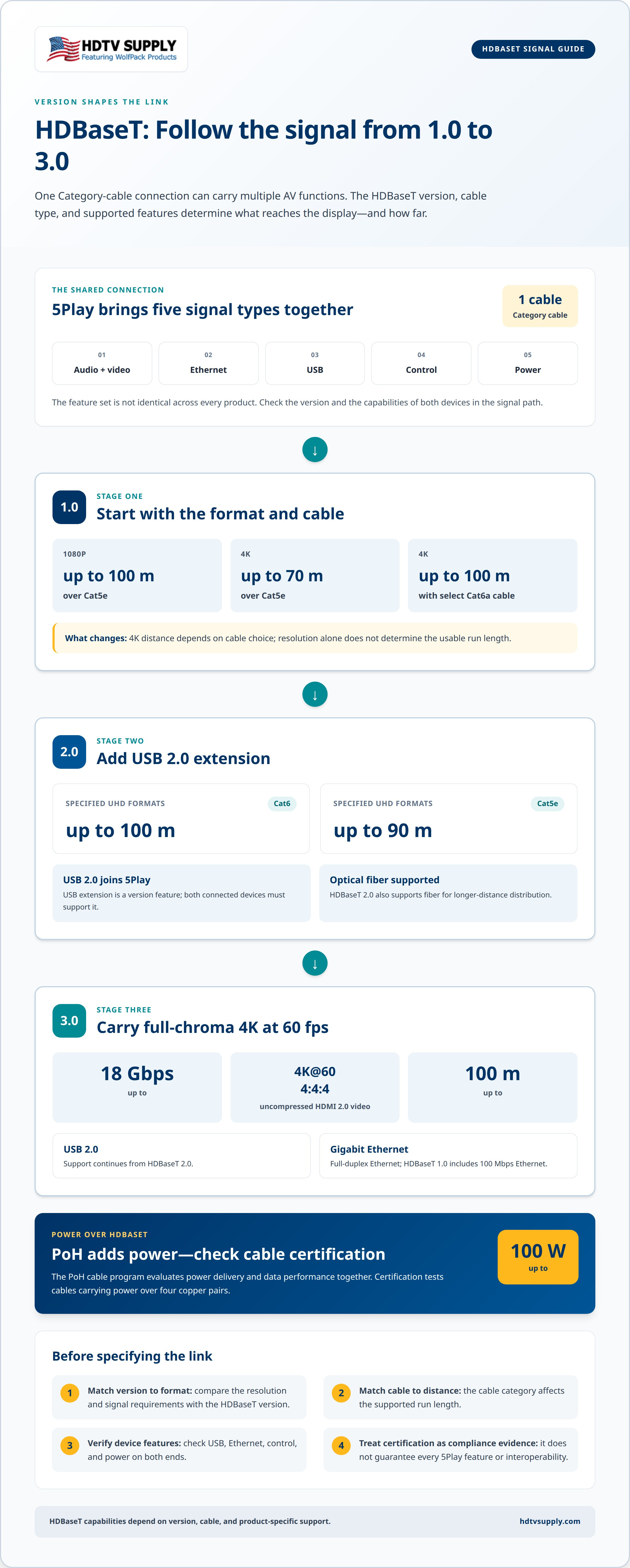
HDBaseT carries uncompressed video and audio alongside control and other signals over Category cable. Its 5Play feature set combines audio and video, Ethernet, USB, control signals, and power on one connection. The practical advantage is consolidating functions that might otherwise need separate links between source and display devices.
Version and cable type shape signal capabilities. HDBaseT 1.0 supports 1080p up to 100 m over Cat5e, while 4K over Cat5e reaches up to 70 m. With select Cat6a cable, 1.0 can carry 4K up to 100 m. These figures show why resolution alone doesn’t determine usable distance.
HDBaseT 2.0 adds USB 2.0 extension to 5Play and supports optical fiber for longer-distance distribution. For its specified UHD formats, it reaches up to 100 m over Cat6 or 90 m over Cat5e. That makes cable category a key comparison point when preserving the required format across a longer run.
HDBaseT 3.0 supports up to 18 Gbps and uncompressed HDMI 2.0 video at 4K@60 4:4:4, reaching up to 100 m. This matters when a system needs full-chroma 4K at 60 frames per second rather than a lower-bandwidth format. Its USB 2.0 support also carries forward a feature introduced in version 2.0.
HDBaseT certification explained alongside product-specific feature lists helps distinguish standard compliance from actual device capabilities. Certification confirms compliance, but doesn’t establish support for every 5Play feature or interoperability with every certified device. Compare version, resolution, cable category, and required control or USB functions. HDBaseT certification explained in the context of signal transport also clarifies the difference from HDMI’s stated native limitation of 15 meters: HDBaseT can extend signals up to 100 m over standard Category cable.
USB, Ethernet, control, and power distribution
HDBaseT’s 5Play design combines several signal types on one Category cable, but each device’s supported features depend on its version. HDBaseT 1.0 includes 100 Mbps Ethernet, while HDBaseT 3.0 provides full-duplex Gigabit Ethernet. That difference matters when network traffic must travel alongside AV signals. A certified label alone doesn’t establish which Ethernet capability a product provides.
USB support also varies by generation. USB 2.0 became part of the 5Play feature set with HDBaseT 2.0, released in 2013, and HDBaseT 3.0 supports USB 2.0 as well. This can let a system extend USB alongside video and audio, but the feature must be supported by the transmitting and receiving devices. Control signals are another 5Play function, allowing compatible AV equipment to carry control over the same link.
Power over HDBaseT, or PoH, adds DC power delivery to this combination. The PoH cable certification program evaluates cables carrying up to 100 W over four copper pairs while maintaining HDBaseT data transmission performance. Its safety assessment matters because a cable carrying power also needs to preserve data performance. The PoH standard is based on IEEE 802.3 Power over Ethernet clauses, with modifications for safe power delivery. UL Solutions evaluates PoH cables under UL 4299.
Plan the link around the functions the system needs. For example, a connection carrying video, USB peripherals, Ethernet, control, and power depends on compatible features at both ends, not just one device’s specifications. Distinguish signal transport from system operation: WolfPad TV Control Systems handle AV control, while HDBaseT describes how signals travel between compatible devices. This helps avoid assuming that a control system itself provides USB, Ethernet, or PoH.
Which HDBaseT certification levels and categories exist?
HDBaseT class labels describe product capabilities, while cable categories describe cable construction and performance. They are not interchangeable certification grades. Keeping them separate helps you determine whether a connection supports the required features and distance.
Class A supports the full 5Play feature set over up to 100 m of Category cable. That makes it the broader option when a link needs audio and video, Ethernet, USB, control, and power. Class B supports distances up to 70 m but doesn’t support Ethernet. A system requiring network traffic over the HDBaseT link therefore needs more than a suitable cable: the device class must also support Ethernet.
Cable recommendations form a separate category. HDBaseT 3.0 cable testing covers two types of HDBaseT3 Recommended Cables: standard and premium. Both are suggested to meet Category 6A or better transmission performance requirements and use U/FTP construction. HDBaseT 1.0 requires at least Cat5e, with Cat6 recommended; HDBaseT 3.0 recommends Category 6a U/FTP. These recommendations concern the cable, not whether an endpoint is Class A or Class B.
For a fixed installation, solid-core cable is recommended over stranded cable. Match the cable guidance to the HDBaseT version, then match the device capability to the required feature set. For example, a Class B link won’t provide Ethernet simply because it uses a higher-category cable. Conversely, a Class A label doesn’t establish that every endpoint supports every 5Play feature.
The HDBaseT Alliance certification programs provide a framework for compliance with the HDBaseT Standard and reliable interoperability. Certification still doesn’t guarantee that products support all 5Play features or interoperate with every certified product. Compare the class, cable category, and documented product features together. For AV systems requiring signal distribution and control, explore AV distribution options suited to the system design.
HDTV Supply
HDTV Supply connects HDBaseT planning with professional AV equipment for signal distribution and system control. Certification helps define device and cable capabilities; choosing suitable switching and control equipment is the next design consideration.
For multi-display systems, HDMI Video Wall Processors and WolfPackSecure 4K 60 4:4:4 HDMI Matrix Switchers address video processing and source distribution. WolfPad TV Control Systems support the control side of an AV setup. These offerings complement HDBaseT planning, but they don’t replace checking each product’s own specifications against the system’s required formats, connections, and functions.
If your design needs AV switching, video wall processing, or control equipment, contact HDTV Supply to discuss your requirements.
Turn your signal plan into a system design
With HDBaseT certification explained, the next step is to translate technical requirements into a practical AV layout. Map the sources, displays, and control points your system needs, then identify where switching, distribution, or video processing fits. This ties equipment decisions to how the system will be used, rather than to a certification label alone.
HDTV Supply offers modular matrix switchers, commercial TV distribution packages, and touchscreen control systems for different AV needs. The right combination depends on your setup’s signal-routing and control goals. Treat certification as one factor in the design, alongside each device’s stated capabilities.
Ready to discuss equipment for your AV design? Contact HDTV Supply to explore a suitable next step. A clear system plan puts your technical decisions to work.
Frequently Asked Questions
What is HDBaseT Technology?
HDBaseT is an AV transmission technology that carries signals between compatible devices over Category cable. It can transport uncompressed video and audio alongside control, Ethernet, USB, and power, depending on the version and equipment. For example, a display link may carry video and control together instead of requiring separate connections for each function. The devices at both ends determine which features work.
What is HDBaseT certification and what does it certify?
HDBaseT certification indicates that a product has been tested for compliance with the HDBaseT Standard. It applies to the product’s assessed capabilities, not every feature a buyer might expect from the technology. For instance, certification alone does not establish that a device supports Ethernet or USB. Treat it as evidence of standards compliance, then consider the product’s documented capabilities for your system.
How does HDBaseT product testing and certification work?
Product testing compares an HDBaseT-enabled device with a Golden Unit, assessing operation and feature functionality. The certification program is open to HDBaseT Alliance members, and Alliance bylaws require enabled products to be tested and certified before market release. Product tests assess devices, while cable certification examines cable performance and, for PoH, power-related safety and data transmission.
Who certifies HDBaseT products and where are authorized testing labs?
The HDBaseT Alliance administers its product certification program through Alliance-ratified testing facilities. There are two such facilities. UL is one route for applicants beginning product certification testing; PoH cable evaluations are conducted by UL Solutions under UL 4299. These roles relate to specific testing programs, so product certification and PoH cable certification shouldn’t be treated as the same assessment.
How can you verify whether an HDBaseT product is certified?
Look up the product in the HDBaseT Certified Product List, then compare its listed features with the functions your installation needs. Check the exact model, because certification doesn’t mean every product supports the complete 5Play feature set. Also review manufacturer information for functionality disclaimers that could affect interoperability. A certified transmitter and receiver may still differ in supported features.
What is the difference between HDBaseT certification and HDMI certification?
HDBaseT certification concerns compliance with the HDBaseT Standard, including functions carried over an HDBaseT link. HDMI certification relates to HDMI products and requirements, not whether an HDBaseT extender or cable meets HDBaseT criteria. In a system using both technologies, the source and display’s HDMI connections and the extension link have distinct roles. One certification does not prove the other.
Leave a Reply
Want to join the discussion?Feel free to contribute!